At midnight on this day in history, the 28th July 1588, five hell-burners were ordered to be sent amongst the galleons of the Spanish Armada at Calais. Hell-burners were fire-ships, ships that were packed with wood and pitch and set alight. The high winds at Calais caused an inferno which resulted in complete chaos and the Armada’s crescent formation was wrecked as galleons scattered in panic.
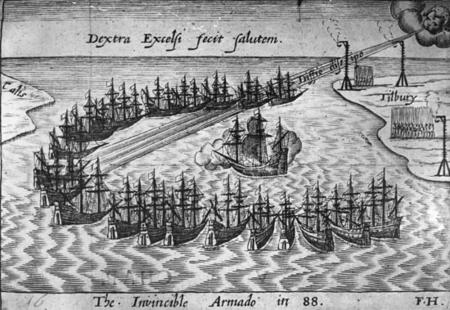
The English move had been a success and, as Alison Weir says:-
“This meant that the little English ships would now be able to fight on more equal terms. As a result of this action, morale amongst Spanish forces was fatally weakened.”1
Notes
- Elizabeth the Queen, Alison Weir, p391
Related posts:
 The Spanish Armada 4: The Battle of Gravelines
 The Spanish Armada 6 – The Spanish Fleet Homeward Bound
 The Spanish Armada 5 – The Protestant Wind
 The Spanish Armada 1: The Assembling of Troops at Tilbury Fort
 Spanish Armada 9 – God Blew and They Were Scattered
 The Spanish Armada 8 – Elizabeth’s Tilbury Speech
 The Spanish Armada 2 – Leicester Invites Elizabeth to Tilbury
 The Spanish Armada 7 – Elizabeth I Visits Tilbury
 Sir Francis Drake Sets Sails from Plymouth for Spain – 2 April 1587
Singeing the King of Spain’s Beard – April 1587
Sir Francis Drake Sets Sails from Plymouth for Spain – 2 April 1587
Singeing the King of Spain’s Beard – April 1587
 Painting the Armada Exhibition
Sir Francis Drake Sets Off on his Circumnavigation – 13 December 1577
Painting the Armada Exhibition
Sir Francis Drake Sets Off on his Circumnavigation – 13 December 1577

The English had a tremendous home field advantage. There was a special on the History Channel a few years back that discussed this in detail, I just wish I could remember the name of it!
Anyway, with the famous legend of Drake insisting on finishing his game of bowls, apparently, he had good reason to know the Spanish Armada would wait:
1. Drake knew the tides, weather, and currents – the Gulf Current, a major oceanic current, was a major factor against the big, lumbering galleons the Spanish used for warships.
2. Galleon technology was far behind that of the technology the English used for negotiating their own waters. The English ships could tack effectively and speedily against the winds, while the Spanish galleons could not.
3. The galleons were top heavy, due to the fighting platforms, meaning that they could capsize very easily. Naval technology had changed surprisingly rapidly, but the Spanish didn’t keep up as well.
4. Armaments – While it was true that the Spanish had more and larger cannons, it was faster and easier to reload the English guns, and fire the English guns, than it was the Spanish. The English sailors were also better gunners than the Spanish.
5. The number of troops on the Spanish ships was a disadvantage, too, because the ships were actually somewhat overcrowded, making it more difficult to fight ship to ship with the English – had the English used similarly sized galleons, and used the tactics the Spanish were anticipating, it might have been a much closer match. The fighting platforms that made the galleons so top heavy were actually meant to be surfaces for the troops to board another vessel, which proved impossible because of the size difference between the Spanish and English ships.
6. Drake knew Spanish tactics and fighting styles. The Spanish called him a pirate with considerable justification, because he could and would fight dirty, and I mean really dirty, the Hell Burners being proof positive of this. I don’t think the Spanish could conceive of such dirty “dishonorable” or “ungentlemanly” tactics on the part of the English, even though Drake was notorious among them.
I might be mis-remembering some of the details, so take everything I have stated here with a largish grain of salt. But Elizabeth knew EXACTLY what she was doing when she put men like Sir Francis Drake in charge.
awesome.
I think the English deserved that win, just to show that the Spaniards weren’t THAT almighty and unbeatable.
It just goes to show that England outsmarted them even though they were the weaker one. Although, you had to see that England had advantage since they were in their own waters and knew the waters, tides, and everything while to the Spaniards, this was like a us on Mars…
…Well, OK, not that far, but still. They had home field, so you had to give them that. So now you just kno what happens to guys like the King of Spain when they get too arrogant and snobby… no offense.
But also, Francis Drake did some damage to the armada and since he stole and wrecked stuff from the Spaniards a few times already, he should have kind of known which tactics the Spaniards would use, thus making the win even easier.
So yeah… HOORAY FOR QUEEN ELIZABETH I !!!
“God blew and they scattered”