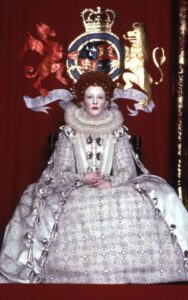
 In the final scene of Shekhar Kapur’s “Elizabeth”, starring Cate Blanchett, we see Kat Ashley cutting Elizabeth’s hair off and Elizabeth making a dramatic entrance in front of her court dressed as a bride in an elaborate white gown, pearls (which symbolise purity), a red wig, a huge ruff and a whitened face.
When Elizabeth sees her new short hair, she says to Kat, “Kat, I have become a virgin”, and when she appears at court she says to William Cecil, Lord Burghley, “Observe, Lord Burghley, I am married to England.”
It is an amazing final scene. It is incredibly dramatic and emotional and really makes you think about Elizabeth and how she changed into the iconic queen of her later portraits, the Gloriana and the Virgin Queen. In the movie, Elizabeth I is not a virgin. She has an affair with her childhood sweetheart, Robert Dudley, and so the scene at the end is about Elizabeth transforming herself by assuming this new persona and stating her commitment to England by “marrying” England. It is this new stronger Elizabeth who heralds in the country’s Golden Age. So, it is a persona rather than the real Elizabeth.
But what about the real Elizabeth? Whatever your thoughts on Elizabeth’s virgin status, it is clear that she considered herself married to her country and that she made a conscious decision not to marry – but why? Surely it was her responsibility to carry on the Tudor line, to secure the succession and to provide England with an heir, so why would Elizabeth make such a huge decision? Here are some possible reasons but please do share your thoughts in the comments section below:-
- Psychological – It is said that after Catherine Howard’s execution the 8 year old Elizabeth told her friend Robert Dudley that she would never marry. Did she decide not to marry because of what happened to her own mother, Anne Boleyn, and her stepmother, Catherine Howard?
- Mary I’s example – Elizabeth saw the damage that Mary’s marriage to Philip II did to the country. This marriage caused unrest and rebellion and it also broke Mary’s heart.
- Control – In Tudor times, a wife was expected to submit to her husband and Elizabeth, as monarch, may not have wanted to give away any control to her husband, when it was she who was responsible for the running of the country.
- Love – Elizabeth loved Robert Dudley and it may be that she chose not to marry because she could not marry her true love.
- Diplomacy – Remaining unmarried meant that she could enter marriage negotiations and play countries off against each other.
- Fear of childbirth – Two of Elizabeth’s stepmothers, Jane Seymour and Catherine Parr, had died just a few days after childbirth so was Elizabeth frightened of having children?
- Commitment to her country – Elizabeth wanted to do the best for her country and felt married to her country.
- The perfect marriage never came along – Marriage negotiations always seemed to come to nothing because of diplomatic wranglings and problems.
- Medical reasons – In my post “Elizabeth I – A Virago, Genetically Male or Simply a Strong woman?” I looked at R. Bakan’s theory that Elizabeth had testicular feminization syndrome which meant that she looked like a female and would have had female external genitalia but that the uterus and uterine tubes would have been either rudimentary or absent, and that the vagina may also have been absent. She would also have been sterile. If Elizabeth did not have a vagina then she would not have wanted anyone to know about it. I can’t credit this theory at all!
- Elizabeth was a man – I love this theory! According to The Bisley Boy legend, the real Elizabeth died in childhood and a boy took her place. Obviously, the imposter would have been discovered if “Elizabeth” had married!
Related posts:
 Robert Dudley to Marry Mary Queen of Scots?
 Elizabeth and Leicester – Bess and Robin
 The Marriage of Robert Dudley and Amy Robsart
 Elizabeth’s Women
 Elizabeth, Seymour and Shakespeare
 The Legacy of Elizabeth I
 Did They or Didn’t They?
 Elizabeth I – Queen of PR
 Elizabeth I Facts
 Did Robert Dudley Murder Amy Robsart?
 Elizabeth I’s Suitors
 Elizabeth I
I’m on the run, so I will be as efficient as possible in my response. None of the theories about Elizabeth losing her virginity, having some “defect,” or being a boy have any merit whatsoever:
(1) Elizabeth was an extremely healthy, strong child from birth onward.
(2) Henry VIII had Elizabeth brought into court, completely naked, at the age of 2 or 3 to show foreign dignitaries that she was a beautiful, completely normal little girl (to interest them in a future marriage alliance). There is no way the presence of testicles of any size (much less the lack of female genitalia) could have been disguised.
(3) The queen’s body belonged to the Crown. In essence, it was state property. As such, all her “proper bodily functions” were documented. Historical records show that she was a normal woman with an irregular menstrual cycle. There is absolutely no way, surrounded as she was by ladies-in-waiting and serving women 24 hours a day, that a “female defect” or other issue could have been concealed. The Spanish and the Vatican, among others, would have paid dearly for such information.
(4) When Elizabeth was in her 40s, she went through a complete gynecological examination in order to prove to the French court (marriage negotiations with her then-suitor, the Duc d’Anjou, were proceeding very well) that she was still fertile. The physicians who performed the exam pronounced her completely normal, healthy and capable of still bearing a child.
(5) When Robert Dudley, the only man she ever loved enough to have been tempted to yield her virginity to, returned from a campaign in the Netherlands to find that the “marriage negotiation game” with the Duc d’Anjou had become extremely lovey-dovey, he was livid, and asked Elizabeth angrily in public, “Are you still a virgin?!” Elizabeth’s response was equally livid. Elizabeth was in her mid-40s when this angry exchange took place between them.
(6) Anne Boleyn knew that her daughter was destined to rule — which is why, when Henry offered to spare her life if she would go into permanent exile in France with Elizabeth — she refused (a little-known fact, but a fact nonetheless). All her life, Elizabeth surrounded herself with Boleyn and Howard cousins — and she surely knew what her mother sacrificed for her.
(7) Elizabeth was brilliant, disciplined (except for her famous Tudor/Boleyn temper, that is), extremely well educated, and wise. She knew she had to forgo marriage and sex in order to avoid the pitfalls that would have accompanied “yielding” in that era. She was a normal woman — but like a number of normal women who will not settle for second-best or relationships that would compromise the work they feel called to do — she knew how to sublimate her personal life to her state responsibilities. She gave her life for England.
Elizabeth, a boy? Seriously? Where on earth do people come up with these things? I do suppose it’s good to have myths so we can investigate further but…whaaa?
The eternal question–why did Elizabeth choose virginity over wedded bliss and motherhood? I think most of the reasons are well-listed by Claire–well, except for the testicles and her being a male imposter–and I think her reasons were a combination of those already mentioned. I do not doubt that she loved her Sweet Robin but I think she suffered from psychological trauma in losing her mother and cousin through marriages gone sour. She also saw Jane Seymour die after childbirth and her beloved Katherine Parr. She witnessed, first-hand, the inconstancy of men after wedding and bedding their beloved. I think she did not want to relinquish her sexual power over me, nor her political power–she was, herself, a political tool as well she knew. SHe kept France and Spain, the Austrian states, etc. all on tenderhooks, waiting to see whom she would marry. She played it like a genius, which I think she was in many ways. So, while she might have enjoyed the courtships of many men, she knew that would always be the best part of the male/female relationship. And, she was doing what she thought best for England. Plus, she wasn’t crazy about having an heir–she did not think a ruler could trust her offspring–all grasping at the crown. She is such an enigma in so many ways. As fascinating as her mother. I did not know about Henry’s offer to Anne B about France, going and taking Elizabeth. Where is this information?
Thanks, Claire–another great piece!
Points 1,2 and 3 above should be enough to sway her decision not to marry. I believe she truly did love Robert Dudley from a very young age. Later in life they were imprisoned in the Tower together and throughout his remaining life he was dedicated to her in all ways. They were as good as man and wife and this bond between them caused much jealousy throughout the court. So other then having actually having children and the infamous piece of paper that states that you are married in the eyes of God and before witnesses they were “married in their hearts” Although she toyed with others throughout her life, no one could take the place in her heart that was owned by Robert Dudley. I find it extremely romantic actually! I especially like point number 6 above by Carol. I would also like to believe that Queen Elizabeth I did in fact respect her mother and understood her, otherwise, Anne’s death would in ALL ways seem a senseless killing. She kept her mother alive with those around her, she even wore her mother’s portrait in a ring I believe. Had the so called love affair between her and the Duc d’Anjou, well lets call that a lovers quarrel. That was stemmed from pure jealousy.
After all, did not Robert himself marry flirt around court…..it was a game they played but bottom line, they loved each other. Carol’s 7th and final comment, “She gave her life to England.” Yes she did completely and that is one of the reasons she went down in world history as one of the best Monarchs to live. Might I just add, one of the most colorful and beautifully adorned.
All of them, except the last are reasons enough. Her mother died, her sister was humiliated, her last stepmother died in childbirth…it all spelled that women and men were a dangerous combination.
My understanding is that a fusion of the first five reasons given above are the true grounds for her refusal to publicly acknowledge her marriage to her lover Robert Dudley in the Tower under Mary’s imprisonment, and then subsequent concealed pregnancy to him when as Master of her Horse he had the chambers with adjoining door to hers, during his marriage to Amy Robsart. This is the key to all the difficulties surrounding their love match. He was already in an arranged loveless marriage to a passive aggressive old maid that may have suited him when an impoverished nobleman under Mary’s oppression. But now as Elizabeths favorite; the world was his oyster, the only grit was Amy.
Into this stew nefarious interests bacame involved and amidst a swirl of rumours of her arranged death by Lord Robert, she is found dead at the foot of the stairways at her family home with a broken neck.
Suspicion which never left him immediately fell upon Lord Robert, from this moment the decision was made to never marry. From then on confirmed by the disastrous reign of Mary Queen of Scots, who proceeded to make the same fatal mistakes in full public view.
Now I do not believe that Lord Robert killed or arranged for Amys death despite what Greenparson wrote that I suspect was a pseudonym for Francis Bacon, who you would think would know, being the first issue of Elizabeth and Lord Robert, and insinuated into the household of her chief lady in waiting the sister to Robert Cecil and husband to Nicholas Bacon, the Lord Keeper of her seal and known as a hidden poet and Author that paid others for their name under which to publish.
Using the Sherlock Holmes criterion to solve crime mysteries that the prime benificiary is the most likely culprit, then there is no way that killing his wife in any way helped Lord Robert then or in the future ever. It was forever a blot on his name.
To the finger points directly towards Robert Cecil, he benefitted directly by keeping Lord Robert and his issue Francis and later Lord Essex another even more complicated plot but neccessary to understand the last years of Elizabeth, on the sidelines, for all his life, and the life of his dwarfish son, who while they were alive made Francis’s life hell.
But we must be gratefull, the blocks he presented were overcome in the most sublime way as the English renaissance the Rose of England flowered into eternal beauty of the immortal works and words of Bacon the SpearShaker.
Hi Carol,
I’ll address your points in sequence:-
1) Yes, Elizabeth was a healthy child.
2) Testicular feminization syndrome – As R Bakan pointed out, sufferers of this syndrome can have completely normal looking female genitalia and also a vagina can be present so Elizabeth as a naked baby would have looked like any other normal female baby – the testes are internal and so are not visible. He also says that menstruation can occur in some cases. I don’t believe that Elizabeth had this syndrome, I’m simply playing Devil’s Advocate!
3) As I said in 2) there would be no outward signs that Elizabeth had testicular feminization syndrome. If she had a vagina then even a rudimentary internal examination would have shown her as “normal”.
4) See 3)
5) Yes, I believe that Elizabeth was a virgin.
6) Although it is clear that Anne Boleyn made plans to make sure that Elizabeth was surrounded by people who could help her in the future (see https://www.elizabethfiles.com/the-cambridge-connections/3853/), I don’t believe that she could have known that Elizabeth would one day rule over England. I also have found no evidence in the primary sources that Anne was offered exile in France. On the 16th May 1536 Archbishop Cranmer visited Anne in the Tower to get her to confess to an impediment to her marriage and to obtain her consent to dissolve the marriage and to disinherit and bastardise her daughter Elizabeth, and I think it is likely that she was offered some type of deal in exchange for this BUT this could have been a more merciful death (death by sword) or the opportunity to join a convent. Sir William Kingston reported to Cromwell “Yet this day at dinner the Queen said she would go to “anonre” [a nunnery], and is in hope of life”. LP x.890 I’m sure that if Anne had been offered exile in France with Elizabeth then she would have jumped at the chance, after all, she had spent many years in France and could have bided her time there and then supported Elizabeth in claiming the throne at a later date.
7) I completely agree with you.
By the way, the reasons I cited in my post were “possible reason”, reasons that have been cited by historians and academics, not my own opinions. If I had to choose I’d choose a combination of the first eight.
Thanks for your comment and thoughts!
Hi Kerry,
Thanks for your comment but I just can’t agree with your theories:-
1) There is no evidence to support the idea that Dudley and Elizabeth secretly married or that they had a child. Elizabeth had many enemies and there is no way that she could have kept a pregnancy and child secret. People were just waiting for Elizabeth to make a mistake so that they could dethrone her.
2) Amy Robsart was not an old maid. Both Dudley and Amy were 17 when they married in 1550 and the marriage was a love-match, or a “carnal marriage” as William Cecil described it, rather than an arranged union. The couple were sweethearts and very much in love. Obviously the marriage deteriorated as Dudley spent more and more time at court with Elizabeth but the couple were originally happy. Amy was only 28 when she died, far from an old maid, and I can’t find any evidence that she was “passive aggressive” although she was depressed in the months leading up to her death because of the fact that she was in pain and she was dying.
3) Robert Cecil was not even born on 1560 so he cannot have murdered Amy or organised her death, he was born c1563. Do you mean William Cecil? If so, Alison Weir does believe that he may have had something to do with Amy’s death, in that he wanted to frame Dudley so that Elizabeth would not marry him. I cannot agree. I don’t believe that Cecil would have chosen to implicate the Queen in such a scandal.
4) Francis Bacon was born in January 1561. This is the month when Elizabeth appointed Cecil Master of the Wards and in the winter of 1560/1561 Elizabeth was active at court and so I can’t see how she could have given birth or been pregnant without people noticing and the news getting out, afterall, this was a time when everyone was worried that she would marry Dudley.
Of course a man would explain the reign of a strong woman, the strongest ruler EVER, by stating she was really a man. Too hard to accept that Elizabeth was just that smart and successful.
I was too caught up with the boy comment to properly state my feelings, so forgive me for a second post. If Anne Boleyn’s treatment during marriage didn’t sway her, Kathryn Howard’s probably did. Maybe Anna of Cleves’s harsh rejection also stung, considering how fond of her Elizabeth was. Jane Seymour and Katharine Parr both died suffering deaths due to childbearing, and Queen Mary I agonized over trying to make her husband love her. With such an extensive and well-known family history, I can’t blame her for not marrying.