Following on from last week’s article “Elizabeth I – Queen of PR”, I thought it would be good to start our examination of Elizabeth I portraits with the famous Armada portrait. This portrait is by an unknown artist (possibly George Gower) and was painted circa 1588, the same year as Elizabeth I’s defeat of the Spanish Armada.
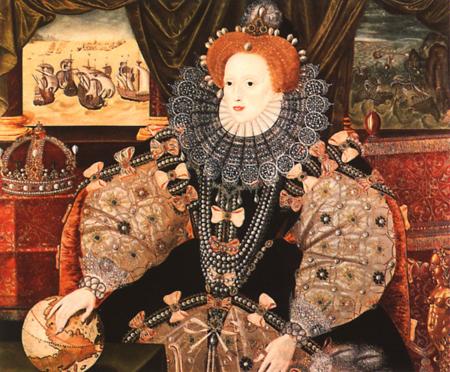
The Armada Portrait is rich in symbolism, as are many of Elizabeth’s portraits, so I’ll start the ball rolling with symbols I can see and have found during my research, but please do add your own thoughts in the comments section below.
Symbolism in the Armada Portrait
- Pearls – Like her mother before her, Elizabeth loved pearls and in her portraits pearls symbolise purity and virginity. Pearls symbolised purity. Marilee Cody, on her excellent site on Tudor portraits – http://www.marileecody.com/eliz1-images.html – suggests that the pearls were Dudley’s last gift to Elizabeth and so had special meaning to Elizabeth.
- Elizabeth – Although Elizabeth was around 55 when this portrait was painted, she is presented as youthful and vibrant with her made-up face, bright red hair and unblemished complexion. She is also dressed in all her finery and rich jewels, and really is the iconic, ever-youthful Virgin Queen.
- Elizabeth’s gaze – C J Cairns writes of how the way that she is gazing into the distance could symbolise her looking to the future of her realm.
- Posture – Just as her father liked his posture to speak of his power and magnificence, Elizabeth too has adopted a posture of power.
- Ruff – C J Cairns writes of how her ruff frames her face like rays of the sun.
- Window scenes – I think it was David Dimbleby in his series “The Seven Ages of Britain” who noted that in the window on the left hand side of the painting there is the arrival of the Armada and then on the right there is the defeat of the Armada. This portrait could be seen as a tribute to Elizabeth’s success at protecting the nation from Spanish invasion or you could see a religious meaning: perhaps the ships are being forced onto the rocks by the “Protestant wind”. C J Cairns comments that Elizabeth has “called upon the elements to dispel the Spanish Catholic threat”.
- Globe – If you look at the placement of Elizabeth’s hand on the globe, you can see that her hand is over the Americas which England was busy colonising. As Marilee Cody points out, this painting was painted one year after the birth of the first English child in the colonist’s settlement of Virginia. Her fingers are extending to other parts of the globe and this symbolises that Elizabeth’s power is fa reaching and that the whole world is at her disposal.
- Pillars – An article on wikipedia says that “The Queen is flanked by two columns behind, probably a reference to the famous impresa of the Holy Roman Emperor, Charles V, Philip II of Spain’s father, which represented the pillars of Hercules, gateway to the Atlantic Ocean and the New World.”
- The egg shaped object – Of you look at the right hand side of the painting, you can see that there is an egg shaped object above Elizabeth’s shoulder and in front of the window. It appears to be a pomegranate which symbolised fertility, abundance, generosity, union, prosperity, rebirth, resurrection and eternal life.
- The Crown – Confirmation of Elizabeth’s powerful position as monarchy and her royalty and majesty. If it is indeed an imperial crown, as some have suggested, it speaks again of Elizabeth’s far reach and Elizabeth as Empress.
- Carving – The arm of the chair has a carving of a mermaid which, according to C J Cairns was “a symbol of the potential destructive nature of females” and that Elizabeth’s position with her back to the image could signify her rejection of its meaning. I wonder if it actually speaks of Elizabeth’s power over the seas.
- Bow – One article on this portrait has suggested that the placement of the large bow is a “blatant display of Elizabeth’s virginity” just as Henry VIII’s large codpiece spoke of his sexuality and prowess.
Notes and Sources
- Elizabeth I: The Armada Portrait by C J Cairns
- Portraits of Queen ELizabeth I, by Marilee Cody
- Portraiture of Elizabeth I of England
Related posts:
 Elizabeth I Phoenix Portrait
 The Elizabeth I Pelican Portrait
 Is Anne Boleyn’s Famous Portrait Actually Elizabeth I?
 Secret Snake in Elizabeth I Portrait
 The Spanish Armada 5 – The Protestant Wind
 Elizabeth I’s Image
 Elizabeth I – Queen of PR
 The Spanish Armada 8 – Elizabeth’s Tilbury Speech
 John Donne Portrait Needs Help
 Painting the Armada Exhibition
 Sir Francis Drake Sets Sails from Plymouth for Spain – 2 April 1587
Singeing the King of Spain’s Beard – April 1587 – The Spanish Armada
Sir Francis Drake Sets Sails from Plymouth for Spain – 2 April 1587
Singeing the King of Spain’s Beard – April 1587 – The Spanish Armada
Sharon, I’m not sure about the pendant she’s holding out to the viewer to emphasize. It’s tilted, but resembles the one from this portrait (The Clopton Portrait)
http://www.historicalportraits.com/InternalMain.asp?ItemID=451
which calls it “The Mirror of France” and said it had belonged to Henry VIII. It pops up again in the Sieve Portraits, one of which can be seen on this page:
http://www.luminarium.org/renlit/elizaredsieve.jpg
There are three pages of portraits starting at the link below and each can be clicked on to enlarge. The Sieve portraits are on page 2, the Armada portraits, page 3.
http://www.luminarium.org/renlit/elizface.htm
There are similar jewels in other portraits. The one in the 3rd Armada portrait looks smaller, but I wonder if it’s a distorted perspective because the Armada gown is huge compared to some others.
Thanks for the referrals, Impish. I noticed there were other jewels in later paintings that she is also pointing out.
Impish, Thanks for all the links. I didn’t realize there were so many images of her. My favorite picture of her is still the one where she is wearing a white dress and seems to have angel wings behind her – the one that was used for the magazine cover that Claire’s husband made.
“My favorite picture of her is still the one where she is wearing a white dress and seems to have angel wings behind her”
I see what you mean – the sleeves fall all the way down behind her like the medieval depictions of full-length feathered wings on angels.
I think my favorite is either the portrait of her at 13 in the red dress, or the Ermine Portrait. I like the large transparent veils of later in the reign like the one in the Rainbow Portrait:
http://englishhistory.net/tudor/monarchs/eliz1-rainbow.jpg
I found it hard to visualize in 3-D until the Cate Blanchett movie about Elizabeth: The Golden Age illustrated it so beautifully:
http://g1.globo.com/Noticias/Cinema/foto/0,,11734102-EX,00.jpg
http://www.fanpop.com/spots/cate-blanchett/images/13640983/title/elizabeth-golden-age
Impish, I also really like the Rainbow Portrait. I think Cate Blanchett looked beautiful in the white dress – thanks for the links.
Personally, I think the egg-shaped object is a pomegranite. Elizabeth I wouldn’t have just randomly stuck a knob on her portrait. It had to symbolise something, so it could bea pomegranite as others have said.
Also thanks for all the information. It was really helpful when I needed to anylize the portrait.
🙂
Hi Hat,
I agree, I think it’s a pomegranate too. I’m glad you found the article useful.
Have only skimmed over the information you have provided but was wondering if it came to your attention in the bottom right corner, the statue. It is possible that this statue is Spanish by its detailing. Perhaps it was stolen from one of this ships, as it is hard to believe that it would be a gift.
Thanks for the rest of the info though 🙂
Hi Hayley,
Do you mean the mermaid? I can’t figure out whether it’s a carving or statue. According to C J Cairns was “a symbol of the potential destructive nature of females” and that Elizabeth’s position with her back to the image could signify her rejection of its meaning. I wonder if it actually speaks of Elizabeth’s power over the seas. However, you’re right on that it could be Spanish and could be a trophy from piracy or something and could be Elizabeth’s way of showing her triumph over the Spaniards. I’m not sure!
The problem with many portraits of this age is that we no longer see them as intended. The most obvious one is colour. And this picture suffers from it badly. When we print things today you will sometimes see a colour chart to tell the printer when the different colour inks are running out. Well we can do that with this picture so if we use some common sense instead we see that the ships are sailing on sand! So that was clearly blue. Most of the rest of the picture has changed to, but I have worked out the bows were scarlet and blue. The table cloth bright green, the globe highly coloured with blue of course for the water. There is also an absence of yellow in the picture and I think the underside of the cape she wears was that colour. The curtains were also bright green.
But more than one artist has worked on this picture. The two hands are very different. The one on the globe being painted after the other hand by an artist not as good as the first. The cruder artist left the good hand untouched, but painted a new head and ruff on top of the dress. The evidence for this is that the string of pearls are cut off and should be slightly visabile under the ruff. Even on the crude head the colour has gone leaving a white finish to a once pinky flesh look of the face, plus yellow hair! Yes Elizabeth was a blond!