Following on from last week’s article “Elizabeth I – Queen of PR”, I thought it would be good to start our examination of Elizabeth I portraits with the famous Armada portrait. This portrait is by an unknown artist (possibly George Gower) and was painted circa 1588, the same year as Elizabeth I’s defeat of the Spanish Armada.
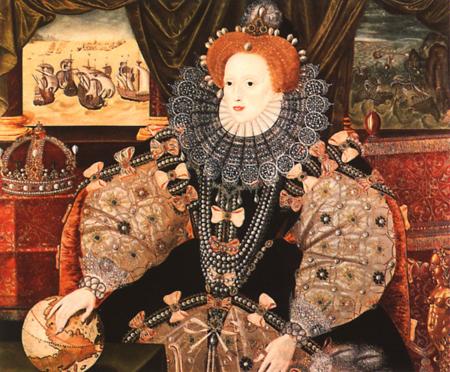
The Armada Portrait is rich in symbolism, as are many of Elizabeth’s portraits, so I’ll start the ball rolling with symbols I can see and have found during my research, but please do add your own thoughts in the comments section below.
Symbolism in the Armada Portrait
- Pearls – Like her mother before her, Elizabeth loved pearls and in her portraits pearls symbolise purity and virginity. Pearls symbolised purity. Marilee Cody, on her excellent site on Tudor portraits – http://www.marileecody.com/eliz1-images.html – suggests that the pearls were Dudley’s last gift to Elizabeth and so had special meaning to Elizabeth.
- Elizabeth – Although Elizabeth was around 55 when this portrait was painted, she is presented as youthful and vibrant with her made-up face, bright red hair and unblemished complexion. She is also dressed in all her finery and rich jewels, and really is the iconic, ever-youthful Virgin Queen.
- Elizabeth’s gaze – C J Cairns writes of how the way that she is gazing into the distance could symbolise her looking to the future of her realm.
- Posture – Just as her father liked his posture to speak of his power and magnificence, Elizabeth too has adopted a posture of power.
- Ruff – C J Cairns writes of how her ruff frames her face like rays of the sun.
- Window scenes – I think it was David Dimbleby in his series “The Seven Ages of Britain” who noted that in the window on the left hand side of the painting there is the arrival of the Armada and then on the right there is the defeat of the Armada. This portrait could be seen as a tribute to Elizabeth’s success at protecting the nation from Spanish invasion or you could see a religious meaning: perhaps the ships are being forced onto the rocks by the “Protestant wind”. C J Cairns comments that Elizabeth has “called upon the elements to dispel the Spanish Catholic threat”.
- Globe – If you look at the placement of Elizabeth’s hand on the globe, you can see that her hand is over the Americas which England was busy colonising. As Marilee Cody points out, this painting was painted one year after the birth of the first English child in the colonist’s settlement of Virginia. Her fingers are extending to other parts of the globe and this symbolises that Elizabeth’s power is fa reaching and that the whole world is at her disposal.
- Pillars – An article on wikipedia says that “The Queen is flanked by two columns behind, probably a reference to the famous impresa of the Holy Roman Emperor, Charles V, Philip II of Spain’s father, which represented the pillars of Hercules, gateway to the Atlantic Ocean and the New World.”
- The egg shaped object – Of you look at the right hand side of the painting, you can see that there is an egg shaped object above Elizabeth’s shoulder and in front of the window. It appears to be a pomegranate which symbolised fertility, abundance, generosity, union, prosperity, rebirth, resurrection and eternal life.
- The Crown – Confirmation of Elizabeth’s powerful position as monarchy and her royalty and majesty. If it is indeed an imperial crown, as some have suggested, it speaks again of Elizabeth’s far reach and Elizabeth as Empress.
- Carving – The arm of the chair has a carving of a mermaid which, according to C J Cairns was “a symbol of the potential destructive nature of females” and that Elizabeth’s position with her back to the image could signify her rejection of its meaning. I wonder if it actually speaks of Elizabeth’s power over the seas.
- Bow – One article on this portrait has suggested that the placement of the large bow is a “blatant display of Elizabeth’s virginity” just as Henry VIII’s large codpiece spoke of his sexuality and prowess.
Notes and Sources
- Elizabeth I: The Armada Portrait by C J Cairns
- Portraits of Queen ELizabeth I, by Marilee Cody
- Portraiture of Elizabeth I of England
Related posts:
 Elizabeth I Phoenix Portrait
 The Elizabeth I Pelican Portrait
 Is Anne Boleyn’s Famous Portrait Actually Elizabeth I?
 Secret Snake in Elizabeth I Portrait
 The Spanish Armada 5 – The Protestant Wind
 Elizabeth I’s Image
 Elizabeth I – Queen of PR
 The Spanish Armada 8 – Elizabeth’s Tilbury Speech
 John Donne Portrait Needs Help
 Painting the Armada Exhibition
 Sir Francis Drake Sets Sails from Plymouth for Spain – 2 April 1587
Singeing the King of Spain’s Beard – April 1587 – The Spanish Armada
Sir Francis Drake Sets Sails from Plymouth for Spain – 2 April 1587
Singeing the King of Spain’s Beard – April 1587 – The Spanish Armada
Regarding those pillars… On the left hand picture, depicting the Armada arriving to attack England, they’re very visible. On the right hand picture, depicting the defeated Armada, they’re very dark and almost completely obscured by the drapery. If the pillars represent the power of Philip’s family, the Hapsburgs, and the HRE, does their representation on the right hand picture symbolize Elizabeth dealing a mighty blow to that power and not just Philip? After all, Spain and the HRE were arguably the most powerful coalition in the world, and Philip threw everything he had at her and she repulsed that attack. So is she, in effect, declaring herself to be the most powerful person in the world now with her victory? How galling that must have been for Philip. LOL.
I believe there are two or three versions of this portrait that exist, so they must have been copied for distribution. After all, what good is propaganda if no one sees it? I think it would have been hilarious if Elizabeth had sent a copy directly to Philip – he would have had an aneurysm!
The mermaid was a traditional symbol of female licentiousness and destructiveness and Mary Queen of Scots was associated with this symbol in much of the literature of this time. I think Spenser’s The Faerie Queen used this guise to allude to Mary Stuart…I think there may be a reference somewhere in Shakespeare as well but I can’t quite remember where.
It was Mary’s execution that was one of the triggers to the launching of the Armada, so it would be appropriate to include the mermaid as part of Elizabeth’s chair to show her Protestant victory over Mary – another Catholic power in her world.
The pomegranate is also a symbol associated with Spain. Principally, it was (and still is) the symbol of Granada, which Philip’s grandparents had reconquered from the Moors. Catherine of Aragon had taken it as her personal badge when she came to England, ironically in view of her sad gynaecological history.
Its position in the window in front of the scattering of the Spanish fleet could therefore be taken as some sort of savage joke – the alleged flourishing Spanish empire floundering against Elizabeth’s (or God’s) might. Again ironic in view of her childless state.
It was said that the storm that blew at the time of the Armada was whipped up by the magician and alchemist John Dee. The fact that he was several hundred miles away in Prague at the time is not considered to have been an obstacle to this enterprise.
This piece of handy-work, however, was reflected in one or two motto’s of the time such as “He blew and they were scattered” and in the legend struck on the Queen’s Armada medallion something like: “God breathed and they were scattered.” It was seen at the time as a kind of divine intervention. So Dee would probably not have wanted to claim all the credit for himself.
Maybe it is just me, but dosen’t the ‘pomegranate’ look more like the sort of knob you may find on the top corners’ of the backs’ of chairs’? I haven’t had a propper look at it, though, so correct me if I’m wrong.
Rose, I’m not entirely convinced, myself, about the ‘pomegranate’. Here’s a slightly bigger version of the above version:
http://www.tudorplace.com.ar/images/Eliza10Armada.jpg
There’s a streak on it that resembles the KOA badge pomegranate that is split open to expose the seeds, but I don’t see any seeds here. It might just be the light reflecting off the egg or knob or finial or whatever it is. There’s another version of the portrait here (warning, it’s a biggie):
http://upload.wikimedia.org/wikipedia/commons/f/fe/Elizabeth_I_Armada_Portrait_British_School.jpg
It doesn’t have that streak on it, and is the exact same color of the throne, making it look like a finial or some other decorative element. And just for fun, here’s a third version that doesn’t show anything but Elizabeth in front of an ordinary window: no Armada pictures, no crown, throne, etc.
http://www.luminarium.org/renlit/elizagower.jpg
Irish_Impulse- thanks for the links to the other paintings. The paintings appear to be copies/ reproductions by different artists, so there is no telling if it is supposed to be a pomegranate or not.
One of the things that I did notice was the roses on Elizabeth’s dress. In some of the paintings, they appear to be black and red. In others, they are black and white, and the one at this address (http://www.luminarium.org/renlit/elizagower.jpg) has the roses in red and white- showing that she is a Tudor- from the York and Lancaster bloodlines.
So pleased you are looking at all the rich symbolism attached to E. This is a wonderful painting. Such power and self-confidence. That is what Elizabeth is all about. What a gal!
Impish, in the third picture you posted, Elizabeth is holding a piece of jewelry that she is wearing in her right hand. Since everything has meaning in her paintings, I wonder what that piece stands for? It’s hard to even make out what it is. When I zoom in, it’s kind of blurry and can’t really make it out.
I’m not so sure that is a pomegranite. Looks like a finial to me. Why would there be an empty chair behind her in the portrait? Could it symbolize Elizabeth as the one and only ruler of England?
The idea that the pearls might have been a gift by the Earl of Leicester comes from his will, in which he left Elizabeth a “jewel with three great emeralds with a fair table diamond in the middest … and a roap of fair white pearl, to the number of six hundred, to hang the said jewel at.” He had intended this as a gift when she last visited Wanstead (his Essex house), but since he was practically broke, it had to serve as his bequest to “Her Majesty”.
He especially begged his “dear wife, see it performed”. So we can be sure, poor Countess Lettice (Elizabeth’s she-wolf) had delivered it to the Queen pretty soon after Leicester’s death. He died shortly after the Armada, so several authors have entertained this nice idea that she wore Sweet Robin’s pearls.