My inspiration from this article comes from the comments left on my “Bisley Boy” post, particularly the one left by historian and author Leanda de Lisle who said:
“I’m afraid this kind of sexist myth about Elizabeth is not that uncommon. In the sixteenth century it was believed that women who exercised power over men lost their femininity and were rendered barren. It was an idea drawn from the Greek myth of the masculine women called the Virago, And these beliefs are surprisingly persistent, In 1985 a doctor Bakan went so far as to suggest that Elizabeth’s mental toughness suggested she suffered from testicular feminization and was genetically male. I discuss these theories briefly in my book on the Grey sisters (Jane, Katherine and Mary).”
I just had to research this further and look into the work of Dr Bakan!
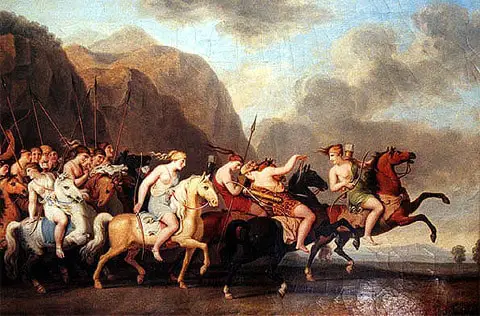
A Virago
I must admit to knowing the word “virago” but not really knowing what it meant or the story behind it. Here are some dictionary definitions I found:-
virago
Etymology: Middle English from Latin viragin-, virago, from vir man
- A loud overbearing woman
- A woman of great stature, strength and courage
- A noisy or scolding or domineering woman
- Amazon – a large strong and aggressive woman
- A strong, brave or warlike woman
- A strong, large, man-line woman; an amazon
The term “virago” seems to be interchangeable with “amazon” which refers to the Amazons, a race of women warriors in Greek mythology who inhabited Scythia, near the Black Sea. Their society was matriarchal and one myth states that no man was allowed to live in their lands but that they visited a neighbouring tribe once a year to have sexual relations in order to prevent their race from dying out. If male babies resulted from these encounters, they would be killed, left in the wilderness or sent back to their fathers. It is said that they cut off or burned off one breast so that it was easier for them to throw spears.
It is easy to see why Elizabeth may be called a “virago” or “Amazon”, after all, she was tall, aggressive, brave, domineering and scolding, but these terms are not always complimentary terms in that the Amazons were seen as man-haters. Far from being a man-hater, Elizabeth seemed to come alive in the presence of men and enjoyed flirting with them and sharing her wit and intelligence.
Genetically Male
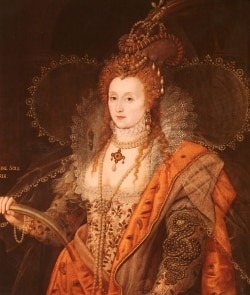
I looked up the work of R. Bakan, from the Faculty of Education, Simon Fraser University, Burnaby, B.C., Canada. Bakan wrote an article, or medical hypothesis, entitled “Queen Elizabeth I: A Case of Testicular Feminization” in 1985. In this article, Bakan puts forward the idea that Elizabeth I was a case of testicular feminization and that this diagnosis explains why she never married, why it was believed that she had some kind of congenital defect or was barren, and that is also explains her physical appearance, behaviour and character. Bakan says that although many modern historians believe that Elizabeth’s refusal to marry has a psychological explanation, s/he believes that:
“recent advances in our understanding of the process of sexual differentiation, particularly, the description of the testicular feminization syndrome, justify a re-evaluation of the “physical defect evidence” of Elizabeth’s contemporaries.”
Before we go into Bakan’s reasoning as to why s/he believes Elizabeth may have suffered from this syndrome, let’s find out a bit more about it.
What is Testicular Feminization Syndrome?
Bakan explains that the term was first used in 1953 and that it describes an hereditary disorder of sexual differentiation which is probably transmitted by the mother. Bakan goes on to explain that sufferers are phenotypic females, although they have internal testes and X and Y chromosomes, and that the syndrome is rarely accompanied by any other abnormalities. The sufferer’s external genitalia are female, but the uterus and uterine tubes are either rudimentary or absent, and the vagina “ends blindly in a pouch or is absent”. The sufferer is always sterile, although menstruation can occur in a few cases.
When the sufferer hits puberty, breast develop normally and she appears female. Characteristics include slim hips, large hands and feet, thin and elongated hands and fingers, and sufferers tend to be tall and attractive. Their sexual orientation is always female and they enjoy the company of buys, sport and “rough” games in childhood. They also tend to be of above average intelligence and very practical.
Bakan sums up the characteristics of someone with testicular feminization by saying that:
“testicular feminization individuals typically present attractive, intelligent, practical females, above average in height, slim, active, athletic with notably long and beautiful hands. They have a normal life span and are free of related
illnesses and obvious malformations. The only signs of abnormality are the lack of menstruation and the absence or
foreshortening of the vagina.”
Sound familiar?
Testicular Feminization and Elizabeth I
Bakan says that “the characteristics of persons with this syndrome are strikingly similar to descriptions, by her
contemporaries, and by historians, of Elizabeth’s appearance, personality, and behaviour, as well as of the specific physical defects which they believed made her sterile and unwilling to marry.”
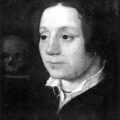
We know from the portrait of the young Elizabeth, which accompanies this post, that Elizabeth had lovely long slender hands with long and elegant fingers, but Bakan also uses the words of P Johnson, who studied portraits of the Queen along with contemporary descriptions and concluded:
“she was a little above average height for her time and class; that she was slim and extremely active;… On one point all authorities written and visual are agreed: she had beautiful hands, with long fine fingers, to which
she loved to draw attention by repeatedly drawing off, and putting on, her gloves. There can be little doubt that, in her day, she was an attractive woman”
A M. de Maisse is also quoted as saying:
“…she drew off her glove and showed me her hand, which is more than mine by more than three broad fingers. It was formerly very beautiful, but it is now very thin, although the skin is still most fair.”
after visiting the Queen in 1597.
Bakan also points out that her gloves, which are now in the Ashmolean Museum, are evidence of her abnormally long fingers and the fact that her fourth fingers were longer than her index fingers, a common male trait.
As far as her personality is concerned, Bakan talks of how the Queen showed many “male” characteristics in that she was physically aggressive and swore a lot. He quotes her tutor, Roger Ascham, as saying that she was “intellectually masculine” and William Cecil as saying “that if today she was more than a man, tomorrow she would be less than woman”. Bakan also points out her attitude towards marriage. There are many examples of Elizabeth speaking out against marriage and insisting that she would remain a virgin and never marry, and Ascham likened her to Hippolyta, Queen of the Amazons, “for by nature, and not by the counsels of others, she is thus adverse and abstinent from marriage.”
But is there any evidence of Elizabeth I having any reproductive abnormalities to back up Bakan’s claims?
Bakan thinks so. Bakan cites historians J Morris and Alison Plowden as saying that she had either amenorrhea (the absence of menstruation) or irregular periods. Ben Jonson is also quoted as saying:-
“she had a membrane upon her, which made her incapable of any man, though for her delight she tried many. At the coming over of the Duke of Alencon there was a French surgeon who took it in hand to cut it, yet fear stayed her and his death”
and French writer, Brantome, as saying of a woman, thought to be Elizabeth:-
“she was unfit to be a wife having only the smaller opening through which she passed water.”
Mary Stuart (Mary Queen of Scots) also remarked in a letter that she had heard from Lady Shrewsbury that Elizabeth was foolish for desiring a marriage with the Duke of Alencon when such a union could not be consummated, and it seems that Quadra and de Feria, the Spanish ambassadors believed that Elizabeth could not bear children.
According to Bakan, the historians Pollard and Mumby concluded that, on the basis of evidence from her contemporaries, that Elizabeth had some kind of physical defect that made childbearing impossible and Pollard points out that Elizabeth, as monarch, would never have willingly refused the chance of producing an heir to carry on the Tudor line and to secure the throne, so she must have had no choice in the matter.
The Psychological versus the Physical Explanation
Many of today’s historians argue that Elizabeth’s refusal to marry and her desire to remain a virgin are to do with psychological reasons, rather than physical ones. Psychological reasons could include:-
- Elizabeth linking sex with death – Alison Weir writes of how Elizabeth could have linked the two because of her mother and stepmother both being executed for adultery, Catherine Parr dying in childbirth and her Thomas Seymour, the man she first had any type of sexual experience with, being executed also.
- A fear of childbirth – Her stepmothers, Catherine Parr and Jane Seymour, had both died after childbirth, as had her grandmother, Elizabeth of York.
Bakan discounts these reasons, arguing that we cannot use today’s psychoanalysis and views on marriage to explain the behaviour of a 16th century queen, and that Elizabeth’s characteristics along with her instructions in her will, that her body should not be examined or embalmed, point to her having a physical defect which she believed made her barren and that is why she refused to marry.
My Thoughts
Bakan’s theory is an interesting one but it seems to be flawed in that, according to his/her own words, testicular feminization is hereditary. Anne Boleyn had a few pregnancies and obviously gave birth to Elizabeth, so she must have had a normal, functioning womb, and Elizabeth Howard, Anne’s mother, was said to have given her husband, Thomas Boleyn, a baby every year although only 3 survived childhood. Bakan also talks of how Anne Boleyn had six fingers and that this type of abnormality can be related to developmental disorders. But, I don’t believe that Anne had six fingers anyway. I can’t see Henry VIII moving heaven and earth to marry a six fingered woman who could pass on such a defect to the heir to the throne, can you?
Why, oh why, do we have to think that there was something wrong with Elizabeth for her to choose celibacy? OK, it was seen to be her duty to provide and heir but she was monarch and she was in charge, if she refused to marry and have children then what could anyone really do about it? Why do people need to explain her choice by making out that she was psychologically damaged or had some kind of defect or abnormality?
Also, I find it annoying that Elizabeth is seen to be masculine just because she was strong and courageous. I know that there were very strong views about women and how a woman should behave in the 16th century, but haven’t we moved on from that. Can’t a woman govern a country successfully without being likened to a man? I’m no feminist but I think we are taking so much away from Elizabeth and her incredible achievements if we say that she had male characteristics.
My own opinion is that Elizabeth was a strong woman who was well ahead of her time and her world, and even ours today, could not cope with that.
Well, I’ve rambled on for far too long, what do you think? Please share your opinions below.
Sources
- “Queen Elizabeth I: A Case of Testicular Feminization” by R. Bakan – This can be purchased from http://www.sciencedirect.com/ for $31.50, just search for the title or author.
- “Elizabeth the Queen” by Alison Weir
- “The Sisters Who Would be Queen” by Leanda de Lisle
Related posts:
 Why Didn’t Elizabeth I Marry?
 The Old Myths Regurgitated – The Bisley Boy and More
 Elizabeth’s Women
 Was Elizabeth a Jealous Old Hag?
 Elizabeth I – Her Father’s Daughter and the Lion’s Cub
 Elizabeth, Seymour and Shakespeare
 Did They or Didn’t They?
 Tudor Contraception
 Elizabeth I – Queen of PR
 Elizabeth I
 Elizabeth I’s Nativity Chart
 Elizabeth and the Two Katherines
I’m with you, Claire and clearly many women buy into the idea that women in charge have to be in some way masculine. When women began to enter the workforce in the U.S. in larger numbers and in higher, authority-carrying jobs, I saw too many wearing pin-stripped suits in order to fit in. Why was that? Perhaps because only males or male-substitutes had the authority in this culture to be decision makers.
A strong woman must have been equally inexplicable in the Sixteenth Century. We see it from the beginning of her reign when the Spanish ambassador Count de Feria remarked: “She gives orders and has her way like her father before her.”
The idea of Amazons, viragos goes back beyond written history. It seems that the single and most enduring of explanations for a strong, commanding woman has to be that she is in some hidden way more like a man.
It’s the only explanation that makes sense to too many writers of history. In that way, how far have we advanced from Elizabethan times?
Jeane Westin, The Virgin’s Daughters: In the court of Elizabeth I
P.S. Claire, why aren’t you writing books?
Gosh! I’ve heard of some pretty weird explanations for somebody not wanting to marry, but this takes the biscuit. Geneticist must dream one day of finding a genetic explanation for everything, every decision taken in life. Elizabeth didn’t marry for many reasons. She saw what it did to others, especially her mother and later Mary Queen of Scots. To be a woman and Sovereign, and head of the Church was a unique position, and called for unique solutions. The one that fitted the bill on all counts was to remain single. She was just too smart – which is another reason why she didn’t saddle herself with a waste of space sitting at her right hand.
Funny, no one ever questions why Mistress Blanche, Elizabeth’s life-long confidante, never married and why she too died a maid. It was probably just not that unusual to take that choice.
Maybe it was a little like the expectations, pre-reformation, that a priest would not marry. It gave them an air of mystery and exclusivity – as if they had other things to think about than sex. Perhaps Elizabeth used this in her own way, to earn the respect of her people. Wedded to the realm, as she stated to Parliament. I wonder what she would have made of Mr Bakan and his ideas? Probably would have eaten him for breakfast.
Hi Jeane,
I really agree with you and I also think that women in positions of power who are ruthless are seen as b****es, yet men who act in a similar manner are just seen as doing their job properly. We haven’t come on at all, have we?
By the way, I wrote my first book “The Secret Island” at aged 11, my second book at 13 “Death on the Slopes” and many unfinished manuscripts since. They’ve never seeen the light of days and are probably in a box somewhere in my house. I’d love to write a book but just wouldn’t know where to start now!
Hi Rochie,
I think she would have boxed Mr Bakan’s ears, while swearing and spitting at him!
Very interesting article Claire. I never heard of this condition and it does not make much sense. Sounds like more insecure males who can’t cope with strong independent women.
I don’t buy this either. Men don’t like strong women, and since Elizabeth was so strong, that they have to “medicalize” her to try and belittle her. I don’t think Elizabeth would have made a good friend to women, but heck was she a damned good monarch!
Actress Jamie Leigh Curtis has been rumoured for years to be what’s known as an XY Female, essentially what Bakan is claiming about Elizabeth. There are apparently different degrees of the condition, ranging from being female but having a Y chromosome to full hermaphroditism. But I agree with Claire-just because someone is strong, doesn’t make her less feminine!
The idea of a vestigal penis was thought of while Elizabeth reigned. One of the ambassadors wrote to his kind that it was said she had one and was therefore not capable of bearing children. Again, so obvious now that it was unacceptable to be a strong woman without such an explanation.
I’m sure she swore and hit out at people because she could and there was no one to check her. And it was accepted that underlings, servants could be physically punished at that time. Everyone was subordinate to the queen.
Rochie, you’re right about Blanche. When she didn’t marry it was thought to be loyalty to the queen, but Elizabeth could have been just as loyal to her people.
And Claire, you start a book at the beginning.
Jeane Westin, The Virgin’s Daughters: In the court of Elizabeth I
I totally agree with you. In all almost all times, women who did so called “men’s job” and did it well were seen as losing feminity, in apparence, in attitude and even in their very body. Since this type of successful women is often associated whith female homosexuality ( another chauvinist prejudice), i’m surprised that nobody created the theory that lizabeth was in fa
You really see how ‘good’ women are supposed be submissive and ‘bad’ ones are powerful in the way that the character of Frances Brandon (the mother of the Grey sisters) was re-invented from pious mother to a female Henry VIII .Even her supposed (invented) characteristics are those more normally associated with men – lustful, cruel, and ambitious (bad bad. although in men not so bad as they translate also as virile, ruthless and er ambitious.) Historians even use a picture of Lady Dacre and son, claiming it is Frances and a toy boy husband. The woman is heavy and narrow eyed and we are told – ah – look at this – Frances looked like Henry (her uncle) By contrast Jane (good) is the poor, blindfold child on the scaffold I think Elizabeth had very good political reasons not to marry at different periods in her life , Leanda
The physical attributes that they talk about could be attributed to many women, including Mary Queen of Scots (a paternal relation). Not only was she tall for her time, but her height continues to be above average today (she was 6 foot tall). She too was attractive, and had long slender fingers. They were both intelligent, and both queens. The only thing that differed between Mary Queen of Scotts and Elizabeth, was how they thought. Mary ruled with her heart (and married Lord Darnley against Elizabeth’s wishes), while Elizabeth ruled with her head.
Mary Boleyn, like her mother Elizabeth Howard, had no problem producing children, so to say that this a defect is something that comes from the maternal bloodline appears to be be a non-issue in this case.
In regards to not having a medical exam/ embalming of her body post mortem, I feel that might have something to do that she didn’t like the idea of anyone slicing up her body (the body of a royal). There are plenty of people today who select not to have autopsy done after death, and no one accuses them of having a genetic defect.
So, I would have to agree with Claire. The idea of Elizabeth having testicular feminization is “poppycock.” I think that then, as in today- people just have a hard time seeing a woman in position of power not being ruled by their emotion. Amazing how sometimes little changes in 500 years.