My inspiration from this article comes from the comments left on my “Bisley Boy” post, particularly the one left by historian and author Leanda de Lisle who said:
“I’m afraid this kind of sexist myth about Elizabeth is not that uncommon. In the sixteenth century it was believed that women who exercised power over men lost their femininity and were rendered barren. It was an idea drawn from the Greek myth of the masculine women called the Virago, And these beliefs are surprisingly persistent, In 1985 a doctor Bakan went so far as to suggest that Elizabeth’s mental toughness suggested she suffered from testicular feminization and was genetically male. I discuss these theories briefly in my book on the Grey sisters (Jane, Katherine and Mary).”
I just had to research this further and look into the work of Dr Bakan!
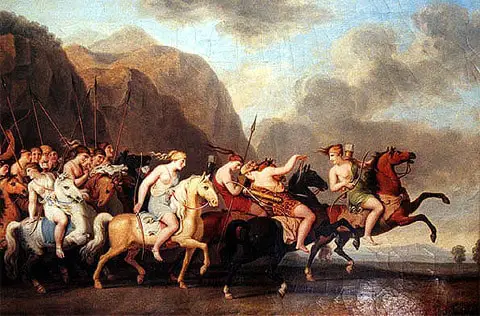
A Virago
I must admit to knowing the word “virago” but not really knowing what it meant or the story behind it. Here are some dictionary definitions I found:-
virago
Etymology: Middle English from Latin viragin-, virago, from vir man
- A loud overbearing woman
- A woman of great stature, strength and courage
- A noisy or scolding or domineering woman
- Amazon – a large strong and aggressive woman
- A strong, brave or warlike woman
- A strong, large, man-line woman; an amazon
The term “virago” seems to be interchangeable with “amazon” which refers to the Amazons, a race of women warriors in Greek mythology who inhabited Scythia, near the Black Sea. Their society was matriarchal and one myth states that no man was allowed to live in their lands but that they visited a neighbouring tribe once a year to have sexual relations in order to prevent their race from dying out. If male babies resulted from these encounters, they would be killed, left in the wilderness or sent back to their fathers. It is said that they cut off or burned off one breast so that it was easier for them to throw spears.
It is easy to see why Elizabeth may be called a “virago” or “Amazon”, after all, she was tall, aggressive, brave, domineering and scolding, but these terms are not always complimentary terms in that the Amazons were seen as man-haters. Far from being a man-hater, Elizabeth seemed to come alive in the presence of men and enjoyed flirting with them and sharing her wit and intelligence.
Genetically Male
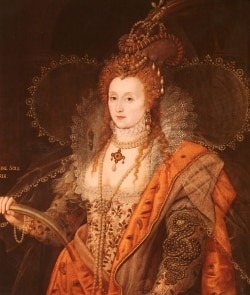
I looked up the work of R. Bakan, from the Faculty of Education, Simon Fraser University, Burnaby, B.C., Canada. Bakan wrote an article, or medical hypothesis, entitled “Queen Elizabeth I: A Case of Testicular Feminization” in 1985. In this article, Bakan puts forward the idea that Elizabeth I was a case of testicular feminization and that this diagnosis explains why she never married, why it was believed that she had some kind of congenital defect or was barren, and that is also explains her physical appearance, behaviour and character. Bakan says that although many modern historians believe that Elizabeth’s refusal to marry has a psychological explanation, s/he believes that:
“recent advances in our understanding of the process of sexual differentiation, particularly, the description of the testicular feminization syndrome, justify a re-evaluation of the “physical defect evidence” of Elizabeth’s contemporaries.”
Before we go into Bakan’s reasoning as to why s/he believes Elizabeth may have suffered from this syndrome, let’s find out a bit more about it.
What is Testicular Feminization Syndrome?
Bakan explains that the term was first used in 1953 and that it describes an hereditary disorder of sexual differentiation which is probably transmitted by the mother. Bakan goes on to explain that sufferers are phenotypic females, although they have internal testes and X and Y chromosomes, and that the syndrome is rarely accompanied by any other abnormalities. The sufferer’s external genitalia are female, but the uterus and uterine tubes are either rudimentary or absent, and the vagina “ends blindly in a pouch or is absent”. The sufferer is always sterile, although menstruation can occur in a few cases.
When the sufferer hits puberty, breast develop normally and she appears female. Characteristics include slim hips, large hands and feet, thin and elongated hands and fingers, and sufferers tend to be tall and attractive. Their sexual orientation is always female and they enjoy the company of buys, sport and “rough” games in childhood. They also tend to be of above average intelligence and very practical.
Bakan sums up the characteristics of someone with testicular feminization by saying that:
“testicular feminization individuals typically present attractive, intelligent, practical females, above average in height, slim, active, athletic with notably long and beautiful hands. They have a normal life span and are free of related
illnesses and obvious malformations. The only signs of abnormality are the lack of menstruation and the absence or
foreshortening of the vagina.”
Sound familiar?
Testicular Feminization and Elizabeth I
Bakan says that “the characteristics of persons with this syndrome are strikingly similar to descriptions, by her
contemporaries, and by historians, of Elizabeth’s appearance, personality, and behaviour, as well as of the specific physical defects which they believed made her sterile and unwilling to marry.”
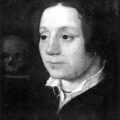
We know from the portrait of the young Elizabeth, which accompanies this post, that Elizabeth had lovely long slender hands with long and elegant fingers, but Bakan also uses the words of P Johnson, who studied portraits of the Queen along with contemporary descriptions and concluded:
“she was a little above average height for her time and class; that she was slim and extremely active;… On one point all authorities written and visual are agreed: she had beautiful hands, with long fine fingers, to which
she loved to draw attention by repeatedly drawing off, and putting on, her gloves. There can be little doubt that, in her day, she was an attractive woman”
A M. de Maisse is also quoted as saying:
“…she drew off her glove and showed me her hand, which is more than mine by more than three broad fingers. It was formerly very beautiful, but it is now very thin, although the skin is still most fair.”
after visiting the Queen in 1597.
Bakan also points out that her gloves, which are now in the Ashmolean Museum, are evidence of her abnormally long fingers and the fact that her fourth fingers were longer than her index fingers, a common male trait.
As far as her personality is concerned, Bakan talks of how the Queen showed many “male” characteristics in that she was physically aggressive and swore a lot. He quotes her tutor, Roger Ascham, as saying that she was “intellectually masculine” and William Cecil as saying “that if today she was more than a man, tomorrow she would be less than woman”. Bakan also points out her attitude towards marriage. There are many examples of Elizabeth speaking out against marriage and insisting that she would remain a virgin and never marry, and Ascham likened her to Hippolyta, Queen of the Amazons, “for by nature, and not by the counsels of others, she is thus adverse and abstinent from marriage.”
But is there any evidence of Elizabeth I having any reproductive abnormalities to back up Bakan’s claims?
Bakan thinks so. Bakan cites historians J Morris and Alison Plowden as saying that she had either amenorrhea (the absence of menstruation) or irregular periods. Ben Jonson is also quoted as saying:-
“she had a membrane upon her, which made her incapable of any man, though for her delight she tried many. At the coming over of the Duke of Alencon there was a French surgeon who took it in hand to cut it, yet fear stayed her and his death”
and French writer, Brantome, as saying of a woman, thought to be Elizabeth:-
“she was unfit to be a wife having only the smaller opening through which she passed water.”
Mary Stuart (Mary Queen of Scots) also remarked in a letter that she had heard from Lady Shrewsbury that Elizabeth was foolish for desiring a marriage with the Duke of Alencon when such a union could not be consummated, and it seems that Quadra and de Feria, the Spanish ambassadors believed that Elizabeth could not bear children.
According to Bakan, the historians Pollard and Mumby concluded that, on the basis of evidence from her contemporaries, that Elizabeth had some kind of physical defect that made childbearing impossible and Pollard points out that Elizabeth, as monarch, would never have willingly refused the chance of producing an heir to carry on the Tudor line and to secure the throne, so she must have had no choice in the matter.
The Psychological versus the Physical Explanation
Many of today’s historians argue that Elizabeth’s refusal to marry and her desire to remain a virgin are to do with psychological reasons, rather than physical ones. Psychological reasons could include:-
- Elizabeth linking sex with death – Alison Weir writes of how Elizabeth could have linked the two because of her mother and stepmother both being executed for adultery, Catherine Parr dying in childbirth and her Thomas Seymour, the man she first had any type of sexual experience with, being executed also.
- A fear of childbirth – Her stepmothers, Catherine Parr and Jane Seymour, had both died after childbirth, as had her grandmother, Elizabeth of York.
Bakan discounts these reasons, arguing that we cannot use today’s psychoanalysis and views on marriage to explain the behaviour of a 16th century queen, and that Elizabeth’s characteristics along with her instructions in her will, that her body should not be examined or embalmed, point to her having a physical defect which she believed made her barren and that is why she refused to marry.
My Thoughts
Bakan’s theory is an interesting one but it seems to be flawed in that, according to his/her own words, testicular feminization is hereditary. Anne Boleyn had a few pregnancies and obviously gave birth to Elizabeth, so she must have had a normal, functioning womb, and Elizabeth Howard, Anne’s mother, was said to have given her husband, Thomas Boleyn, a baby every year although only 3 survived childhood. Bakan also talks of how Anne Boleyn had six fingers and that this type of abnormality can be related to developmental disorders. But, I don’t believe that Anne had six fingers anyway. I can’t see Henry VIII moving heaven and earth to marry a six fingered woman who could pass on such a defect to the heir to the throne, can you?
Why, oh why, do we have to think that there was something wrong with Elizabeth for her to choose celibacy? OK, it was seen to be her duty to provide and heir but she was monarch and she was in charge, if she refused to marry and have children then what could anyone really do about it? Why do people need to explain her choice by making out that she was psychologically damaged or had some kind of defect or abnormality?
Also, I find it annoying that Elizabeth is seen to be masculine just because she was strong and courageous. I know that there were very strong views about women and how a woman should behave in the 16th century, but haven’t we moved on from that. Can’t a woman govern a country successfully without being likened to a man? I’m no feminist but I think we are taking so much away from Elizabeth and her incredible achievements if we say that she had male characteristics.
My own opinion is that Elizabeth was a strong woman who was well ahead of her time and her world, and even ours today, could not cope with that.
Well, I’ve rambled on for far too long, what do you think? Please share your opinions below.
Sources
- “Queen Elizabeth I: A Case of Testicular Feminization” by R. Bakan – This can be purchased from http://www.sciencedirect.com/ for $31.50, just search for the title or author.
- “Elizabeth the Queen” by Alison Weir
- “The Sisters Who Would be Queen” by Leanda de Lisle
Related posts:
 Why Didn’t Elizabeth I Marry?
 The Old Myths Regurgitated – The Bisley Boy and More
 Elizabeth’s Women
 Was Elizabeth a Jealous Old Hag?
 Elizabeth I – Her Father’s Daughter and the Lion’s Cub
 Elizabeth, Seymour and Shakespeare
 Did They or Didn’t They?
 Tudor Contraception
 Elizabeth I – Queen of PR
 Elizabeth I
 Elizabeth I’s Nativity Chart
 Elizabeth and the Two Katherines
A question- If a body at oversite was found in the walls of a young girl in fine Tudor dress. Did not the reverend organise a proper buriel on sacred ground. If so where is this young girl buried?
If it was the princess and a close cousin, a boy took her place. Then it is far more likely hie male parts would of been totally removed. Not un-usual in those days when choir boys and boy actors who played girls were castrated or had their parts removed, one so they would remain soprano and the other so they would not develop any male traits. Very few people were allowed close to the queen. She was secretive and dominant, at least in public. Can you even imagine what would of happened to anyone who dared to profess the queen a man. One would say though that Mary saw Elizabeth as a rival. She had her locked in the Tower for awhile and then sent away under the protecterate of one of her trusted people. So whilst living in the tower and under this protectorate, such anomalities would of undoubtedly been found and Elizabeth dis-credited, unless the alteration was that good.
One would do better to look at the fact her mother, Katherine Howard and lady Jane Grey all fell to the executioner. All were relations. She came from a family where both sides wer strong willed. her father was a man capable of great genorosity and kindness and equally capable of great cruelty. She had a childhood where she could trust no-one. Once Mary came to the throne Elizabeth was surrounded by spies looking for reason to have her executed. When in power she survived many assassination attempts. Cecil and a very select few were ever allowed to get close to her. Is it surprising. She had to be strong, her vision was to see the friction between catholic and protistant finished. She wanted to unite England and she did.
Her skin being pock marked and her hair falling out, would of been caused by the lead based make up.she used.
This was all done to help create the look of the virgin queen. and it succeeded. She married herself to England and in that moment smashed the schemes of many a gent who wanted her hand. There was no doubt that her father must have appeared to her as a fearful character. The men in her mother’s family had schemed to get her mother on the throne and by so doing had cost her life. Ever since she was a child, she had men not seek her friendship for her, but for what she possessed. Her life was devoted to her country and she knew if she married her power would be broken.
As a man, I respect a queen who overcame the impossible, gave up her own wants for those of a nation and united a nation.
Although I agree that it may be slightly out of line to medicalise her actions, I think the theory is an interesting one and has considerable evidence to support it. The idea that she was intersexual should not undermine that she was a powerful woman – a lot of people on here have commented that it undermines her feminine power, but it shouldn’t. There’s still a stigma attached to intersexuals which makes us rush to Elizabeth’s defence when she’s accused of being one, but if it was found that she was it wouldn’t be a bad thing. Hermaphrodites are a lot more common than we are led to believe, and it doesn’t make anyone a weaker or less effective ruler. If anything it’s good – she can be a positive role models for those who experience what she (might have) experienced. Elizabeth was a passionate woman, and knowing what her grandfather had gone through to establish the dynasty, and that her father moved heaven and earth to continue it, I can hardly believe that she would voluntarily end the Tudor monarchy. While psychology does provide a slight explanation, which I support fully, I don’t think that alone would have stopped her doing what she wanted. I believe that it is highly likely that she did have some sort of gender confusion, and that that shouldn’t be considered a bad thing! Diversity is what makes the British monarchy interesting.
She was brilliant. IMO she refused to marry or have an heir because she refused to be regarded as a brood mare, which would have diluted her authority. Did she not say, in her Speech at Tilbury, that she might have the “body of a week and feeble woman, but the heart and stomach of a king”? This was a very sexist world. She had to be a perpetual virgin in order to seem “impenetrable,” and incorruptible. These strange theories about her physiology certainly didn’t hurt that reputation. Brilliant to the end, and beyond.
“Bakan’s theory is an interesting one but it seems to be flawed in that, according to his/her own words, testicular feminization is hereditary. Anne Boleyn had a few pregnancies and obviously gave birth to Elizabeth, so she must have had a normal, functioning womb, and Elizabeth Howard, Anne’s mother, was said to have given her husband, Thomas Boleyn, a baby every year although only 3 survived childhood.”
Its important to actually understand the genetics of AIS before denying the possibility on such a basis. A child with AIS is genetically XY but because the body does not respond to the androgens they exhibit physically and developmentally as a female. The undescended testes in the persons body produce a small amount of estrogen that is sufficient in puberty to allow breast development. (This is normal, all men produce some estrogen and women produce some testosterone just in different quantities).
Individuals with AIS inherit the syndrome on their X chromosome that they get from their mother, their other chromosome being Y. The mother is a carrier and whilst she may have some mild symptoms is generally still fertile as she is protected by her other normal X chromosome. 50% of her XY conceived children will have AIS. Their Y chromosome does not protect them, so their bodies are unable to respond to the androgens produced through the genetics of the Y chromosome that under normal circumstances would cause them to develop into a physical male. The lack of response to the androgens means that they develop looking like a female externally, including undergoing some aspects of female puberty (breasts etc) but as they do not develop any female internal organs other than a partial vagina (to varying depths) they do not menstruate and cannot conceive children.
Some people with AIS do have a low level response to androgens. If this is the case they are born looking female and when puberty arrives there is some enlargement of the clitoris giving it the appearance of a small penis. Breast development still occurs. In some instance the testes that are usually retained in the body of full AIS people may descend into the labia in those with partial AIS.
Thus if there are historical accounts of lack of menstruation and an odd appearance to Elizabeth’s genitalia such as a shallow vagina, enlarged clitoris or odd shaped labia then that evidence along with the other physical characteristics would be highly suggestive. I have heard of possible evidence of lack of menstruation but am not familiar with any other physical descriptors. If they do exist then they may add emphasis to actual and anecdotal evidence that support her having AIS, but if such accounts do not exist they only way to be sure would be to get a DNA sample from her corpse and see if it is XX or XY.
Sutely the key point in all this was the lack of a post mortem.
Why on earth this should upset the feminist lobby I cannot thnk. She was all woman with a strong masculine side. There are many normal men with equally powerful feminine leanings. It is pretty obvious she had some of the charactaritstics of a Virago. Hands,fingers,height boyishness and possibly a malfunctioning vagina.
Edward, her fingers were like those of Anne Boleyn, who was known for her long fingers, she wasn’t at all boyish from what I can see, and her father was tall. Those characteristics do not mean that she was a virago.
She was not very tall. Considering her father was Henry VIII who was very tall this is even surprising.
Compare with known AIS, Duchess of Windsor, for example.
Thank you Dee for your explanation on AIS. Helps us understand how it can be hereditary and still AIS persons are, of course, sterile.
I´ve often wondered if there was *some* kind of defect Elizabeth knew about that made her either fear marriage or made her know it was impossible.
Does anyone know if the doctors would have been able to actually examine her? I´ve read somewhere doctors could not touch or look at the royal women, so would there ever have been an internal examination as we know it? I seem to remember a story about a doctor having to look at his “patient” as she walked by on the other side of the open door.
Is there a link or material somewhere on the “gyneological exam” Elizabeth had
when she considered (or not) the French marriage? Wiould that have been a real examination or, rahter, the doctor maybe just discussing things with her in polite terms?
I do not think she was an AIS person anyway.
I´ve often wondered why Henry VIII wasn´t able to have more live children though. He didn´t even have but one royal bastard, and he did have mistresses. There´s a mystery!! Also, he had a very high tenor voice, and Mary I had a gruff voice.
I admire Elizabeth I and think she was a very, very clever, strong woman. And, it must have been extremely difficult to stay celibate all her life!
It was documented by Elizabeth’s physician that she was all normal and more than capable of bearing children. Why didn’t she??? Well theory goes that she was a bit traumatized by her fathers constant marriages and what she knew of her mothers fate as well as the fact that she could never marry any of the men she loved due to governmental restrictions. She was not as absolute a monarch as her father, she relinquished some of her rights to her cabinet and her parliment, something Henry VIII would never have done, so she was not able to just marry any man she wanted. Though it was well said that she desired to marry her long time lover Lord Robert Dudly, who she was intimate with and that is also documented, However knowing her position an unexpected pregnancy would have caused such chaos in her rule and realm she backed off. She is called the Virgin Queen out of her sacrifice she made to her realm in not marrying and reducing her power by taking a husband and relinquishing her authority, she chose her people over her own happiness. That is why she is so remembered, for only a monach who truly loves her realm and people would do that. It is well recorded she had lovers.
At first when I was reading this and I read about the traits matching I was seeing a somewhat decent case being made. But Jonson’s words and the others are probably a reaction of the time to the burning question of why Elizabeth refused to marry. When the real reasons were more simple; she’d never had a good example of it in front of her and she knew the inevitable power struggles that would happen on bearing a succession of children, not to mention the high likelihood of death in childbirth and another disastrous regency to befall her country.
Then I realized that the description also matches myself to a T, although I’m fairly quiet. It also matches about half my friends. The fact is if you are very tall, you’re also likely to have the other characteristics – strong, large hands and feet! I always get comments on my finger and toe length; I’d be horrified if people thought that made me genetically male. The fact is the disorder is extremely rare and just one type of hermaphroditary, albeit a much more ‘livable’ kind sort in which less people are aware and therefore judge.
Hi,
AIS is hereditary! It is possible to be a carrier of the gene without having AIS itself. This is where your arguement is a little flawed. Anne could have been a carrier of the AIS gene without being sterile.
Also, it was said that ALL AIS people identify as female. This is false. I know many AIS people who identify as male. They are all born female looking female and have male chromosomes but some feel more male than female.
That being said. I do agree with you. I think that a woman should be able to be strong without being associated with physical and psychological conditions she doesn’t have.
Hi, I just came across this post and found it really interesting. It is absurd to try and find physical and psychological ‘fault’ with this Queen because she demonstrated strong qualities that were were not allowed for women in the 16th Century. I thought that your post was excellent. Your response very well thought out. My only qualm is your discouraging statement…. “I’m no feminist” as if that is a bad thing. A feminist being someone who supports equality and gender parity for women, you sounded very much like a feminist. Bravo!