 As promised, I want to share with you what was said in last night’s Channel Five “Revealed” programme, “The Virgin Queen’s Fatal Affair”. I wrote copious notes so that I didn’t miss anything and I have divided the different topics into sections so that it is easy for you to take in.
The programme featured the following experts:-
- Philippa Gregory, author of many historical novels including “The Virgin’s Lover”
- Tracy Borman, historian and author of “Elizabeth’s Women”
- Sarah Gristwood, historian and author of “Elizabeth and Leicester”
- Steven Gunn, historian
- Chris Skidmore, historian
- Edward Impey, archaeologist
- Dominic Taylor, architect
- Allen Anscombe, forensic pathologist
- Simon Adams, historian and author of “Leicester and the Court”
The Implications of Amy’s Death
Both at the start and end of the programme, it was suggested that Amy Robsart’s death changed the course of English history because it made Elizabeth into the Virgin Queen. As a result of Amy’s death, Elizabeth did not marry and the Tudor dynasty was brought to an end.
Elizabeth and Dudley’s Relationship
Sarah Gristwood spoke of how Elizabeth made Robert Dudley her Master of the Horse when she came to the throne and that this meant that he was in charge of all the fun things and that when he arrived to see her it was always with “an invitation to play”.
It was suggested that Dudley was Elizabeth’s “surrogate” husband and that in the first two years of her reign Elizabeth was besotted with him. She arranged for him to have a bedchamber next to hers, she spent all of her time with him and this led to scandal and rumour. Dudley was seen as a poor choice and a unsuitable consort because both his father and grandfather were executed as traitors, and William Cecil thought that England would face a very dark future if Elizabeth was to marry Dudley. Also, Dudley was married to Amy Robsart.
Dark Whispers
In 1560 there were “dark whispers” at Court. In March 1560 it was rumoured that Dudley was going to divorce his 28 year old wife, who he had not seen for over a year, and William Cecil told of how Elizabeth and Dudley were trying to get rid of Amy. By September 1560, the Court was alive with rumours, Elizabeth seemed so obsessed with Dudley that she was seen to be abandoning her country, Dudley was gaining power and influence, and William Cecil was at his wit’s end. Cecil told the Spanish ambassador that he saw ruin for the Queen if she continued the way she was going.
The Death of Amy Robsart
Amy Robsart died on the 8th September 1560 at the house she was renting in Oxfordshire, Cumnor Place. She was found dead at the foot of the stairs. According to the programme, her death had all of the ingredients of an Agatha Christie thriller and it was used in Walter Scott’s 1821 romantic novel, Kenilworth, where Amy is murdered by Dudley’s steward, Sir Richard Varney. At the time, at the inquest into Amy’s death, the coroner ruled that her death was down to “misfortune”, an accident .
The Stairs
Cumnor Place was pulled down in 1810 so the stairs that Amy was said to have fallen down no longer exist. However, archaeologist Edward Impey was able to build a model of Cumnor Place based on old drawings and plans and concluded that Amy must have lodged in the Great Chamber. Architect Dominic Taylor made a 3D model of the staircase shown in an old plan of this part of the house and concluded that although it was a dangerous staircase, in that it twisted half-way down at a landing, a wall would have stopped Amy from falling right down to the bottom. Also, statistics of falls on staircases show that a healthy young woman would have been unlikely to have died in such an accident.
But was Amy healthy?
Was Amy Dying?
There have been suggestions that Amy had terminal breast cancer and was dying in 1560. Philippa Gregory mentioned the theory that I have discussed already here on the Elizabeth Files, that of Professor Ian Aird who suggests that Amy may have died from a spontaneous break of her neck due to secondary deposits in her bones and that is why she fell.
The case for Amy having cancer is based on a remark by de Feria that she had “a malady in one her breasts”, a comment by Robert Dudley about how within six months his position would be much changed and remarks made by Elizabeth I about how Amy was dying. However, Chris Skidmore rejects the idea that Amy was dying. He spoke of how Amy moved from house to house in the last two years of her life, something that an ill woman just would not do, and forensic pathologist Allen Anscombe called the thinning bone theory no more than speculation and did not agree with it. Sarah Gristwood examined a letter at Longleat, a letter written by Amy to her tailor just a fortnight before her death, in which she asks him to make a new collar for a dress. Gristwood wonders if Amy was ordering it because she was expecting to be reunited with her husband when he visited nearby Windsor.
Dudley’s Reaction to Amy’s Death
Robert Dudley’s reaction to his wife’s death was discussed. All agreed that the news of Any’s death was a blow to Dudley and that his letters to his steward, Thomas Blount, show his astonishment and consternation. He immediately ordered an investigation into Amy’s death and sent Blount to Cumnor. Her funeral cost Dudley the equivalent of £100,000 but he did not attend her funeral. Apparently, the vicar at Amy’s funeral added to the scandal by mentioning that Amy had been pitifully murdered!
The Investigation
Thomas Blount rode to Cumnor Place and launched an investigation into Amy’s death. He questioned the servants and found that Amy was alone when she had died. According to her maid, Mrs Picto, Amy had been in an angry mood that day, and had demanded that her servants leave her alone and that they attend the local fair. Sarah Gristwood mentioned how odd this was. She spoke of how wanting the house to yourself is a very modern idea and that in Tudor times there were always servants around so Amy’s behaviour was very strange. Mrs Picto also spoke of how Amy had been praying daily on her knees for God to deliver her from her situation. Although this suggests that Amy may have been suicidal, it was pointed out that suicide was unthinkable for a Tudor woman, that Amy had just sent off to have a dress altered and that the staircase was unsuitable for committing suicide.
It was concluded that an accident was improbable, that suicide did not fit the facts so, therefore, Amy must have been murdered.
The Coroner’s Report
The original coroner’s report into Amy’s death was found by Steven Gunn when he was searching the archives of Tudor accidents. The report states that Amy had a broken neck, that her hood and clothing were intact and that she had two head wounds. The head wounds were described as “dyntes” which are usually used to describes blows like those of a sword in battle, and they were recorded as being 1/2 a thumb length deep and two thumb lengths deep. Allen Anscombe, the forensic pathologist, felt that these wounds were more like puncture wounds caused by a mace, spear or halberd, and that if he saw these types of head injuries today he would ask the police to launch a full scale murder enquiry.
Whodunnit?
But, if it was murder, who killed Amy? The programme examined the following suspects:-
Robert Dudley
Although, at first glance, it seemed that Dudley had the most to gain from his wife’s death and therefore was the most likely killer, there is evidence in his defence – his reaction to Amy’s death, his letters to Blount, his desire for a full investigation.
Dudley’s Henchmen
Could Dudley’s henchmen have taken matters into their own hands and killed Amy for Dudley so that he could marry Elizabeth?
A contemporary account in the British Library describes how Sir Richard Verney, a retainer of Dudley, was in Cumnor on the day that Amy died and that he arranged her death. However, the programme asked if Dudley would really have tolerated one of his servants killing Amy and suggested that Dudley would have cleared his own name and stopped all of the scandal and rumour by bringing his servant to justice.
At this point, the programme asked “who would Amy clear the house of servants for?” and it was suggested that Amy would make sure the house was empty and that she was alone if she was asked to do so by her husband, her Queen or William Cecil.
Elizabeth I
Tracy Borman spoke of Elizabeth’s fiery temper and the way that she could lash out at people in anger, such as stabbing one lady in the back of the hand with a fork and breaking the finger of another lady when she married without the Queen’s permission. It was also pointed out that, according to a letter written from the Spanish ambassador to Philip II, Elizabeth had spoken of how Amy was dead or nearly so before news of Amy’s accident had reached court. Did Elizabeth know something? However, Borman argued that Elizabeth was too much of a pragmatist to involve herself in murder and that also the secret would have eventually come out.
William Cecil
Philippa Gregory spoke of her belief that William Cecil was involved in Amy’s death, that he benefited most from her death and that he made the connection between Amy’s death, Dudley’s reputation and the impossibility of Elizabeth marrying Dudley. It was pointed out that Amy’s death prevented Dudley and Elizabeth marrying and that before Amy’s death Cecil had been close to resigning but after her death his career soared. However, Chris Skidmore said that he’s not sure that William Cecil would have taken the risk of making Dudley a widower.
Kenilworth
Even though Amy’s death caused scandal and Dudley suffered as a result, he did not give up wooing Elizabeth. In 1575 he entertained the Queen at Kenilworth Castle with lavish pageants and displays, which Shakespeare alludes to in “Midsummer Night’s Dream”, and Sarah Gristwood spoke of this being “his last throw of the dice”. However, all of it was wasted on Elizabeth.
The Virgin Queen
The programme concluded by saying that Amy’s death prevented Elizabeth marrying Dudley and that it caused Elizabeth to become “The Virgin Queen”. Amy’s death, therefore, changed the course of history and ended the Tudor dynasty.
Amy’s Tomb
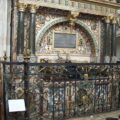
The programme ended with Chris Skidmore visiting Amy Robsart’s tomb in a corner of Oxford’s University Church. This is actually a memorial tablet rather than Amy’s tomb as it is not known exactly where in the church her body lies. In his article, “The Death of Amy Robsart”, Professor Ian Aird wrote:-
“The exact site of Amy’s grave has never been known, though in the contemporary account it was said to
have been at the east end of the church of St. Mary the Virgin in Oxford. In November 1946, after a fire in that church, it became necessary to re-lay the whole of the pavement of the chancel, and opportunity was then taken of exploring the area where Amy Robsart’s grave might have been expected to be. It was discovered, however, that all the area had been dug over subsequent to her burial, and some vaults of a later date were discovered, one of them, incidentally, being that of Cardinal Newman’s mother. The disturbance of the soil down to a depth of about six feet was very great and bones and soil were so intermingled and in such complete disorder that if there had been a grave in the area all trace of it was lost, destroyed by the previous disturbance. There is thus no hope now of recovering Amy Robsart’s remains and of observing the kind of broken neck which caused her death.”
My Thoughts
I cannot say that I was convinced by any of the arguments put forward by the programme as to me it just seemed like speculation and there really was no new evidence brought to light. I’ve always been torn between three theories – accident, suicide and murder by an unknown person – and I still am. Amy’s behaviour leading up to her death suggests suicide, although her faith may have prevented her from actually doing so, and the two deep head wounds suggest murder, however, I have not seen the coroner’s report and so find it difficult to come to a conclusion. What I am sure of is that Robert Dudley, Elizabeth I and William Cecil had nothing to do with her death.
What do you think?
Related posts:
 8th September 1560 – Death of Amy Robsart
Did Robert Dudley Murder Amy Robsart?
8th September 1560 – Death of Amy Robsart
Did Robert Dudley Murder Amy Robsart?
 The Marriage of Robert Dudley and Amy Robsart
8 September 1560 – The Mysterious Death of Amy Robsart
The Marriage of Robert Dudley and Amy Robsart
8 September 1560 – The Mysterious Death of Amy Robsart
 Update on “Did Robert Dudley Murder Amy Robsart?”
 A Response to “Did Robert Dudley Murder Amy Robsart?”
 Robert Dudley to Marry Mary Queen of Scots?
 In Memory of Two Top Tudor Men
The Virgin Queen’s Fatal Affair: Revealed
In Memory of Two Top Tudor Men
The Virgin Queen’s Fatal Affair: Revealed
 4 September 1588 – Death of Robert Dudley, Earl of Leicester
 The Arthur Dudley Myth
Did They or Didn’t They?
The Arthur Dudley Myth
Did They or Didn’t They?
Yes, Carol, I was disappointed that they didn’t come up with anything really revolutionary. Amy’s death has always been regarded as suspicious so that’s really nothing new and I think it was a very sweeping statement to say that Amy’s death changed the course of history, how simplistic!
Hi, Thanks again, Claire! It’s indeed funny that two people mention the idea that Amy might have been expecting her lover! I remember that I said this same thing as a kind of joke to my mother once. Now, I think one of her two survivng letters makes clear that she really loved her husband then, in 1557. What’s hardly ever mentioned, and what has contributed to the notion of the totally abandoned wife, is that we have not a single letter from either Robert to her or her to him. There clearly were letters, and there is nothing sinister about them having disappeared. It is the same case with Lettice, his later wife. It is obvious that a huge part of his family correspondence has been lost, there is no letter to his brother Ambrose, with whom he was very close, nor to his two sisters. There is one letter from Ambrose to him and two or so from his younger sister to him. There are only very few letters (from originally quite a number) from Elizabeth to him, and no one in the original he would have seen. Equally, the French ambassador’s dispatches from 1558/1560 are almost completely missing, which would have given another angle to the whole thing. Dudley was an indefatigable letter-writer, but very much has been lost. It’s the people whose archives have survived who inadvertently made the history: The Cecils and the Habsburgs.
Thanks for the summary (very good summary, by the way!) of the program. It sounds like they rehashed the same info with their own pet theories. I am most intrigued by the wounds on Amy’s head–they do seem like the most suspicious aspects of the event. I love Alan’s theory about a lover–the same thought had occured to me as I read over the almost empty house–she was only 28, her hubby was wooing the Queen, she hadn’t seen him in a year?? But, if she was terminally ill, that sort of seems unlikely. I don’t believe Dudley or Elizabeth had anything to do with it. As I said before, Mrs. O could have been involved in a mercy-killing, sort of Tudor-style Dr. Kovorkian (sp?). When you think of who profitted most, it would be Cecil, though I’m not sure he would have done it–he was a leading Protestant and these guys took their faith quite seriously. Murder? Well, it would be really breaking those commandments. It could have been a hit man from another of Dudley’s enemies–Norfolk? I mean, Dudley was very unpopular excet with the Queen. Someone could have set him up. In the end, we’ll never know. But it’s fun to hear all the theories and hope for more evidence!
That remark by the preacher at Amy’s funeral is also from Leicester’s Commonwealth, which is of course a satire with a political agenda. “Pitifully slain” he is supposed to have said, but only in the “Commonwealth”; that’s one of the more famous “incidents” from that book! I am absolutely sure about the stairs: although Skidmore later mixes them up himself in his book, he first shows that the stairs on the 18th century sketch are leading down from the gallery to outside the house. Then there is a different staircase leading to Amy’s room in a completely different part of the building complex, but there is no sketch, no way of knowing today what it was like. According to the coroner’s report, the stairs she fell down led to a “certain room” where she was before the accident. If the “certain room” is not the gallery, it cannot be the reconstructed stairs. As regards the coroner’s report, the likelihood is that it was the stairs from her “Great Chamber”, the best in the whole complex, but far away from the gallery and hall. Skidmore clearly mixed up both stairs because he had a sketch from the other one.
My memory may be faulty (and I cannot pull up Channel 5 programs on my computer here in the colonies) but I have no problem believing that Amy committed suicide. And I recall that Dudley ordered TWO coroner’s inquests. I’ve watched people die of cancer and unless heavily drugged they can lbeg for death. Also, If she were taking poppy for the pain, she could have been dizzy and fallen.
We’ll never know, but I believe she committed suicide and Dudley protected her and insured her Christian burial….perhaps from some remnant of affection, or to protect his own name. If a suicide, she could have been buried outside the church, even at a crossroads at midnight, like a witch. For Dudley, that verdict would have been almost as bad as murder and also doomed his chances for marrying Elizabeth.
He was ambitious. He had family baggage and he was hated and unpopular, as favorites often are. But he was not stupid, nor was Elizabeth.
We’ll never know, but we have enough theories to chew on forever.
Jeane Westin
The Queen’s Lady Spy, Coming from NAL, 2012
His Last Letter, Elizabeth I and the Earl of Leicester, NAL, August, 2010
The Virgin’s Daughters, In The Court of Elizabeth I, NAL, August 2009
This was so interesting. Wish we could see the 3D of Cumnor Place. I have always wondered about her death because of the relationship between Dudley and Elizabeth. I do not in any way think the Queen knew anything about it. But I am not so sure about Robert? With his wife out of the way he had a better chance with the Queen,however, he must not have known Elizabeth well enough when it came to actually getting married to someone. She was not for that!! Why such a huge funeral and where is she buried?? Also where was Cumnor Place located in England? I enjoyed Jeane Westin comment, but if he knew she was wanting to take her own life, why would he not stay closer to her? But to reassure her of a Christian funeral shows that he knew she was going to probably succeed in taking her own life. Something does not fit here…..I am leaning towards the idea that Robert had someone do the dirty deed for him…..Hummmmmm Whatever, the Queen was NOT happy and poor Amy paid the price I think for nothing!!!
But that’s the point about WHY WAS SHE KILLED IN HER HOME? A killer acting in the Dudley interest would never have drawn suspicion on his boss in that way. Not when there were all these rumours about him and the Queen in the country. This is the really weak point in the argument that Amy was NOT ILL and therefore had to be done away with. If she was indeed murdered at her home it could only have been to frame Dudley.
Suicide is more likely, Robert seems to have had that suspicion immediately, not to mention Blount and the maid; Elizabeth did hardly ever let him from her side, he simply was not allowed to leave his post (ambassadors etc., that not very nice chronicle has a court insider say she was sexually jealous of his wife; it reminds one of her later behaviour regarding his ladies).
The funeral was costly but hardly too extravagant for the wife of a duke’s son and the Queen’s favourite. Robert’s mother’s funeral cost as much (o.k. she was a duchess, but still…)
Incidentally, if somone had an inkling that Elizabeth didn’t want to marry at all, it was Robert. Robert, who knew her very well since “before she was eight years old”, said Elizabeth told him at that time and many times later she would never marry. Of course he hoped, and she gave him reason to, but he was never a fool, and he was not a villain either!
There is no real reason to doubt the investigation was not as thorough as it might have been: a number of the jury members, all locals, didn’t like Forster, Amy’s host (they were “very enemies of him”). They would gladly have implicated him in something, because he was richer than they were. Hostile neighbours … are not easily managed.
So, accident is still quite likely, followed by suicide, caused by a painful illness or even by “a strange mind”. Murder theories are imho too much tailored for modern consumption; it was always a widespread suspicion if anyone prominent died in the 16th century, even without a running scandal. I’ve never come across evidence that any highly placed persons seriously thought that Dudley killed his wife: colleague Throckmorton thought it was suicide; colleague Cecil knew very well Dudley was innocent; Elizabeth clearly was convinced all her life he was; there is no hint that Philip II, William of Orange and so on thought Dudley was an especially evil person. Of course, killing your wife may have been seen as normal, but it was a rare occasion indeed in those circles (outside France and Italy that is).
Elizabeth had some nasty faults, but she was not of a murderous nature at all, and I can’t believe she would have allowed herself being so close to a wife killer or to have get him away with this unpunished; not for her own security; not for the justice of her state. She knew Robert’s character — and she said repeatedly that he was of “a very good nature”, etc., she said this months after Amy’s death, but also many years later. And we all know she was an excellent judge of character and a very wise woman.
This show sounds like a group of writers wanting some free publicity to sell their books. It seems like a murder plot is so much more interesting than an accident so we’ll just put the facts together for a more interesting show, so the ratings will be higher and we get more money!
Im also tending to think Dudley was set up and that Amy was murdered.
As has been pointed out, he was hated and the favourite with a traitourous family history so a murder against his name would finally tarnish him and his prospects with the Queen forever.
I did like the comment from Christine Hartweg – “You can prove everything if you choose your ambassadors and rumours well!” This is so true, without definitive evidence we can turn anyone from history into how we want them to be.