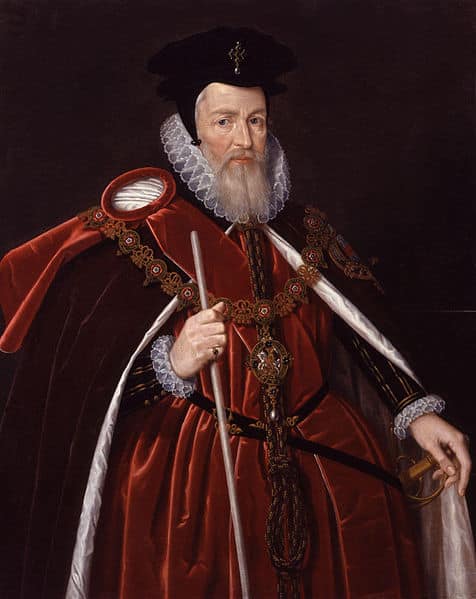
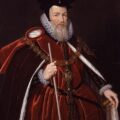
 I meant to write this article to coincide with the anniversary of William Cecil’s death, the 4th August 1598, so I’m sorry this is a day late. I think the best way to commemorate someone’s death is to celebrate their life and what a life William Cecil had! He really was an incredible man and is one of my favourite historical characters.
Here is a bio of William Cecil:-
William Cecil, 1st Baron Burghley
Birth: 13th September 1521 in Bourne, Lincolnshire
Parents: Richard Cecil, former Groom of the Robes, Constable of Warwick Castle and High Sheriff of Rutland, and his wife Jane Heckington.
Family: William Cecil had three sisters – Anne, Margaret and Elizabeth. His grandfather David Cecil had been one of Henry VIII’s favourites and was High Sheriff of Nottingham. Cecil could trace his ancestry back to an Owen from the reign of King Harold and a Sitsyllt from the time of Rufus.
Education: Cecil went to The King’s School Grantham and then Stamford School. At the age of 14 he started at St John’s College, Cambridge, where he met men like John Cheke and Roger Ascham. It was at Cambridge that Cecil met Mary Cheke, John Cheke’s sister, and fell in love. This relationship led to Cecil’s father removing him from Cambridge to Gray’s Inn before Cecil had obtained his degree.
Marriage: William Cecil married Mary Cheke in 1541 against his father’s wishes. He was widowed in February 1543 and went on to marry Mildred Cooke, daughter of Sir Anthony, the eminent humanist and scholar, in December 1546. According to Cecil’s friend, Roger Ascham, Mildred was on a par with Lady Jane Grey as far as intellect was concerned, being one of the two most learned young women in England.
Children: A son, Thomas, in May 1542 from his first marriage to Mary Cheke. Thomas Cecil became the 1st Earl of Exeter and was a member of Elizabeth I’s government. Cecil’s second marriage to Mildred produced a son, Robert, in June 1563, who, after Cecil’s death in 1598, became Elizabeth’s leading minister. Cecil and Mildred had three daughters and two other sons, but Cecil outlived all of his children except Robert and Thomas.
Career: William Cecil started his career by serving Edward Seymour, the Duke of Somerset and Lord Protector from 1547 – 1549. He became Somerset’s Master of Requests in 1548 and acted as his secretary. Fortunately for Cecil, he managed to escape harm when Somerset fell from power in late 1549, but he was imprisoned in the Tower of London for a few months. In September 1550, Cecil was made a Secretary of State in Edward VI’s government, under the new “rule” of John Dudley, Earl of Warwick, and became Chancellor of the Order of the Garter in April 1551.
In June 1553, Cecil was commanded by Edward VI to sign his “Device for the Succession” naming Lady Jane Grey as heir, although he tried to resist signing it, knowing it put him in danger. When Lady Jane Grey fell from power, Cecil once more escaped from harm and although he was a Protestant he conformed to the Catholic regime of the new queen, Mary I.
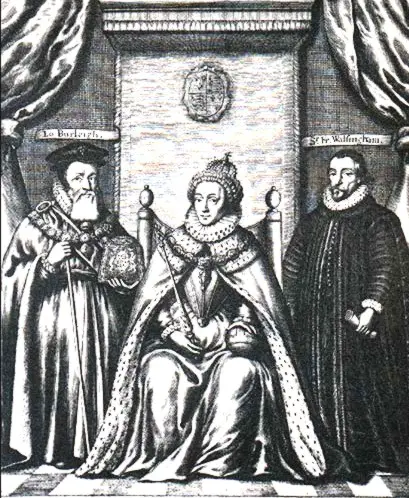
It was not until 1558 when Mary I died and Elizabeth I became Queen that Cecil once again became important in government. He had always been close to Elizabeth and she trusted him, making him her Secretary of State and chief adviser. She nicknamed him her “Spirit” and relied on his wisdom and intelligence. William Cecil was responsible for creating the intelligence service headed up by Sir Francis Walsingham.
William Cecil was temporarily banned from court for his part in the execution of Mary Queen of Scots. Elizabeth I had been putting off signing Mary’s death warrant as she could not bring herself to kill a fellow queen and relative, and was also fearful of the consequences, but she did sign the warrant and gave it to William Davison, with instructions not to do anything with it until she commanded. Davison took it to Cecil and the Council, under the direction of Cecil, decided to send the death warrant and see it carried out before Elizabeth could change her mind. It was what was needed to be done and although the Queen raged at her council she eventually forgave them. Cecil had shown that he did not shy away from making difficult decisions to protect his Queen.
Titles and Offices in the Reign of Elizabeth I: Secretary of State (1558), Member of Parliament for Lincolnshire (1559) and Northamptonshire (1563), Master of the Court of Wards and Liveries (1561), Chancellor of Cambridge University (1559), Chancellor of Trinity College, Dublin (1592), Baron Burghley or Burleigh (1571) and Lord High Treasurer (1572).
Religion: William Cecil was a Protestant. Although Elizabeth I had said that she had “no desire to make windows into men’s souls”, Cecil did not believe in religious tolerance and said that England “could never be in safety where there was a toleration of two religions. For there is no enmity so great as that for religion; and therefore they that differ in the service of their God can never agree in the service of their country.”
Death: William Cecil died on the 4th August 1598 at his home in London. His son, Robert, went on to take his place and become Elizabeth I’s principal adviser. William Cecil was laid to rest at St Martin’s Church, Stamford.
RIP William Cecil.
Notes and Sources
- Wikipedia page on William Cecil
- Article on William Cecil at Luminarium.org
- Elizabeth the Queen, Alison Weir
Related posts:
 A Belated Happy Birthday to William Cecil, Lord Burghley and RIP Sir John Cheke
 4 August 1598 – Death of William Cecil, Lord Burghley
William Cecil, Lord Burghley
4 August 1598 – Death of William Cecil, Lord Burghley
William Cecil, Lord Burghley
 21 December 1545 – William Cecil Marries Mildred Cooke
In Memory of Two Top Tudor Men
The Cambridge Connections – Part 2
Cecil’s Fast and Elizabeth I’s Navy
21 December 1545 – William Cecil Marries Mildred Cooke
In Memory of Two Top Tudor Men
The Cambridge Connections – Part 2
Cecil’s Fast and Elizabeth I’s Navy
 On This Day in History – Sir Francis Drake Knighted and the Birth of William Strachey
 Death of Roger Ascham – 30 December 1568
 Happy Birthday William Shakespeare and RIP
 The Cambridge Connections
 Katherine Grey – Heir to Elizabeth by Leanda de Lisle
I’m a big fan of William Cecil. I think that he did a lot of good during Elizabeth’s reign. I’m not sure if this is true, but I’ve read a lot of fiction where Elizabeth got in one of her tempers (inherited from Anne =) Very endearing) and Cecil calmed her down and helped her make the right decision (for instance, when Elizabeth found out about her Robin’s and Lettice Knollys’ secret marriage and tried to have them thrown into the tower, but Cecil coolly told her that they had committed no crime). I think he was very intellectually astute and a good advisor: clever, perceptive, and level-headed.
Well, it depends on your definition of greatness, doesn’t it? Was Stalin a great dictator? Was Hitler (evidently Charlie Chaplin didn’t exactly think so)? A great politician is an oxymoron. I realize that this website is devoted, in more than one sense, to the idea of Elizabeth I, but she could be, like Burghley, horribly vicious. But you also rather muddy the waters when you write that man is “inherently flawed” That smacks of the preposterous idea of original sin, and we don’t need to be reminded of the corrupting power of religion. Burghley was, like his son Robert, a megalomaniac, whether you happen to like it or not!!
Micki, I got the impression that Claire was pointing out that people do not always make the best decisions – I know that I would have done a lot of things differently if I had 20/20 hindsight! I didn’t think she was referring to “original sin” but just that people make both good and bad decisions and that politicians are not perfect by any means. I believe that democracy is the worst form of government around, except for all other forms that have been tried, as my U.S. government teacher said, a long time ago. I don’t know how to define a great politician, since it seems that politics involves a lot of compromising and not keeping the promises one intended to make once elected. Even George Washington, often viewed as the best president, was a slaveowner and he signed a document saying all men are created equally. I think Elizabeth I did a lot of good things for her country, keeping in mind the fact that the views, values, and culture of that era are very different from the 21st century, I am not sure if Cecil (Burghley) was a typical politician of his time or if he did cross the boundary lines and was more corrupt than others, but it is a good idea to be open minded and listen to different opinions, as long as we can be respectful of other opinions.
Well put, lisaannejane. I like your teacher’s comment, too!
I wasn’t referring to original sin, but more the fact that none of us are perfect and we can’t expect our monarchs or leaders to be so either. I’m sure I’d make huge mistakes working under such pressure and responsibility.
This site is devoted to researching the life and times of Elizabeth I, warts and all. She intrigues me and there is much to admire in her personality and achievements, but, like the rest of us, she was far from perfect and made mistakes.
Thanks, lisaannejane, that is exactly what I meant.
Thanks for your input, impish_impulse and Claire, I wanted Micki so see that there was more than one way to interpret what you wrote, Claire, and that leaders from any country have made both good and bad decisions throughout history, but that does not mean that they are not worth studying and learning about.
I, too, admire Cecil but I think the times indicate a lot of what we consider corruption these days went on. Every servant of the Queen found himself enriched beyond belief as long as he kept her favor. That’s just the way it was. In some cases, it is still that way. Power is attractive and many people seek it. That makes them do things that may not be ethical. That at least has not changed. Cecil was a survivor, a quality I admire. And I think he was a steadying influence on Elizabeth, a calmer voice that she could trust.
Elizabeth the first was very well educated, she used longer words in her speeches than Mary Woolstonecraft. The Mona lisa is rumoured to be Anne Bo9leyn, Anne of a thousand days, The aski the big red parrot.
Thank you for writing this article however it does seem to be a rather air-brushed view of William Cecil. From what I have read, he was essentially like most politicians a self-serving individual with very few morals. Somebody who changed allegiances whenever they saw which way the wind was blowing. Can’t think why he should be lauded as a great man, personally.
In your later replies you also say that Elizabeth was basically ‘all for tolerance’ until she had to deal with the ‘Catholic threat’ – what threat would that be exactly? From the Catholics who had lived for many years in her own kingdom, i.e. her own subjects?
I suggest that you do a litttle more research in future rather than airbrushing people and presenting them as heroes.
You are obviously entitled to your opinion, Malcolm, as I am to mine, and that’s my view of William Cecil, just as people have differeing views of every historical character. It all depends on what sources we use, which we believe and how we interpret them. As far as Elizabeth and the “Catholic threat”, I was not being anti-Catholic or implying that all of the Catholic people were rising up against her, I was simply referring to the plots against Elizabeth which forced her to take action.