 On this day in history, 29th October 1586, four days after a commission had found Mary Queen of Scots guilty of conspiring to assassinate Elizabeth I, Parliament met to discuss her fate. It was decided that Elizabeth should be petitioned to execute Mary.
In my previous article on Mary Queen of Scots, “The Trial of Mary Queen of Scots”, I told of how Elizabeth did not sign Mary’s death warrant until the 1st February 1587 and we know that she gave orders for it not to be sent to Fotheringhay until she said so. It is clear that Elizabeth was struggling with taking such action against a fellow queen, an anointed sovereign, and a woman with Tudor blood. The idea of regicide horrified her but her Parliament were calling for action and a strong monarch always acts against those who conspire to dethrone and assassinate them. It surely would have been a sign of weakness if Elizabeth had let Mary go on plotting against her.
It seems from Elizabeth’s actions – signing the death warrant but not sending it, asking Paulet to kill Mary under the Bond of association – that she was trying to deal with Mary without taking any responsibility for what happened. As John Guy says, “She had carefully contrived things so that she would win whatever happened. If Mary was killed under the Bond of Association, Elizabeth could disclaim responsibility. If Cecil covertly sealed the warrant and sent it to Fotheringhay behind her back, she could claim she had been the victim of a court conspiracy.” But we cannot know for sure what was going through Elizabeth’s mind at that time. Elizabeth was caught between a rock and a hard place, as Alison Weir describes:-
“If she signed the warrant she would be setting a precedent for condemning an anointed queen to death, and would also be spilling the blood of her kinswoman. To do this would court the opprobroum of the whole world, and might provoke the Catholic powers to vengeful retribution. Yet, if she showed mercy, Mary would remain the focus of Catholic plotting for the rest of her life, to the great peril of Elizabeth and her kingdom. Elizabeth knew where her duty lay, but she did no want to be responsible for Mary’s death.”1
No wonder she procrastinated! What a decision to have to make and I don’t think anyone can blame her for taking her time, for refusing to bow to Parliamentary pressure and for taking steps to distance herself from what happened in the end. What else could she do?
Mary – Tragic Heroine and Martyr?
Recently, this site has been bombarded with comments (see comments on Free Report page and my article on Mary’s trial) proclaiming Mary Queen of Scots’ innocence, protesting that she was the rightful queen of England, Scotland and France, calling Elizabeth a “Killer queen”, accusing Elizabeth of framing Mary and accusing me of romanticising Elizabeth. They were hard to take seriously when that person also thought that Mary Queen of Scots was the daughter of Mary I (!), but they did make me think about how Mary has been romanticised in the past and seen as a tragic heroine and even a Catholic martyr. Even today, she is proclaimed a martyr, not just by the commenter on this site but also the the New Advent Catholic Encylopedia who say:-
“There can be no question that she died with the charity and magnanimity of a martyr; as also that her execution was due, on the part of her enemies, to hatred of the Faith.”2
and then write of how Pope Benedict XIV would have formally declared her a martyr “if only the charges connected with the names of Darnley and Bothwell could be entirely eliminated”3.
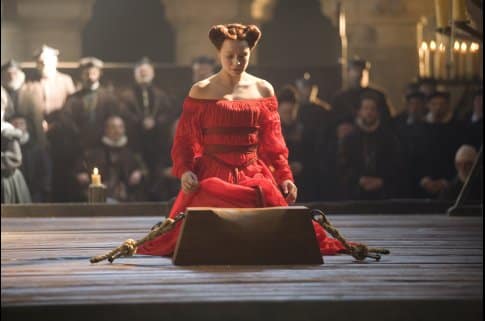
Mary saw herself as a martyr. At her execution, on the 8th February 1587, she wore a crucifix and a black gown and as she prepared herself for her beheading she took off her gown to reveal a bodice and petticoat of scarlet, the colour of martyrdom. In her final moments she was proclaiming that she was a martyr to her faith.
However, whatever Mary thought and whatever message she was sending by her garb, I don’t believe that she was a martyr, well, not in the sense that she meant.
martyr – noun (mär-tər)
- a person who voluntarily suffers death as the penalty of witnessing to and refusing to renounce a religion
- a person who sacrifices something of great value and especially life itself for the sake of principle
- victim; especially : a great or constant sufferer4
Perhaps she could be seen as a martyr according to definitions 2) and 3), but she did not died for her Catholic faith, she was executed because she plotted to kill the Queen of England. Uh oh, now I’m treading on dangerous ground with those who believe she was framed. Well, I do believe that William Cecil and Sir Francis Walsingham did all they could to bring down Mary Queen of Scots, but I don’t believe that they framed her. They set a trap and she fell into it. She gave them the evidence that they were looking for and that they needed to convince Elizabeth to get rid of her once and for all.
John Guy, in his book “Mary Queen of Scots: My Heart is My Own” explains Walsingham and Cecil’s roles in the downfall of Mary Queen of Scots brilliantly:-
“the plot [Babington plot] was not in itself a ‘projection’ [using agent provocateurs to foment conspiracies that were then conveniently ‘detected’] to frame her – it really existed; but rather than nipping it in the bud, Cecil’s spymaster allowed it to develop so that he could obtain the written evidence to put her on trial for her life”. Walsingham and Cecil let the plot continue so that Mary would ‘hang herself’ by getting involved and she did by replying to Babington who was conspiring to get Elizabeth assassinated by a group of ’six gentlemen’:-
‘The affairs being thus prepared and forces in readiness both without and within the realm, then shall it be time to set the six gentlemen to work taking order, upon the accomplishing of their design, I may be suddenly transported out of this place, and that all your forces in the same time be on the field to meet me in tarrying for the arrival of the foreign aid, which then must be hastened with all diligence.’ “5
John Guy comments that “Mary’s meaning is clear. She had consented to Elizabeth’s assassination and a foreign invasion. Strictly, she had not specified what the ‘work’ of the six gentlemen was to be, but the letter from Babbington to which she was replying included the graphic passage, ‘For the dispatch of the usurper, from the obedience of whom we are by the excommunication of her made free, there are six noble gentlemen, all my private friends, who for the zeal they bear to the Catholic cause and your Majesty’s service will undertake that tragical execution.’ When the two letters are read together, Mary’s complicity in the plot was undeniable.”6
Cecil and Walsingham did not frame Mary, they laid a trap and she condemned herself with her own words and actions. She was clearly giving her blessing and her support to Babington’s plot to assassinate Elizabeth. What’s more, Babington confessed and so did Mary’s secretaries.
The Babington Plot was not a one-off, it was not the only time that Mary had conspired against Elizabeth, and as early as 1568 she had approached Philip II to help her with her cause. She also never gave up on her claim to the English throne. Elizabeth spent two decades giving Mary the benefit of the doubt and sympathising with her, yet Mary carried on plotting. I just can’t see Mary as a tragic heroine or martyr and Elizabeth as a cold-blooded killer, however I look at the situation.
What do you think?
Please share your thoughts in comments below – thank you!
Notes and Sources
- “Elizabeth, the Queen”, Alison Weir, p375
- Mary Queen of Scots, New Advent Catholic Encyclopedia
- Ibid.
- Merriam-Webster
- My Heart is My Own: The Life of Mary Queen of Scots, John Guy, p483.
- Ibid.
Related posts:
 The Trial of Mary Queen of Scots
 Mary Queen of Scots – Part One
8 February 1587 – Mary Queen of Scots is Executed
Mary, Queen of Scots – 8th December 1542
Mary Queen of Scots – Part One
8 February 1587 – Mary Queen of Scots is Executed
Mary, Queen of Scots – 8th December 1542
 The Execution of Mary Queen of Scots – 8th February 1587
 Mary Queen of Scots – Part Two
 Mary Queen of Scots Lands in Scotland
 24 April 1558 – Mary Queen of Scots Marries the Dauphin
8 February 1587 – The Execution of Mary, Queen of Scots
Mary Queen of Scots
Mary Queen of Scots Marries Lord Darnley
24 April 1558 – Mary Queen of Scots Marries the Dauphin
8 February 1587 – The Execution of Mary, Queen of Scots
Mary Queen of Scots
Mary Queen of Scots Marries Lord Darnley
 Robert Dudley to Marry Mary Queen of Scots?
Thank you for your extensive research, Claire. Based upon my own research, I do believe Mary can be considered a martyr of the Catholic faith. First of all, Elizabeth should not have been holding Mary prisoner all of those years. As much as I admire Elizabeth, she had no legal right to keep Mary captive. She did so for several reasons, one of which was that Mary was a Catholic and a contender for the throne of England. Mary was a rallying point for the Catholics of the realm who were being persecuted by Elizabeth. Secondly, Mary did not plot to kill Elizabeth; she plotted to *escape* which as the prisoner of a foreign power she had every right to do. Why is it so wrong for Mary to plot against Elizabeth when Elizabeth was holding her as a prisoner? Thirdly, Antonia Fraser and Alison Weir demonstrate that Mary played no part in Darnley’s murder and she married Bothwell unwillingly, after he raped her. Elizabeth should have helped Mary instead of having her imprisoned. Fourthly, Mary was told by one of the gentlemen escorting her to the scaffold that her death would mean that Protestantism would live, whereas if she lived it might mean Protestantism would die. It was THAT statement (which I paraphrase) which told Mary that she was indeed dying because she was a Catholic and a Catholic queen.
I will add that Elizabeth had no legal right to have Mary put on trial. English law adamantly insisted on a trial by one’s peers. Mary was an anointed Queen and had no peer but Elizabeth, and Elizabeth had no right to try a foreign head of state. Furthermore, Mary was not given counsel and she was in a foreign land where the customs and proceedings were strange to her. She was put at a distinct disadvantage during her trial, which had the air of a kangaroo court and contravened the laws of the kingdom.
Mary was raised in France to be the wife and Queen of the King of France. Once Francis died her reason for existence ended and I imagine she was flung into a state of confusion. Not having training to rule a country alone, of course, she made many mistakes and in an effort to show her subjects she would rule, she made many more including her marriage to Darnley. She was saying, in effect, “I am Queen and I will make the decision as to whom I shall marry regardless of my subjects desires.” That she was also a Catholic ruler of a Protestant country did not help her image with her subjects; I would think most assumed that once enthroned in Scotland she would see the “errors” of her religion and convert to the national religion. If she had done that, much would have been different; her strong faith prevented her from living a lie and when her Lords determined she would never change nor did she have the knowledge needed to rule effectively, her days were numbered. Her biggest mistake was thinking she could enter England without permission and expect help from Elizabeth. Truthfully, the two countries were not extremely friendly to one another and had not been for years. It was only through careful negotiations that peace was kept; there were many hard feeling between the countries. Her Lords wanted Mary gone and Elizabeth wanted her off the throne so of course, her entry into England just handed them the perfect opportunity to put her away. Her execution was for plotting Elizabeth’s death and planning to usurp the throne; there was no other way to ensure there would be no more plots. If she had lived and continued to plot Elizabeth’s death; at some point someone might have succeeded in assassinating Elizabeth. Death was the only way to insure rebels would not continue to try to find ways to free her and put her on the throne. It did make her a martyr in many eyes because her faith and because it was the only weapon the Catholic faction had to continue to try to discredit Elizabeth and to persuade people to come back to the Catholic faith.
Mary was just not equipped with the education and knowledge to be a ruler of a country that frankly, did not want her because of her religion. She was trained to be a wife and a queen; to dance at balls and support her husband/King as she provided heirs. If Francis had lived, I have no doubt that she might never have set foot in Scotland again and would have been happy to be the center of attention at the French court.
All that can be levelled against the personage of Mary Stuart, dowager Queen of France and Queen of Scotland is that she gave tacit support to a scheme that would have resulted in her freedom. This is entirely understandable considering that she has been unlawfully held against her will for nineteen years. Her entire motivation was not for the assassination of Elizabeth but to gain her freedom which had been denied her. As she stated at her trial, without her papers, without recourse to evidence, without counsel and essentially without due process, she could not be held accountable for the actions of certain unruly men. If they wanted to assassinate Elizabeth it was their affair, she was essentially concerned with her freedom.
The comments above are truly tragic and betray a real lack of understanding. She was in fact well received in Scotland but made some unfortunate choices, especially with regard to her second husband which earned the enmity of certain nobles. It was absolutely nothing to do with ignorance or an inability to rule as some of the above have ludicrously asserted ironically betraying their own ignorance in the process That she was after the death of her first husband a ‘without reason for existence’, is beneath any rational persons dignity to furnish with rebuke. She was a dowager Queen of France and a Queen of Scotland, of Royal descent. May she rest in peace.
I’m just finishing reading “The True Life of Mary Stuart Queen of Scots” by John Guy, and I have to say, I’m pretty shocked to read the comments on this website as they don’t match the depiction of Mary in the book at all.
None of this changes the fact that Mary Queen of Scots was the rightful heir. Elizabeth was and is the usurper, if you want to speak of legalese.
How was Elizabeth a usurper?
Mary Queen of Scots was not the legal heir of May I of England because at that time the law of England prohibited an alien from inheriting the throne. Mary was born in Scotland and was therefore an alien. Parliament had to change this law to allow James VI to become King of England. If you believe Elizabeth was barred from inheriting the throne then the heir of Mary I was Lady Margaret Douglas [ daughter of Margaret Tudor and aunt of Mary Queen of Scots, mother of Darnley and born in England]. Alternatively if you believe the will of King Henry VIII determined the line of succesion then Elizabeth’s heir was Lady Katherine Grey [younger sister of Lady Jane Grey].
I suspect Mary was setup by walsingham who knew Elizabeth & the law well. I think he did it for two reasons. He really wanted to protect Elizabeth yet he had a hate for Catholic old Religion so it was a combination of both.
I wonder if Elizabeth could have tried a third strategy. She was absolute Monarch at the time for the most part. She was a master of politics & going by history, she has so far been the most powerful leader earth has really ever had. UK, US, Canada & others came to be because of Elizabeth’s defeat of Spanish Armada. What if she got enough members of privy counsel to rally behind her on some unknown, unused law? One they could have come up with that would have said, an anointed Queen could not be sentenced to death? Elizabeth could have spent some months using her propaganda network as well as other means to get message to the public that Mary had seemingly been involved in something massive yet because of the law allowing & Elisabeth having a good & powerful heart, she wouldn’t execute Mary?
It would have lead to even Catholic sympathy for Elizabeth & her being known as strong but also forgiving as a good Christian Queen. The longer term problem might have been no Armada & England having stayed as an Island nation for hundreds of more years or forever. Right or wrong with Mary the Queen, it seems for hundreds of years, it worked out globally in a better way as it has been. That having been said, I feel bad for Mary. I admit to being a huge Elizabeth fan. I love to read about things from those times & all of Tudor Times. I like Gothic times too. I wonder about how 500 years will view our times. We are rather barbaric in 2017 on the global perspective and often in our own nations. I do think Elizabeth was likely the best leader of any time. i might not agree with absolute Monarchy but I do think she did well for what form of government it was. I like Elizabeth 2. I think she’s done a good job for her times & what it is she does. The British are so lucky to have such a rich history. I wonder if most of them realize it.
All this romanticism of Elizabeth annoys me. She was brutal vicious and even attacked her ladies. Mary was not like this but was kind and loved her ladies.Elizabeth undermined Mary at all times by funding her enemies and pretending she did not. Even she could not deny she was illegitimate and under the law then was not entitled to her crown. It is wrong to say Mary deserved execution as she was an independent monarch and no one had any right to judge her. As she was held by force she was entitled to fight back.As for the Babington plot this came after Elizabeth had tried to have Mary killed by returning her to Scotland to.be executed. As for Elizabeth’s concern for her people she refused to pay the soldiers who fought the Armada and many starved to death. Elizabeth promised to restore Mary and lied through her teeth. Anyway Mary won as her son inherited the throne.