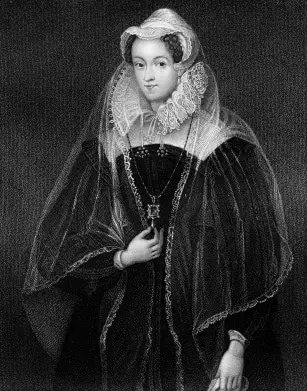
On this day in history, 14th October 1586, the trial of Mary Queen of Scots began at Fotheringhay Castle in Northamptonshire. Historian John Guy, author of “My Heart is My Own: The Life of Mary Queen of Scots”, has written a brilliant chapter on Mary’s downfall, “Nemesis”, and I have him to thank for the information in this article.
Mary Queen of Scots had, at first, refused to appear before Elizabeth I’s commission, but had been told by William Cecil that the trial would take place with or without her. She appeared in front of the commission at 9am, dressed in a black velvet gown and a white cambric cap and veil. Mary then protested against the commission, arguing that the court was not legitimate and arguing against the fact that she was not allowed legal defence and was not able to call any witnesses. Mary was also not permitted to examine any of the documents being used against her. Her protests were in vain and the prosecution went ahead and opened the trial with an account of the Babington Plot, arguing that Mary knew of the plot, had given it her approval, agreed with it and had promised to help. Mary protested her innocence:-
“Mary: I knew not Babington. I never received any letters from him, nor wrote any to him. I never plotted the destruction of the Queen. If you want to prove it, then produce my letters signed with my own hand.
Counsel: But we have evidence of letters between you and Babington.
Mary: If so, why do you not produce them? I have the right to demand to see the originals and copies side by side. It is quite possible that my ciphers have been tampered with by my enemies. I cannot reply to this accusation without full knowledge. Until then, I must content myself with affirming solemnly that I am not guilty of the crimes imputed to me…”1
Unfortunately for Mary, Elizabeth’s spymaster, Sir Francis Walsingham, had collected a great deal of evidence:-
- A confession made by Sir Anthony Babington who had also pleaded guilty at his own trial.
- A deciphered transcript in English of Mary’s reply to Babington.
- A reciphered copy of Mary’s original letter to Babington which looked exactly like the original.
- Confessions from Mary’s secretaries.
When the prosecution produced all of this evidence, Mary burst into tears but still denied her involvement, claiming that the documents were counterfeit. Walsingham proclaimed his innocence, stating that the documents were real. A distraught Mary proclaimed that “I would never make shipwreck of my soul by conspiring the destruction of my dearest sister.”2 The court was then adjourned for lunch.
After lunch, the secretaries’ confessions were read out, much to Mary’s shock and horror. Mary argued that her letters must have been tampered with after she had seen them, and then argued:-
“The majesty and safety of all princes falleth to the ground if they depend upon the writings and testimony of their secretaries… I am not to be convicted except by mine own word or writing.”3
The trial continued the next day with the prosecution accusing Mary of consenting to Elizabeth’s assassination in her reply to Babington. Mary tried to argue that although she had written “then shall it be time to set the gentlemen to work taking order upon the accomplishing of their design”4, she had not specified what the “work” was. However, as the prosecution pointed out, Mary had also appealed for foreign help and although she argued that an act of war, even if it resulted in Elizabeth’s death, was legitimate if it allowed her, a queen, to be free at last, the commission saw her actions as an act of treason.
As the trial closed, Mary demanded that she should be heard in front of Parliament or the Queen, but she was fighting a losing battle. Sentence was delayed as long as possible, by order of Elizabeth, but on the 25th October the commission reconvened and found Mary guilty. On he 29th October, Parliament met to discuss Mary Queen of Scots, the Babington Plot and her role in Lord Darnley’s murder, and it was decided that they should petition Elizabeth to execute Mary. This put Elizabeth in a difficult position as she did not want to be accused of regicide. On the 4th December, Mary was publicly proclaimed guilty and finally, on the 1st February 1587, Elizabeth called her secretary, William Davison, asking him to bring Mary’s execution warrant to her to sign. Elizabeth signed it but told Davison to ask Walsingham to write to Sir Amyas Paulet, in his own name, asking him to kill Mary. This would enable Elizabeth to be rid of her nemesis without taking any responsibility for it, instead Paulet would be acting privately under the Bond of Association*. Paulet was understandably horrified, protesting that “God forbid that I should make so foul a shipwreck of my conscience.”5 Meanwhile, Sir William Cecil called a secret meeting of Elizabeth’s Privy Council which agreed to send the signed warant to Fotheringhay. Cecil appointed the Earls of Shrewsbury and Kent to direct the execution and the council agreed to keep Elizabeth in the dark until the deed was done.
On the 8th February 1587 Mary Queen of Scots was executed at Fotheringhay Castle. Although Elizabeth was furious with her Council, so much so that Cecil fled to his home and Davison was thrown into the Tower, John Guy points out that whatever happened to Mary, whether she was assassinated or executed, Elizabeth could deny any responsibility:-
“She had carefully contrived things so that she would win whatever happened. If Mary was killed under the Bond of Association, Elizabeth could disclaim responsibility. If Cecil covertly sealed the warrant and sent it to Fotheringhay behind her back, she could claim she had been the victim of a court conspiracy.”6
Clever!
* The Bond of Association – p474 John Guy describes the Bond of Association as “a licence to kill”. Anyone signing the Bond, which was drawn up by Cecil and Walsingham in 1584 after the 1583 Throckmorton plot, was swearing to “pursue as well by force of arms as by all other means of revenge” anyone plotting to cause harm to the Queen.
Notes and Sources
- My Heart is My Own: The Life of Mary Queen of Scots, John Guy, p490.
- Ibid., p492
- Ibid.
- Ibid., p483
- Ibid., p496
- Ibid., p497
Further Reading
- State trials of Mary, Queen of Scots, Sir Walter Raleigh, and Captain William Kidd, Condensed and copied from the state trials of Francis Hargrave, esq., London, 1776, and of T. B. Howell, London, 1816, with explanatory notes, p1-57
Related posts:
 14th October 1586 – Trial of Mary Queen of Scots
 Mary Queen of Scots – Part One
 Mary Queen of Scots – Tragic Heroine?
 Mary Queen of Scots
 24 April 1558 – Mary Queen of Scots Marries the Dauphin
 The Execution of Mary Queen of Scots – 8th February 1587
8 February 1587 – The Execution of Mary, Queen of Scots
Mary Queen of Scots Marries Lord Darnley
Mary, Queen of Scots – 8th December 1542
Mary Queen of Scots
The Execution of Mary Queen of Scots – 8th February 1587
8 February 1587 – The Execution of Mary, Queen of Scots
Mary Queen of Scots Marries Lord Darnley
Mary, Queen of Scots – 8th December 1542
Mary Queen of Scots
 Mary Queen of Scots – Part Two
Mary Queen of Scots Lands in Scotland
Mary Queen of Scots – Part Two
Mary Queen of Scots Lands in Scotland
Michael,
Stop picking on Claire. She has provided us with such a treasure trove of information about Anne Boleyn, Elizabeth and the Tudors in general. She takes painstaking care to provide us with carefully researched and valuable information. Let me quote a comment made by author Jeane Westin: “Claire is one of the most thoughtful, thorough and dedicated writers on the Tudor era that I know. Her websites The Anne Boleyn Files and The Elizabeth Files are my required reading every morning.” That goes ditto for me. You are entitled to your opinion but you are not entitled to insult and abuse Claire. Mary Queen of Scots was hardly the paragon of virtue that you seem to believe she was. The facts are indisputable. She endorsed at least one plot that included having Elizabeth murdered. Even though it never came to fruition (thank God) I think that qualifies HER as a killer queen and not Elizabeth. Elizabeth was protecting her throne and her country which had suffered enough under the Catholic rule of Mary I. I guess you think that it would have been better for England for the Scots queen to pick up where Mary I left off and actually succeeded in bringing the Inquisition there. If Mary I would have lived longer I can assure you that’s what would have happened. Food for thought? A veritable feast if you ask me.
Michael, I think you should do a little more research and develop your own MQS files. We must all remember the harshness of the Tudor times. Being a royal relative was a curse in that you were considered a threat through potential uprising. We can judge very little of their actions by our present day standards.
Dear Claire,
I have just found your w/site and read the diatribe between Mr Currie, yourself and others with interest. Michael’s surname is of interest as this is a Scottish name. I believe the Currie’s are a Highland Clan who were mainly Catholic at this period, so perhaps he has some self-interest here?
Some study of the original papers in the English National Archives, the Cecil Papers and the letters of Amyas Paulet, might give Michael a chance to come to a more rounded conclusion. MQS has clearly worked her charms on him, as was hoped they would on Sir Amyas Paulet, Mary’ last gaoler. Thankfully, he was too staunch a man and far too loyal a man to succumb to such blandishments.
Had Mr Currie been alive in 1586 and voicing his opinions as loudly as he does here, he might well have found himself suffering the same fate as Babington and his crew….
Bit late in the day, but have just come across this, and I have never seen written such a load of inaccurate ranting on MQOS in my life as posted by M.Currie. its laughable to the point of hysteria, except for the insults which are not acceptable. But that goes to prove the point, that in a heated debate such as this, when a person starts becoming personal and offensive, it is then they realise that they have lost the debate and falls back on rude and ignorant remarks, and yes Mr. Currie I am speaking about you, now I am going to give you something else to rant about if you are still hovering about:
Mary was more French than Scottish in her ways and out look. Shipped across to France as a child, was spoilt, molycoddled and pampered and had a head full of romantic rubbish and no common sense. She signed her own country over to the French, which luckily for Scotland, was retified.
She came back to Scotland to take her throne and was not impressed by the very basic living style, the people, the religious tones or the harsh climate.
She had no idea how to rule, would not take on advise given by those that did, her main aim, to put it bluntly, was to get laid.. and even her choice in that was disney. A male version of herself, a spoilt fop. Whether she was involed in Darnleys murder or not, she did herself no favours by jumping in bed with the renegade Bothwell, likely before Darnleys murder. How stupid must you be with people suspecting you of murder entering Edinbugh visible pregnant with another mans child (twins).
Her own people despised her for the strumpet/murderss they thought she was, if she had not have fled they would have lynched her. After her escape and abdication she was abandoned by her country, her husband and even her son, all though a baby, when he grew to a young man he never offered a helping hand to his mother, even France wasn’t bothered. Says it all really, she lost everything because of her bedroom behaviour, Hello,whos a silly girl then….The only place left.. England.
I tell you what Liz, as you call her, you give me santuary for 20 years and I pay you back, with, plots, schemes,declaring myself Queen of England, threats of assassination, but thats o.k. Liz, cos we are family, whats a few disloyal acts between cousins, eh…
The problem is , she wasn’t bloody clever enough to comprehend the consequences of her air-brained schemes, was she. She backed Elizabeth into a corner, and yes Elizabeth wasn’t perfect and made mistakes, but at least she didn’t sacrifice her country for a roll in the sack….
Marys execution weighed on her mind for the rest of her life. Oh yes didn’t notice James kicking off much that his mother was minus her head, did you…
So Mr. Currie you live in the same fantasy world she did if thats the way of you, rewrite history too if you must, but she used her helpless little woman act and her sexuality to con many a stupid man, and its exactly that which lost her everything including her life
.
And in the end Scotland inherited England, so, game over!!!
Hope I haven’t offended any of you nice ladies and gents on the site with my short synopsis of the scottish Queen, I know it was very basic, and I know there was a lot more invoved, and I do enjoy reading about her. But as a Queen, especially in those times, if you let your heart rule your head, you were doomed from the start…..Elizabeth did it the other way round, and kept her royal bottom FIRMLY on the throne,where it rightly should have been.. enough said, bye for now.
Can you give me any information about the trial of Mary. Who were sitting in judgment? Were there any defenders? Were there any pamplets after the trial describing minute details?
Thank you for any insight.
Sarah
Mary didn’t have a “defender” in the sense of having something equivalent to legal assistance, but that wasn’t anything special … Tudor treason trials did not give any rights to the accused. Anne Boleyn didn’t get an attorney and she too, was denied the right of cross-examining the witnesses against her. There were some on the jury who were reputed to sympathize with her, and a Lord Zouch actually voted for acquittal, claiming that the charges “were not sufficiently proven”.
It is significant, though, that the only reason Mary got a trial at all was because Elizabeth vetoed the original law, based on the original “Band of Association”, which allowed Mary to be killed, whether she knew of any plot or not.
I understand the oftentimes red-hot passion that may accompany some idea, opinion, or hypothesis. It frequently adds flavour to a brew, so to speak. But the tone of that passion is sometimes enough to throw a wrench into things. I do understand Michael’s wanting us to see his side: we all wish that in a light-hearted discussion, I figure. And when we accompany mis-facts with apparent disrespect for the opinions and proofs of others, the discussion, stalemates and sours. Claire, as do others here, has always, in my view, presented fair and open-minded dialogue. It’s thus interesting. One might not necessarily agree with all such dialogue, but isn’t that the fun of it? I like some of what you are saying, Michael ..but be nice, now. lol
Ok … lol So here’s my little poem of Mary, Queen of Scots, if I may lighten things.
Humid dingy dungeon saps my rest,
Like heavy sand in tortoise holes;
I yawn within my endless wasted best.
Subjects loyal mocked my cause in callous misery
With Liz whose face and heart had scoffed at me.
The scrolls fine tell my father’s testament of rightful seige
And falsely they did trace my Royal youthful leige.
I chose not once to swallow thee nor did I juggle vice
To stage my honour all of me and men and mice.
My blood with taste of Tudor vile and loathing myth
Forced Pooch a stead on me to bare the truth herewith.
I scanned a thousand nights our spirits bold in reign
And saw our worth that bore conspiracy and lies of hell and shame.
My Scottish Vertebrae of splintered chards from scalp and spine
No better now than spoiled grapes from English Vintage Vines.
My crimson dress it spooked you all, my last at will to do
And warrant null had caused in Sis a rival fit for two.
But now you read my truth thus wrote on pages held by time
When of my word back then you bullied it as feint and slime.
What we know:
Mary Queen of Scots appealed to her cousin Queen Elizabeth for aide. Mary had been abducted and imprisoned by ambitious Scottish lords involved in a coup to overthrow her reign in Scotland. Unbeknowst to Mary, Queen Elizabeth took an active role in this coup that ultimately led to Mary’s death.
Mary’s Scotland reign was free of religious persecution. She desired peace.
While imprisoned by Scottish lords she was forced to abdicate to her infant son’s reign.
Now fleeing to England she appeals to cousin Elizabeth.
In response to Mary’s plea to her family, her cousin; Elizabeth then IMPRISONS her for nearly 2 decades. Mary was only in her early 20’s when the the imprisonment by Elizabeth began.
Mary wanted to be free.
Mary believed in the anointing of a Queen.
Mary had no desire to violate another anointed Queen. Mary only wanted to be free of Queen Elizabeth’s imposed imprisonment. Imprisonment without charge for 19 years. 19 years.
Mary wanted to be free. That is all.
The rest was the politics and plotting of Walsingham, Cecil, Duc de Guise and Phillip of Spain.
Mary wanted freedom.
Hi MariAn,
Thank you for commenting on my article. I think there is a huge difference between fact and theory, evidence and hypothesis, and so I have to disagree with some of what you say, particularly “Mary wanted to be free. That is all”.
Both queens believed that they were God’s anointed sovereigns and that is why Elizabeth took so long trying to figure out what to do with Mary. As I said in a comment above, Elizabeth was sympathetic to Mary’s plight for many years and was willing to consider her as her heir. During the Casket Letters tribunal, Elizabeth was concerned with justice and with understanding “truly and plainly the state of the cause of the Queen of Scots”. Mary never gave up her claim to the English throne, approached Philip II to help her with her cause as early as 1568 and was implicated in plots to dethrone and/or assassinate Elizabeth. Elizabeth had to act as Mary would have done if Elizabeth had been conspiring to take her throne. Elizabeth constantly gave Mary the benefit of the doubt and gave her many chances, she did not cold-bloodedly murder her. As John Guy points out in his biography of Mary, “the plot [Babington plot] was not in itself a ‘projection’ [using agent provocateurs to foment conspiracies that were then conveniently ‘detected’] to frame her – it really existed; but rather than nipping it in the bud, Cecil’s spymaster allowed it to develop so that he could obtain the written evidence to put her on trial for her life”. Walsingham and Cecil let the plot continue so that Mary would ‘hang herself’ by getting involved and she did by replying to Babington who was conspiring to get Elizabeth assassinated by a group of ‘six gentlemen’:-
“The affairs being thus prepared and forces in readiness both without and within the realm, then shall it be time to set the six gentlemen to work taking order, upon the accomplishing of their design, I may be suddenly transported out of this place, and that all your forces in the same time be on the field to meet me in tarrying for the arrival of the foreign aid, which then must be hastened with all diligence.”
John Guy comments that “Mary’s meaning is clear. She had consented to Elizabeth’s assassination and a foreign invasion. Strictly, she had not specified what the “work” of the six gentlemen was to be, but the letter from Babbington to which she was replying included the graphic passage, ‘For the dispatch of the usurper, from the obedience of whom we are by the excommunication of her made free, there are six noble gentlemen, all my private friends, who for the zeal they bear to the Catholic cause and your Majesty’s service will undertake that tragical execution.’ When the two letters are read together, Mary’s complicity in the plot was undeniable.” p483 of Guy’s book. She was conspiring to murder Elizabeth and was not tried and executed on trumped up charges. She was found guilty by her own words and her secretaries and Babington confessed.
Yes, politics and traps were involved but that does not mean that Mary was not guilty, she walked into those traps and implicated herself. She did not desire peace, she desired the throne of England, believing it was hers.
Mary Queen of Scots had a responsibility to deal with Darnley, as her husband, as the witnessed murderer of Rizzio and as a plotter against her own life and the life of the future child and King, James.
QE1 had no responsibility in the Darnley affairs any more than MQoS had in how QE1 dealt with Dudley.
As to plotting against QE1 by QMofS, there was no plotting against QE1 by MQofS when MQofS was a free Queen. Whereas QE1 was forever meddling in Scottish affairs with spies, purchasing Scottish lords, etc. for the purpose of deposing MQofS and destablizing the Scottish kingdom. There is no evidence that MQofS was doing the same toward QE1 when a free Queen.
QE! imprisoned MQofS unlawfully. If QE1 had no malice against MQofS she would have granted her safe passage to France among her relatives the Guises in 1568, not imprisoned her for 2 decades. As it was, it took 2 decades of plotting by QE1 and court to find some reason to behead her. If you don’t want counter-plotting, don’t imprison.
For lawful trials, the accused is permitted to examine the evidence against them, interview the witnesses, let alone access to counsel. If QE1 and court truly believed they had an honest case all of the above would have been permitted.
But the real question is: Why did QE1 imprison MQofS for 2 decades, if not to slowly strangle her?
It never fails to amaze me that no matter how many facts there are, how much documented evidence there is, or how many learned historians write down these things, that there are some who still believe that she was completely innocent in everything.
What sticks out the most, to me anyway is the fact that she lost the support of her own country, and they wanted rid, for a combination of many things, all listed in the history books. In relative times, and the religious conflict that there was then, as soon as Mary crossed that border she became a loose cannon, and a real threat to the English throne, whether she want to be or not. Elizabeth was trapped between a rock and a hard place, and there are some very hard decisions to be made when you are at the top.
But at the end of the day Mary did get the English throne, not directly, but through her son, so in that respect you could say she won…