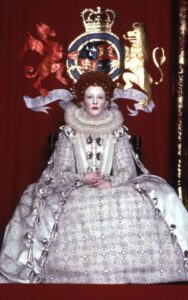
 In the final scene of Shekhar Kapur’s “Elizabeth”, starring Cate Blanchett, we see Kat Ashley cutting Elizabeth’s hair off and Elizabeth making a dramatic entrance in front of her court dressed as a bride in an elaborate white gown, pearls (which symbolise purity), a red wig, a huge ruff and a whitened face.
When Elizabeth sees her new short hair, she says to Kat, “Kat, I have become a virgin”, and when she appears at court she says to William Cecil, Lord Burghley, “Observe, Lord Burghley, I am married to England.”
It is an amazing final scene. It is incredibly dramatic and emotional and really makes you think about Elizabeth and how she changed into the iconic queen of her later portraits, the Gloriana and the Virgin Queen. In the movie, Elizabeth I is not a virgin. She has an affair with her childhood sweetheart, Robert Dudley, and so the scene at the end is about Elizabeth transforming herself by assuming this new persona and stating her commitment to England by “marrying” England. It is this new stronger Elizabeth who heralds in the country’s Golden Age. So, it is a persona rather than the real Elizabeth.
But what about the real Elizabeth? Whatever your thoughts on Elizabeth’s virgin status, it is clear that she considered herself married to her country and that she made a conscious decision not to marry – but why? Surely it was her responsibility to carry on the Tudor line, to secure the succession and to provide England with an heir, so why would Elizabeth make such a huge decision? Here are some possible reasons but please do share your thoughts in the comments section below:-
- Psychological – It is said that after Catherine Howard’s execution the 8 year old Elizabeth told her friend Robert Dudley that she would never marry. Did she decide not to marry because of what happened to her own mother, Anne Boleyn, and her stepmother, Catherine Howard?
- Mary I’s example – Elizabeth saw the damage that Mary’s marriage to Philip II did to the country. This marriage caused unrest and rebellion and it also broke Mary’s heart.
- Control – In Tudor times, a wife was expected to submit to her husband and Elizabeth, as monarch, may not have wanted to give away any control to her husband, when it was she who was responsible for the running of the country.
- Love – Elizabeth loved Robert Dudley and it may be that she chose not to marry because she could not marry her true love.
- Diplomacy – Remaining unmarried meant that she could enter marriage negotiations and play countries off against each other.
- Fear of childbirth – Two of Elizabeth’s stepmothers, Jane Seymour and Catherine Parr, had died just a few days after childbirth so was Elizabeth frightened of having children?
- Commitment to her country – Elizabeth wanted to do the best for her country and felt married to her country.
- The perfect marriage never came along – Marriage negotiations always seemed to come to nothing because of diplomatic wranglings and problems.
- Medical reasons – In my post “Elizabeth I – A Virago, Genetically Male or Simply a Strong woman?” I looked at R. Bakan’s theory that Elizabeth had testicular feminization syndrome which meant that she looked like a female and would have had female external genitalia but that the uterus and uterine tubes would have been either rudimentary or absent, and that the vagina may also have been absent. She would also have been sterile. If Elizabeth did not have a vagina then she would not have wanted anyone to know about it. I can’t credit this theory at all!
- Elizabeth was a man – I love this theory! According to The Bisley Boy legend, the real Elizabeth died in childhood and a boy took her place. Obviously, the imposter would have been discovered if “Elizabeth” had married!
Related posts:
 Robert Dudley to Marry Mary Queen of Scots?
 Elizabeth and Leicester – Bess and Robin
 The Marriage of Robert Dudley and Amy Robsart
 Elizabeth’s Women
 Elizabeth, Seymour and Shakespeare
 The Legacy of Elizabeth I
 Did They or Didn’t They?
 Elizabeth I – Queen of PR
 Elizabeth I Facts
 Did Robert Dudley Murder Amy Robsart?
 Elizabeth I’s Suitors
 Elizabeth I
I realize I’m very late to the debate, but have to laugh at the thought that Elizabeth was deformed or really a man. Lynn has it right, I think, when she says the nay-sayers were trying to ‘explain’ a queen regnant who was not just competent, but brilliant. They didn’t think women were capable and here is Elizabeth proving them wrong – so ‘obviously’ she can’t be a ‘normal’ woman! It’s just an irritatingly condescending form of misogyny.
And yes, all the examples of marriage she had observed would have put anyone off, even without the obvious drawback of sharing or losing the power to control her own country and fate. If she truly made her decision not to marry after Kathryn Howard’s death, everything after that must have just confirmed that she’d made the correct decision. After all, you don’t have to make the mistake yourself to absorb the lesson; you can watch the mistakes of others and file it away in the back of your mind not to do THAT.
Katherine Parr nearly losing her life to the mercurial whims of her husband, Elizabeth’s father, only to lose her life anyway with her next husband in a frighteningly common way for a woman then – through childbirth; that same man then wanting to be HER husband; her cousin Jane losing her life due to the actions of the men she was expected to defer to: her husband, father, and father-in-law; her sister’s disastrous and humiliating marriage; that same man then wanting to be HER husband; her cousin, Mary, QOS, and her disastrous marital history and all of the things she lost because of that… I’m finding it difficult to think why she WOULD want to marry!
Having made that decision, of course she used that to her political gain. It was brilliant of her to turn what was considered a weakness into an advantage. By dangling herself as bait to this power or that, she neatly avoided long-term ties with any of them, which ties might well have dragged England into endless and expensive wars and skirmishes. It’s really amusing to me how she used the societal expectations of how she should behave as a woman (to be a compliant wife and mother) to avoid doing exactly that by endless prevarications of exactly WHICH man she should marry, until oops, it was too late due to her age. And even then, she spins it that she made this great sacrifice for her country by not marrying, when she never wanted to marry in the first place! She was truly ahead of her time by instinctively understanding the importance and having an effortless mastery of image, PR, and spin control.
That still really does’nt help me!!?? Could you tell me what she thought of the optional options for why she liked and didnt like themm??!! Pleassee helppp mee!! :((
Poojaka,
What exactly do you need to know? You can find out more about her suitors at https://www.elizabethfiles.com/info/elizabeth-is-suitors/
Let me know what you need.
Ok in my opinion, I think she secretly wanted to end the Tudor dynasty with her. I think she saw her father as the tirant he was and the cruelty of several wives and her rise to the throne at the bottom… I think she might of just said screw it, Tudor’s have gone long enough and didn’t want any heirs fighting for her crown or turning tyrants themselves…just a theory 🙂
Like your idea Kara! If she did think that, then she was so much wiser than the rest of her relatives.
An intellectually brillant young girl surrounded by women who died as a direct result of getting married, either through losing their heads or childbirth.would seem to have every reason to want to never marry. Elizabeth was that young girl who witnessed a parade of intelligent and beautiful women destroyed by the realities of married life. Accordingly, at her coronation she put on a wedding ring and stated that she was married to England and thus would never marry a man. For almost fifty years I believed that she never married as a result of watching all of her father’s women die because they were married. I also believed that she used her unmarried status to bewitch and entice the european royal men who wanted to marry her as a means of diplomatic intrigue. I now hold a very different view, which surprises me greatly, but I think it is the answer is the result of medical knowledge discovered in the past 20 years –especially in view of the fact that Elizabeth I was a woman whose political decisions and ability orchestrate high level intrigue have long been recognized as very unique for women throughout history, until the modern era. Testicular Feminization actually fits perfectly with much of what is known about Elizabeth. People who have this syndrom often have very long fingers, are very slender and athletic, The effect of testosterone on the brain, even in only slightly higher amounts, masculinizes the brain and its thinking, and it seems that Elizabeth I had ideation more characteristic of a man than a woman — even by the standards of the modern “liberated” woman. There is some evidence that she recognized that she was ‘different’ in that she left no heir in her will, but she did specify that her body could not be examined after death. It is entirely possible that she discovered as a young woman that she had a level of which resulted in the development of a partial vagina — perhaps Dudley helped her make this discovery! By the time she was crowned she had reached an age where she may have had an intense relationship which led to the discovery. It is also possible that Thomas Seymour, with the apparent help of his wife Katherine Parr, made the discovery about a genital anomaly, afterall it is well known that his attentions were inappropriate. He was conveniently executed for his behavior toward Elizabeth, although many other reasons were also given at his indictment. The entire incident also increased Elizabeth’s experiences of the danger of marriage for women. Katharine Parr, her stepmother, in order to please her new husband, Thomas Seymour, aided and abetted his pursuit of Elizabeth, episodes of tickling, surprise visits to her bedroom and inappropriate sexualized behavior toward Elizabeth. The events were sufficiently notorious and well know amongst King’s (Elizabeth’s brother) closest ministers and the regent that Elizabeth was removed from the Parr-Seymour household for her protection. A short time late Katherine Parr died in childbirth with Seymour’s child. Seymour was then free to embark on intrigues and conspiracies with a goal of marrying Elizabeth, and of course he would have keep secret any physical anomalies he knew about in order to be able to marry her and gain power. So Elizabeth, at this time still a teenager, experienced first hand how valuable she was to an ambitious man and also how to intrigue to achieve what she wanted. Since Seymour was executed she was able to conceal any knowledge she had about her anatomy she may have discovered with him; afterall, she would not be the first or last young teenage girl to be sexually abused by a powerful male family member. The final piece of the puzzle falls into place when Elizabeth’s sister Mary married Philip of Spain who wanted to acquire England for the inexpensive price of a wife. When Mary did not conceive an heir in the first year of marriage, Philip returned to Spain abandoning her. I am sure that this lesson was not lost on a young woman about to enter her 20’s. After a return visit by Philip, Mary appeared to be pregnant, exhibiting all the typical signs of pregnancy which continued for months beyond a total of 9 months. Philip left again in disgust and Mary ended up dying, probably of an ovarian or uterine cancer. As a 23 year old woman, 25 when Mary died, Elizabeth clearly had little personal knowledge of a woman who benefited from marriage; they all had to do as their husbands wished, or ended up dying. At 25, with a superior education and intellect, Elizabeth took the throne and married England at her coronation as a means of survival. She surrounded herself with wise and loyal ministers who advised her but for the remainder of her life she never had to concede to a man and she used her marriagability and feminine wiles to keep those powerful men, her ministers and advisors, attentive and willing to please her. When she aged, she had accrued sufficient experience and power in her own right, so that as her marriagability womanly charms faded she able to continue to keep the men of her court interested in pleasing her. Her story is endlessly fascinating and a major turning point in history and culture.
Thanks for your very detailed comment. I’m afraid I don’t put much store in the testicular feminization theory. Elizabeth’s slender fingers and slender frame were inherited from her mother and I think her characteristics and attitude were down to her knowing that she had to act like a man, a King, to rule successfully. She could not be a typical submissive Tudor woman and be a good queen. I think she simply chose to be married to her country, as choosing a husband and marrying would complicate things too much, and she could also use her single status for diplomatic reasons, entering into marriage negotiations with different suitors/countries. I believe it was a choice and not something she did for medical reasons.
Sorry forsomewhat late response to this post but thisis something I gave some thought to.
I agree that part of the reason was pschological. Her mother and Katherine Howard were executed for marital troubles. As was younger Seymour for sexual advances toward her at young age. Then there were always problems elsewhere with marriages and people easily lost their heads over it or marriage sparked a revolt.
Death at childbirth.Jane Seymour and Katherine Parr were two close to her. also she saw it happen to others and it was quite common. So it’s not surprising that she would subconciously equate marriage with death.
Who to marry? Marry a Spaniard and p/o French. Marry a Franchman and p/o Spain. Marry somebody else and p/o both. Marry an Englishman coughdudleycough and have country in revolt. By staying single she kept her options openand everybody wanted to be on her good side. And she saw what foreign marriage did to her sister and her reign. Maybe she even took note that Henry’s foreign marriages were not happy ones.
Plus she enjoyed the whole courting game. Once she married it would be gone.
And don’t forget she never named a successor.The whole “who would succeed me but a king?” may or may not have happened and her rule was for all purposes over at that point anyway. She knew that a named successor would be a focal point for any plot her overthrow (specially a son). She saw this first hand with Mary and saw it happen elsewhere. and she took great care to prevent people from creating marriages that would merge several potential claimants. A husband and a child would be a threat to her rule so it makes sense she tried to avoid creating such threat.
I don’t think it was some sort of concious decission (she came close to marriege after all) but IMO she played the potential bride game to get England through rough times and keep foreigners at bay. Once that danger has passed so did her “good marriage” years and she was for practical purposes off the marriage market.
I don’t buy into whole deformity theory. She lived under lots of eyes, manyof them unfriendly. Anything like that would be discovered and trumpeted by her foreign enemies. I think this is just continuation of reasoning why Elizabeth shouldn’t have ruled. she was smart, courageous and ruledcountry well. Obviously that’s impossiblefor a woman so she had to been a man! She didn’t marry as was expected of women at that age so obviously something was wrong with her body. etc.
All the reasons listed above – from the possible, to the probable via the completely outlandish, have been long debated among historians and history lovers.
However, nobody has, yet,, thought of this one possibility: Elizabeth was probably asexual.
Asexuality is defined, by those who live it (and I am one of them), as another type of sexual orientation whereby, whilst often developing strong affections for other people, an asexual would never be interested in engaging in a physical relationship and could even be repelled by the very idea.
In the world of an asexual, sex does not occupy any place at all. i know, many sexual people find that hard to believe. Asexuals have recently ‘come out’, mostly on the web and you can find out more using Google and YouTube.
My point here is that Elizabeth had many of the behaviours that asexual people currently associate with their orientation: strong resistance to societal pressure to get married/have sex, declarations such as ‘I’d rather be a poor maid and single than queen and married’, occasional questionning of one’s orientation followed by attempts to conform…which attempts are quickly terminated (Elizabeth’s behaviour during the development of the alencon courtship follows that pattern). Some asexuals even talk of having very emotional one to one friendships of the type Elizabeth / Leicester.
Interestinlgy, I could always relate to Elizabeth’s refusal to get married and could never understand why so many people found her choice ‘strange’ and had to find explanations for it. In my mind, even long before I understood anything about my orientation, Elizabeth’s choice has always been normal and the strangeness was with those who questionned it. I know that is not a proof that Elizabeth was asexual, but it is a very strong point in favour of that theory.
She would not of course have thought of herself as ‘asexual’. The word did not exist. But, like many of us before the arrival of asexual websites, she could have been asexual witohut ever being able to understand what made her different from most people.
Also sorry for late response, but how about Elizabeth just liking power. She was Queen of England-who wouldn’t want that? As much as she bemoaned not being able to choose friends, confidents, lovers, etc, I think she, like others with power, didn’t want to give it up. The other reasons for her not marrying, what she saw her father do to 2 of his wives (including her own mother) and seeing 2 of her stepmothers die after childbirth are good justifications but I think ultimately it was being the Queen that kept her from marrying and having children. Why do you think Queen Victoria never stepped down or why the current Queen Elizabeth II hasn’t stepped down? Even though they married and had children, theirs were love matches and not necessarily done to keep the dynasty going. Elizabeth I’s wouldn’t have been-she would have to give up a lot of power and control. I think they all like(d) being Queen too much. I would too.