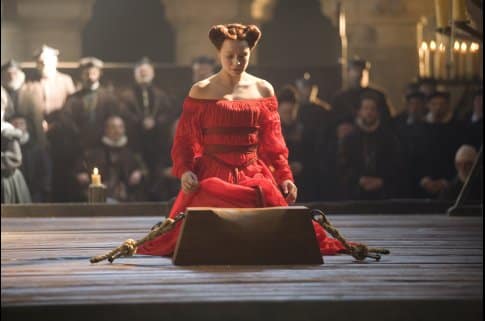
 On this day in history, 29th October 1586, four days after a commission had found Mary Queen of Scots guilty of conspiring to assassinate Elizabeth I, Parliament met to discuss her fate. It was decided that Elizabeth should be petitioned to execute Mary.
In my previous article on Mary Queen of Scots, “The Trial of Mary Queen of Scots”, I told of how Elizabeth did not sign Mary’s death warrant until the 1st February 1587 and we know that she gave orders for it not to be sent to Fotheringhay until she said so. It is clear that Elizabeth was struggling with taking such action against a fellow queen, an anointed sovereign, and a woman with Tudor blood. The idea of regicide horrified her but her Parliament were calling for action and a strong monarch always acts against those who conspire to dethrone and assassinate them. It surely would have been a sign of weakness if Elizabeth had let Mary go on plotting against her.
It seems from Elizabeth’s actions – signing the death warrant but not sending it, asking Paulet to kill Mary under the Bond of association – that she was trying to deal with Mary without taking any responsibility for what happened. As John Guy says, “She had carefully contrived things so that she would win whatever happened. If Mary was killed under the Bond of Association, Elizabeth could disclaim responsibility. If Cecil covertly sealed the warrant and sent it to Fotheringhay behind her back, she could claim she had been the victim of a court conspiracy.” But we cannot know for sure what was going through Elizabeth’s mind at that time. Elizabeth was caught between a rock and a hard place, as Alison Weir describes:-
“If she signed the warrant she would be setting a precedent for condemning an anointed queen to death, and would also be spilling the blood of her kinswoman. To do this would court the opprobroum of the whole world, and might provoke the Catholic powers to vengeful retribution. Yet, if she showed mercy, Mary would remain the focus of Catholic plotting for the rest of her life, to the great peril of Elizabeth and her kingdom. Elizabeth knew where her duty lay, but she did no want to be responsible for Mary’s death.”1
No wonder she procrastinated! What a decision to have to make and I don’t think anyone can blame her for taking her time, for refusing to bow to Parliamentary pressure and for taking steps to distance herself from what happened in the end. What else could she do?
Mary – Tragic Heroine and Martyr?
Recently, this site has been bombarded with comments (see comments on Free Report page and my article on Mary’s trial) proclaiming Mary Queen of Scots’ innocence, protesting that she was the rightful queen of England, Scotland and France, calling Elizabeth a “Killer queen”, accusing Elizabeth of framing Mary and accusing me of romanticising Elizabeth. They were hard to take seriously when that person also thought that Mary Queen of Scots was the daughter of Mary I (!), but they did make me think about how Mary has been romanticised in the past and seen as a tragic heroine and even a Catholic martyr. Even today, she is proclaimed a martyr, not just by the commenter on this site but also the the New Advent Catholic Encylopedia who say:-
“There can be no question that she died with the charity and magnanimity of a martyr; as also that her execution was due, on the part of her enemies, to hatred of the Faith.”2
and then write of how Pope Benedict XIV would have formally declared her a martyr “if only the charges connected with the names of Darnley and Bothwell could be entirely eliminated”3.
Mary saw herself as a martyr. At her execution, on the 8th February 1587, she wore a crucifix and a black gown and as she prepared herself for her beheading she took off her gown to reveal a bodice and petticoat of scarlet, the colour of martyrdom. In her final moments she was proclaiming that she was a martyr to her faith.
However, whatever Mary thought and whatever message she was sending by her garb, I don’t believe that she was a martyr, well, not in the sense that she meant.
martyr – noun (mär-tər)
- a person who voluntarily suffers death as the penalty of witnessing to and refusing to renounce a religion
- a person who sacrifices something of great value and especially life itself for the sake of principle
- victim; especially : a great or constant sufferer4
Perhaps she could be seen as a martyr according to definitions 2) and 3), but she did not died for her Catholic faith, she was executed because she plotted to kill the Queen of England. Uh oh, now I’m treading on dangerous ground with those who believe she was framed. Well, I do believe that William Cecil and Sir Francis Walsingham did all they could to bring down Mary Queen of Scots, but I don’t believe that they framed her. They set a trap and she fell into it. She gave them the evidence that they were looking for and that they needed to convince Elizabeth to get rid of her once and for all.
John Guy, in his book “Mary Queen of Scots: My Heart is My Own” explains Walsingham and Cecil’s roles in the downfall of Mary Queen of Scots brilliantly:-
“the plot [Babington plot] was not in itself a ‘projection’ [using agent provocateurs to foment conspiracies that were then conveniently ‘detected’] to frame her – it really existed; but rather than nipping it in the bud, Cecil’s spymaster allowed it to develop so that he could obtain the written evidence to put her on trial for her life”. Walsingham and Cecil let the plot continue so that Mary would ‘hang herself’ by getting involved and she did by replying to Babington who was conspiring to get Elizabeth assassinated by a group of ’six gentlemen’:-
‘The affairs being thus prepared and forces in readiness both without and within the realm, then shall it be time to set the six gentlemen to work taking order, upon the accomplishing of their design, I may be suddenly transported out of this place, and that all your forces in the same time be on the field to meet me in tarrying for the arrival of the foreign aid, which then must be hastened with all diligence.’ “5
John Guy comments that “Mary’s meaning is clear. She had consented to Elizabeth’s assassination and a foreign invasion. Strictly, she had not specified what the ‘work’ of the six gentlemen was to be, but the letter from Babbington to which she was replying included the graphic passage, ‘For the dispatch of the usurper, from the obedience of whom we are by the excommunication of her made free, there are six noble gentlemen, all my private friends, who for the zeal they bear to the Catholic cause and your Majesty’s service will undertake that tragical execution.’ When the two letters are read together, Mary’s complicity in the plot was undeniable.”6
Cecil and Walsingham did not frame Mary, they laid a trap and she condemned herself with her own words and actions. She was clearly giving her blessing and her support to Babington’s plot to assassinate Elizabeth. What’s more, Babington confessed and so did Mary’s secretaries.
The Babington Plot was not a one-off, it was not the only time that Mary had conspired against Elizabeth, and as early as 1568 she had approached Philip II to help her with her cause. She also never gave up on her claim to the English throne. Elizabeth spent two decades giving Mary the benefit of the doubt and sympathising with her, yet Mary carried on plotting. I just can’t see Mary as a tragic heroine or martyr and Elizabeth as a cold-blooded killer, however I look at the situation.
What do you think?
Please share your thoughts in comments below – thank you!
Notes and Sources
- “Elizabeth, the Queen”, Alison Weir, p375
- Mary Queen of Scots, New Advent Catholic Encyclopedia
- Ibid.
- Merriam-Webster
- My Heart is My Own: The Life of Mary Queen of Scots, John Guy, p483.
- Ibid.
Related posts:
 The Trial of Mary Queen of Scots
 Mary Queen of Scots – Part One
8 February 1587 – Mary Queen of Scots is Executed
Mary, Queen of Scots – 8th December 1542
Mary Queen of Scots – Part One
8 February 1587 – Mary Queen of Scots is Executed
Mary, Queen of Scots – 8th December 1542
 The Execution of Mary Queen of Scots – 8th February 1587
 Mary Queen of Scots – Part Two
 Mary Queen of Scots Lands in Scotland
 24 April 1558 – Mary Queen of Scots Marries the Dauphin
8 February 1587 – The Execution of Mary, Queen of Scots
Mary Queen of Scots
Mary Queen of Scots Marries Lord Darnley
24 April 1558 – Mary Queen of Scots Marries the Dauphin
8 February 1587 – The Execution of Mary, Queen of Scots
Mary Queen of Scots
Mary Queen of Scots Marries Lord Darnley
 Robert Dudley to Marry Mary Queen of Scots?
Personally, I think Mary was innocent. She didn’t really have the brains to plan or carry out any kind of complex conspiracy. She didn’t really have the brains to know to stay away from active conspirators, either.
Before anyone gets on me about the “didn’t really have the brains” comments consider this – I do know she was well educated, and spoke however many languages. But look at how she spent her life, once she left France to take up her duties as Queen of Scotland.
She was a very ineffectual Queen Regnant – Darnley was unpopular, and her nobles were just about, one and all, against the marriage. She married him anyway, and reaped all of the pains of marrying such a man, not just in terms of her personal misery, but in what it cost her as a monarch. It was well known she wanted to get rid of him, and someone did, though whether that was Bothwell is debatable. Then she gets together with Bothwell, the prime suspect in her unpopular husband’s murder, (whom she pardoned!) is allegedly raped by him, but marries him anyway. Then she is captured, and forced to abdicate in her infant son’s favor.
That doesn’t sound terribly intelligent.
Mary then escapes to England, making it known she considered herself the rightful Queen of England, and becomes a “permanent guest” of Elizabeth I. Then she agrees to participate in plot after plot against the royal hostess who was keeping her from possibly being executed by her own nobles.
Mary was raised in France to be Queen Consort – that is, the wife of a monarch, and she served in such a capacity as wife to Francis II. She was NOT prepared for the realities of being Queen Regnant of Scotland, and she was no match for Elizabeth in terms of intelligence and doing what needed to be done as a true Queen in her own right.
Ignorance is no excuse when letter-writing and making seditious overtures – and as for a supposed lack of brain-power, Mary Queen of Scots represents, in my mind, the fulfillment of that old observation, crazy as a fox. Stupidity is one thing, arrogance quite another – and if nothing else, Mary definitely displayed signs of a full-blown superiority complex. My verdict: guilty as charged. And probably mentally imbalanced, to boot. Pity her, perhaps – acquit her, never.
When you look at how masses of people romanticize drug-addicted rock stars, hard-core felons in prison, and any number of other less-than-admirable individuals, it’s no wonder that those with Catholic sympathies, in particular, would turn the self-absorbed, easily swayed, religiously fanatical, and sexually undisciplined Mary Queen of Scots into an icon of romantic illusion — simply because she was executed. When someone has that kind of mythological mindset, no amount of facts will convince him or her. Thanks for the solid, balanced research and writing you provide.
Mary should have been treated better for whom she was. Instead of Elilzabeth keeping her here and then there and moved her yet again and all the places were, well shall we say, not up to the norm for her station. Instead she should have had Mary brought to London and of time had one on one conversations with her. She could have put her under house arrest in say, somerset house on the Strand. Maybe the two women could have become better friends and with Mary spending more time with the Queen she would of had less time on her hands listening to others who were crowding her mind with who knows what causing her to think eventually alone their lines of thought. I think Mary was not a very strong person when it came to making opinions. At least not strong enough to really think them out before making them verbal. Many of her action even back in Scotland were sort of on the spur of the moment? I agree with Claire, she was not a martyr….just a confused, spoiled woman, who made a habit of making the wrong decisions. I still believe if the two women had gotten together and spent time together one on one, things would have been different.
It is interesting to speculate about how history might have been different if these two women hat met in the flesh. I think it might have made it even more difficult for Elizabeth to have executed her, especially if Mary worked her famous ‘charm’ on Elizabeth and gave her proper respect. However, from what I’ve read of Mary’s character, she just as easily could have been haughty and arrogant in a personal meeting with Elizabeth and made Elizabeth’s decision easier! As it was, I think Mary had been raised to think of herself as royal and all that implies. She probably felt she had a better claim than Elizabeth, given Elizabeth’s notorious mother and the fact that Elizabeth was legally a bastard. I don’t believe Mary would ever have given up on trying to take Elizabeth’s throne. She wanted a queenship, thought she deserved one and was willing to take her chances. Her romantic behavior shows she was quite the risk-taker so why not in politics, too. I think she was guilty and her conintued plotting left Elizabeth little choice.
Jane Dunn wrote a great comparitive book on Elizabeth and Mary. Even after reading it, my opinion of Mary did not change. I find her frivolous, arrogant, and out of touch with the social and religious changes happening in Scotland. While Elizabeth can be faulted for many things during her reign, executing Mary is not one of them. Mary would never have stopped trying to upsurp Elizabeth’s throne. Elizabeth of all people should know the dangers associated with potential rival claimants to the throne a la her own grandfather.
I’ve never seen the lure or charm of Mary, or any of the Staurts of that matter. Mary is romaticizied for how her life ended, rather than based upon a serious examination of the facts. Yes, it is sad for anyone’s life to end in bloodshed, but that is my 21st century mentality speaking. I try to position my opinion of figures in the confines of their historical era, not based upon my own viserceral reactions to events.
I agree with Claire here
The penalty for treason in Tudor times was beheading if you were of noble birth – Mary would have known this
It is tragic and horrific that she suffered though in her final moments, no wonder Elizabeth’s mother Anne Boleyn requested to be dispatached by a sword, much quicker
As a born again Christian myself, I see Mary’s death as tragic and unnecessary. While she did plot against Elizabeth more than once, and she was deserving of her imprisonment, she did not succeed in murdering Elizabeth so did not deserve the death penalty. I understand the Machiavellian* principles of governing of that day, but those principles were in direct opposition to the teachings of Christ and the Bible.
If Elizabeth had followed the guidelines of the Bible she would have been protected by God, I believe. Elizabeth was trying to calm her country down regarding these murderous persecutions for one’s faith and I respect her for that. But she should have stayed with it. She should have continued to keep Mary under lock and key for her crimes and sought God’s protection while doing His will and not executing her.
Mary, on the other hand, was being used by others to gain control over England. She, too should have followed her own faith. The Christ of the Bible proclaimed the same teachings in the Catholic faith as He did in the Protestant faith. She was guilty of plotting against the Queen of England … which was also in opposition to the Bible which states clearly that those in government are placed there by God and we should be submissive to their authority. (Of course, not forgetting that God’s authority is higher than any earthly authority.)
Both were guilty of breaking Biblical principles however, I favor Elizabeth in that she did try to spare Mary. I wonder what would have happened if Mary had tried to really be a loyal subject to Elizabeth? How might the story be different as well as the ending? The Catholic faction might still have continued to plot and scheme against Elizabeth and if they succeeded in assassinating would they have forced Mary to the throne? Would God have protected Elizabeth because she stood against the powers of the day and stood up for God’s Word? I believe He would have. Just as I believe He did save England from the Spanish Armada. The light of the Reformation was going to succeed because it was driven by God.
*Definition of Machiavellian “Attempting to achieve their goals by cunning, scheming, and unscrupulous methods; Related to the philosophical system of Niccolò Machiavelli.”
I’ve never understood the romaticising of Mary Queen of Scots. From the facts, it’s an inescapable conclusion that to judge the best she was an incredibly foolish woman and to judge the worst an adulteress and a murderess.
I agree with Candice that Jane Dunn’s book is excellent. It really demonstrates how Mary’s privileged and pampered upbringing prepared her for nothing but the life of a queen consort, whereas Elizabeth’s struggle for survival was the perfect training for a queen regnant.
I don’t think Elizabeth ever dared bring Mary to the south where she would have become a magnet for plotters and malcontents. She may have remembered her own journey from London to house arrest at Woodstock where all the common people took her to their hearts and brought her flowers and gifts. She could not have allowed Mary to do anything similar. Nor would she have wanted to take her court into Mary’s orbit in the north.
I don’t think she had much choice about the execution. There was nothing else she could have done.
I can understand how Mary could drive anyone nuts. She returns to Scotland and makes one bad decision after another, until finally she has to leave the country. And then she plots with others to try to take Elizabeth’s crown. Certainly not the behavior of a guest. Too bad she couldn’t be shipped off to America! I don’t think Elizabeth had any choice but to get rid of her. Who wants to keep a constant threat around?