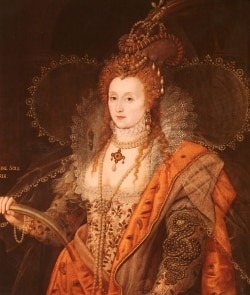
 As promised, I want to share with you what was said in last night’s Channel Five “Revealed” programme, “The Virgin Queen’s Fatal Affair”. I wrote copious notes so that I didn’t miss anything and I have divided the different topics into sections so that it is easy for you to take in.
The programme featured the following experts:-
- Philippa Gregory, author of many historical novels including “The Virgin’s Lover”
- Tracy Borman, historian and author of “Elizabeth’s Women”
- Sarah Gristwood, historian and author of “Elizabeth and Leicester”
- Steven Gunn, historian
- Chris Skidmore, historian
- Edward Impey, archaeologist
- Dominic Taylor, architect
- Allen Anscombe, forensic pathologist
- Simon Adams, historian and author of “Leicester and the Court”
The Implications of Amy’s Death
Both at the start and end of the programme, it was suggested that Amy Robsart’s death changed the course of English history because it made Elizabeth into the Virgin Queen. As a result of Amy’s death, Elizabeth did not marry and the Tudor dynasty was brought to an end.
Elizabeth and Dudley’s Relationship
Sarah Gristwood spoke of how Elizabeth made Robert Dudley her Master of the Horse when she came to the throne and that this meant that he was in charge of all the fun things and that when he arrived to see her it was always with “an invitation to play”.
It was suggested that Dudley was Elizabeth’s “surrogate” husband and that in the first two years of her reign Elizabeth was besotted with him. She arranged for him to have a bedchamber next to hers, she spent all of her time with him and this led to scandal and rumour. Dudley was seen as a poor choice and a unsuitable consort because both his father and grandfather were executed as traitors, and William Cecil thought that England would face a very dark future if Elizabeth was to marry Dudley. Also, Dudley was married to Amy Robsart.
Dark Whispers
In 1560 there were “dark whispers” at Court. In March 1560 it was rumoured that Dudley was going to divorce his 28 year old wife, who he had not seen for over a year, and William Cecil told of how Elizabeth and Dudley were trying to get rid of Amy. By September 1560, the Court was alive with rumours, Elizabeth seemed so obsessed with Dudley that she was seen to be abandoning her country, Dudley was gaining power and influence, and William Cecil was at his wit’s end. Cecil told the Spanish ambassador that he saw ruin for the Queen if she continued the way she was going.
The Death of Amy Robsart
Amy Robsart died on the 8th September 1560 at the house she was renting in Oxfordshire, Cumnor Place. She was found dead at the foot of the stairs. According to the programme, her death had all of the ingredients of an Agatha Christie thriller and it was used in Walter Scott’s 1821 romantic novel, Kenilworth, where Amy is murdered by Dudley’s steward, Sir Richard Varney. At the time, at the inquest into Amy’s death, the coroner ruled that her death was down to “misfortune”, an accident .
The Stairs
Cumnor Place was pulled down in 1810 so the stairs that Amy was said to have fallen down no longer exist. However, archaeologist Edward Impey was able to build a model of Cumnor Place based on old drawings and plans and concluded that Amy must have lodged in the Great Chamber. Architect Dominic Taylor made a 3D model of the staircase shown in an old plan of this part of the house and concluded that although it was a dangerous staircase, in that it twisted half-way down at a landing, a wall would have stopped Amy from falling right down to the bottom. Also, statistics of falls on staircases show that a healthy young woman would have been unlikely to have died in such an accident.
But was Amy healthy?
Was Amy Dying?
There have been suggestions that Amy had terminal breast cancer and was dying in 1560. Philippa Gregory mentioned the theory that I have discussed already here on the Elizabeth Files, that of Professor Ian Aird who suggests that Amy may have died from a spontaneous break of her neck due to secondary deposits in her bones and that is why she fell.
The case for Amy having cancer is based on a remark by de Feria that she had “a malady in one her breasts”, a comment by Robert Dudley about how within six months his position would be much changed and remarks made by Elizabeth I about how Amy was dying. However, Chris Skidmore rejects the idea that Amy was dying. He spoke of how Amy moved from house to house in the last two years of her life, something that an ill woman just would not do, and forensic pathologist Allen Anscombe called the thinning bone theory no more than speculation and did not agree with it. Sarah Gristwood examined a letter at Longleat, a letter written by Amy to her tailor just a fortnight before her death, in which she asks him to make a new collar for a dress. Gristwood wonders if Amy was ordering it because she was expecting to be reunited with her husband when he visited nearby Windsor.
Dudley’s Reaction to Amy’s Death
Robert Dudley’s reaction to his wife’s death was discussed. All agreed that the news of Any’s death was a blow to Dudley and that his letters to his steward, Thomas Blount, show his astonishment and consternation. He immediately ordered an investigation into Amy’s death and sent Blount to Cumnor. Her funeral cost Dudley the equivalent of £100,000 but he did not attend her funeral. Apparently, the vicar at Amy’s funeral added to the scandal by mentioning that Amy had been pitifully murdered!
The Investigation
Thomas Blount rode to Cumnor Place and launched an investigation into Amy’s death. He questioned the servants and found that Amy was alone when she had died. According to her maid, Mrs Picto, Amy had been in an angry mood that day, and had demanded that her servants leave her alone and that they attend the local fair. Sarah Gristwood mentioned how odd this was. She spoke of how wanting the house to yourself is a very modern idea and that in Tudor times there were always servants around so Amy’s behaviour was very strange. Mrs Picto also spoke of how Amy had been praying daily on her knees for God to deliver her from her situation. Although this suggests that Amy may have been suicidal, it was pointed out that suicide was unthinkable for a Tudor woman, that Amy had just sent off to have a dress altered and that the staircase was unsuitable for committing suicide.
It was concluded that an accident was improbable, that suicide did not fit the facts so, therefore, Amy must have been murdered.
The Coroner’s Report
The original coroner’s report into Amy’s death was found by Steven Gunn when he was searching the archives of Tudor accidents. The report states that Amy had a broken neck, that her hood and clothing were intact and that she had two head wounds. The head wounds were described as “dyntes” which are usually used to describes blows like those of a sword in battle, and they were recorded as being 1/2 a thumb length deep and two thumb lengths deep. Allen Anscombe, the forensic pathologist, felt that these wounds were more like puncture wounds caused by a mace, spear or halberd, and that if he saw these types of head injuries today he would ask the police to launch a full scale murder enquiry.
Whodunnit?
But, if it was murder, who killed Amy? The programme examined the following suspects:-
Robert Dudley
Although, at first glance, it seemed that Dudley had the most to gain from his wife’s death and therefore was the most likely killer, there is evidence in his defence – his reaction to Amy’s death, his letters to Blount, his desire for a full investigation.
Dudley’s Henchmen
Could Dudley’s henchmen have taken matters into their own hands and killed Amy for Dudley so that he could marry Elizabeth?
A contemporary account in the British Library describes how Sir Richard Verney, a retainer of Dudley, was in Cumnor on the day that Amy died and that he arranged her death. However, the programme asked if Dudley would really have tolerated one of his servants killing Amy and suggested that Dudley would have cleared his own name and stopped all of the scandal and rumour by bringing his servant to justice.
At this point, the programme asked “who would Amy clear the house of servants for?” and it was suggested that Amy would make sure the house was empty and that she was alone if she was asked to do so by her husband, her Queen or William Cecil.
Elizabeth I
Tracy Borman spoke of Elizabeth’s fiery temper and the way that she could lash out at people in anger, such as stabbing one lady in the back of the hand with a fork and breaking the finger of another lady when she married without the Queen’s permission. It was also pointed out that, according to a letter written from the Spanish ambassador to Philip II, Elizabeth had spoken of how Amy was dead or nearly so before news of Amy’s accident had reached court. Did Elizabeth know something? However, Borman argued that Elizabeth was too much of a pragmatist to involve herself in murder and that also the secret would have eventually come out.
William Cecil
Philippa Gregory spoke of her belief that William Cecil was involved in Amy’s death, that he benefited most from her death and that he made the connection between Amy’s death, Dudley’s reputation and the impossibility of Elizabeth marrying Dudley. It was pointed out that Amy’s death prevented Dudley and Elizabeth marrying and that before Amy’s death Cecil had been close to resigning but after her death his career soared. However, Chris Skidmore said that he’s not sure that William Cecil would have taken the risk of making Dudley a widower.
Kenilworth
Even though Amy’s death caused scandal and Dudley suffered as a result, he did not give up wooing Elizabeth. In 1575 he entertained the Queen at Kenilworth Castle with lavish pageants and displays, which Shakespeare alludes to in “Midsummer Night’s Dream”, and Sarah Gristwood spoke of this being “his last throw of the dice”. However, all of it was wasted on Elizabeth.
The Virgin Queen
The programme concluded by saying that Amy’s death prevented Elizabeth marrying Dudley and that it caused Elizabeth to become “The Virgin Queen”. Amy’s death, therefore, changed the course of history and ended the Tudor dynasty.
Amy’s Tomb
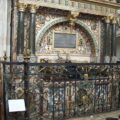
The programme ended with Chris Skidmore visiting Amy Robsart’s tomb in a corner of Oxford’s University Church. This is actually a memorial tablet rather than Amy’s tomb as it is not known exactly where in the church her body lies. In his article, “The Death of Amy Robsart”, Professor Ian Aird wrote:-
“The exact site of Amy’s grave has never been known, though in the contemporary account it was said to
have been at the east end of the church of St. Mary the Virgin in Oxford. In November 1946, after a fire in that church, it became necessary to re-lay the whole of the pavement of the chancel, and opportunity was then taken of exploring the area where Amy Robsart’s grave might have been expected to be. It was discovered, however, that all the area had been dug over subsequent to her burial, and some vaults of a later date were discovered, one of them, incidentally, being that of Cardinal Newman’s mother. The disturbance of the soil down to a depth of about six feet was very great and bones and soil were so intermingled and in such complete disorder that if there had been a grave in the area all trace of it was lost, destroyed by the previous disturbance. There is thus no hope now of recovering Amy Robsart’s remains and of observing the kind of broken neck which caused her death.”
My Thoughts
I cannot say that I was convinced by any of the arguments put forward by the programme as to me it just seemed like speculation and there really was no new evidence brought to light. I’ve always been torn between three theories – accident, suicide and murder by an unknown person – and I still am. Amy’s behaviour leading up to her death suggests suicide, although her faith may have prevented her from actually doing so, and the two deep head wounds suggest murder, however, I have not seen the coroner’s report and so find it difficult to come to a conclusion. What I am sure of is that Robert Dudley, Elizabeth I and William Cecil had nothing to do with her death.
What do you think?
Related posts:
 8th September 1560 – Death of Amy Robsart
Did Robert Dudley Murder Amy Robsart?
8th September 1560 – Death of Amy Robsart
Did Robert Dudley Murder Amy Robsart?
 The Marriage of Robert Dudley and Amy Robsart
8 September 1560 – The Mysterious Death of Amy Robsart
The Marriage of Robert Dudley and Amy Robsart
8 September 1560 – The Mysterious Death of Amy Robsart
 Update on “Did Robert Dudley Murder Amy Robsart?”
 A Response to “Did Robert Dudley Murder Amy Robsart?”
 Robert Dudley to Marry Mary Queen of Scots?
 In Memory of Two Top Tudor Men
The Virgin Queen’s Fatal Affair: Revealed
In Memory of Two Top Tudor Men
The Virgin Queen’s Fatal Affair: Revealed
 4 September 1588 – Death of Robert Dudley, Earl of Leicester
 The Arthur Dudley Myth
Did They or Didn’t They?
The Arthur Dudley Myth
Did They or Didn’t They?
There are two odd elements to the story: (1) Amy’s extraordinary demand to be left alone in the house, and (2) her repeated prayers for deliverance from her situation. I suspect that she had a boyfriend who was to visit her in the absence of the servants, and that she told him that she had decided (after weeks of fervent prayer) to break off the relationship. He flew into a rage and murdered her and then rode off, leaving nothing to connect him with the crime. I concur with those who claim that neither Robert Dudley, nor Elizabeth could have risked being unmasked as the author of Amy’s murder, and as for Cecil, the last thing he would have wanted was for Dudley to be widowed and thus free to marry Elizabth. My verdict? Murder by a person unknown who will always remain so.
Thank you so much, Claire, for giving this deatailed overview!! Of course, I’ve got to make a few points regarding the programme for the moment …
# The coroner’s report certainly does NOT mention anything about Amy’s hood or her dress, let alone they were unmoved. This perennial detail WAS FIRST MENTIONED EVER in the satire “Leicester’s Commonwealth”, 1584, where it also says she was buried several times, and that the inquest’s finding was MURDER.
#Robert’s alleged remaek that he would be free if he live a year, as well as divorce rumours are mentioned in one single dispatch by de Quadra. De Quadra and von Brüner were agressively promoting Elizabeth’s marriage to the Archduke Charles and wishing Dudley to hell. This is a recurrent theme in their dispatches, especially the German’s. He was actively hoping for Robert’s murder or execution, as he deserves — many months before Amy’s death.
#The report on Verney is not contemporary, but near-contemporary. It was written between two years after Amy’s death — but AFTER THE EVENT. It gives useful anti-Dudley gossip but nothing else. The writer says himself he didn’t recognize Dudley at court, so he didn’t know him . The author is extremely anti-Dudley throughout his chronicle and an old follower of the Duke of Somerset, the rival of Robert’s father, the Duke of Northumberland. It is by no means a disintereted news report
#The stairs presented in Skidmore’s book as those being reconstructable from an 18th century sketch are those leading to a gallery over the hall. They are NOT those leading to the room where the archaeologists thimk Amy had here “Great Chamber” . These are a completely different part of the house, quite a distance away from the hall/galllery part. The coroner’s report specifically say that she fell down stairs ADJOINING a “certain chamber”, not a gallery. WE CANNOT RECONSTRUCT the nature of this staircase.
#There was as FULL a murder inquiry at the time as was then possible, not only did Robert press for one, but the jury took their time and had started immediately after the event, before Blount arrived at the scene.
#De Feria’s words in the Spanish original are: “esta muy mala de un pecho”. “she is VERY ill in one brest.”
Perhaps a one or two things more later. Pleas, what did Dr. Simon Adams say in the programme, Claire, I’d really like to know. He is by far the best historian from those mentioned, as well on Robert as on Elizabeth generally!
I’m torn myself, but I’m most inclined to believe it was an accident.
I wonder, though, if maybe Amy had become fed up with her husband’s lack of attention and had decided to take a lover of her own. If she was expecting a visit from a lover, that would explain her ordering everyone out of the house. Perhaps she and her lover got into a quarrel and he pushed her? Or alternatively, perhaps someone hoping to become her lover had begged to see her in private, and when she refused his advances, he pushed her? Getting rather gothic here, I know!
Alan and Susan,
It’s interesting that you’ve both come up with that theory and it is one that the historians have not mentioned. Alan, I too find it interesting that Amy wanted to be left by herself and that she had been praying so fervently for deliverance. It makes me wonder if Mrs Odingsells, the servant who remained behind, had something to do with Amy’s death, perhaps Amy asked her to help her die and Mrs O wanted to help her mistress. Who knows??!!
Christine,
I’ve requested a copy of the coroner’s report from the National Archives as I want to see myself, although I’m not sure whether I’ll be able to understand it! It’s interesting, worrying and very misleading that they’re confusing the coroner’s report with “Leicester’s Commonwealth”!
As with reports made by Chapuys about Anne Boleyn, we have to be very careful in how we read ambassadors’ reports as they are often ‘gossippy”, so I agree with you, although I think that if Dudley and Elizabeth made these comments then they could simply be referring to the fact that Amy was terminally ill.
Verney – Yes, sounds like propaganda, gossip and tabloid journalism to me.
The wrong staircase! That makes me see red because they had the archaeologist saying that Amy must have been lodged in the Great Chamber and then, from what you say, they then reconstructed a completely different staircase. Grrr!!
From Blount’s letters, Dudley sounds very emotional, upset and determined to get to the bottom of what happened to his wife and I agree with you about the murder enquiry. With all the scandal surrounding Amy’s death, the jury and coroner had to do their jobs properly.
I live in Spain and can confirm that “esta muy mala de un pecho” means “she is VERY ill in one breast.” I can only read that as Amy having a tumour in one of her breasts.
I’ve just looked at my notes from last night and the only thing I have actually noted as Simon Adams saying is that Amy’s death was evidently a blow for Amy, that he was very emotional and that there was “something slightly forensic about his approach to it.”
He did come across as someone who was a real academic and knew what he was talking about.
Just a few more observations:
#It was unusual that she sent her servants away, but this point has always been overstressed by far: No where it says she was alone therefore in the house. Forster and his wife had children and servants, and she dined with Mrs. Odingsells, and Mrs. Owen was also there, plus their respective servants. Now, she did have her part of the house, of course. But I regularly come upon other instances of Tudor people being alone with themselves: E.g., Dr. Richard Master wrote to Cecil on 5 March 1575 about his visit to the Queen: “havyng her majestie thys mornyng in the chamber at the aleris ande next to the grene, sytyng alone, …. Then sche akyng, and beyng answeryd of me, how was in the next chamber she cauleth my Lord of Leyter and tellythe hym al.” It is clear from the long letteron a very ordinary day that there was no-one there except Leicester in the adjoining room (no ladies etc.). (Alan Nelson, “Monstrous Adversary: The Life of Edward de Vere, 17th Earl of Oxford”, Liverpool UP, p. 122)
#Statistically unlikely to have been an accident. That’s, frankly, ridiculous. I’ve some experience with an emergency clinic, and stair falls are one of the most common occurrences (including very serious ones). An eight-year-old girl died not that long ago. Age is not a very significant parameter. I’ve also seen many, many accident reports (and U.K. coroner’s cases about fatal stair falls) on the web, plus studies by French and German pathologists about research into statistical methods to distinguish between falls and blows (homicides). The results are everything else then conclusively pointing to murder, rather the contrary. The coroner’s report gives not many details, so accident is still a very plausible option.
#No two pathologists will ever agree on anything. You could see that the Charite Berlin, when the chief pathologist and his former colleague (both professors of international standing) had entirely differring views on the death cause of Rosa Luxemburg (and a possible body of hers).
#It would be interseting what historians would conclude if Robert, rather than Amy, would have died then. There apparently were rumours that he was sending her poison, but there were many more stories that HE would be assassinated. He wore light armour for protection and there were some real plans to kill him, including by the Swedish ambassador. I could easily prove, using the methods of this TV programme, that Elizabeth and Robert were married secretly, that they had children, and so forth. You can prove everything if you choose your ambassadors and rumours well!
The Conde de Feria, btw, was the husband of Jane Dormer, who in turn was the niece of Sir Henry Sidney, Robert Dudley’s brother-in-law and close friend. Feria wrote before any plans for Elizabeth to marry the Archduke. When he wrote Amy was very ill, had he private information? He is, on the other hand, not the only one to write that she had serious health problems, the neutral Venetian is another, and there a quite a number of further hints.
#MOST IMPORTANTLY: If Amy was NOT ILL, why was she murdered IN HER OWN HOUSE. If a Dudley dependant wanted to profit by her death, then why didn’t he meet her at the fair, the neighbouring parish church, the beautiful garden behind the house, the chase behind the house, … best, in another village altogether. She did not travel in her last nine months or more, btw. If she was ill then there was no (urgent) motive to murder her on her husband’s behalf. Verney was her former host, so why didn’t he kill her then at his own house (she stood in the way of her husband’s career then as well)?
It was broad daylight, the house was a larger complex with other people in there, the parish church was nearby, it is unlikely that the plaza before the house would have been entirely abandoned, but no-one was seen leaving the house, at least according to the gossipy “chronicle-report”.
Thanks, Claire for responding! I can most warmly recommend Adams, he is scheduled to publish “Elizabeth I” in the Yale English Monarch series next year. I am really looking forward to this, although I’m afraid it has been postponed several times already… May I correct my transliteration of the letter to Cecil, sorry: it should be:
“havyng her majestie thys mornyng in the chamber at the galeris ende next to the grene, sytyng alone, …. Then sche askyng, and beyng answeryd of me, how was in the next chamber she cauleth my Lord of Leyter and tellythe hym al.”
Christine, you need to write a book about this or we need to make a TV programme!
I do find it interesting that they didn’t mention Mrs Odingsells, Amy wasn’t really home alone at all so any assassin would have been taking a huge risk unless Mrs O was in on it.
I did find the whole “statistics” thing a bit weird as we all know that you can died from the smallest of falls and in completely freak accidents.
I agree with you about the pathologists and I just wish we had Amy’s skull to examine, I’ve always wanted to be a CSI!! I kept saying to Tim, my husband, while we were watching the programme that you can find experts to back up any opinion and why should be believe that pathologist over Professor Aird for example?
I’m not sure why Skidmore was so quick to reject the cancer theory and to paint Amy as a normal, healthy woman. Surely there is more evidence that Amy was ill and the fact that she was praying daily for deliverance makes me think that she was in constant pain.
Regarding the whole moving about, I thought Skidmore was looking at the issue with 21st century eyes when he said that a terminally ill woman would not have wanted to move house so much, perhaps Amy did not have any choice in it, she did not have a proper home.
Yes, it would surely have been easier to kill Amy at some other time and somewhere else.
Thank you, Christine, I’m going to look into some of his articles on Elizabeth and Dudley.
I did not think that the programme came up with any real new insights. I have never believed that Robert killed his wife and nothing has been said to change my opinion..Unless some genuinely new information comes to light, I think that this is always going to remain a mystery. I do think that that is a very interesting theory that Amy might have been seeing somebody else and one that I have never heard any historian come up with, although it does sound plausible.