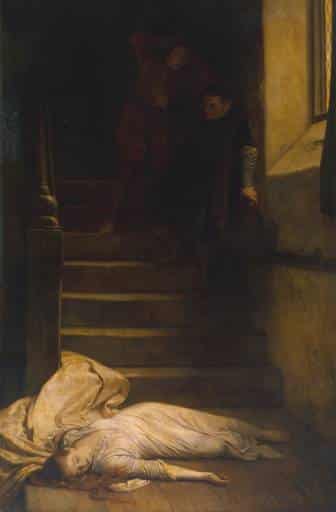
According to a report in yesterday’s “Daily Mail”, entitled “Did Elizabeth I’s lover have wife killed so he could wed the Virgin Queen?”, new evidence has been uncovered which supports the theory that Robert Dudley arranged the murder of his wife, Amy Dudley (nee Robsart), so that he was free to marry Elizabeth I.
Amy’s Death
Amy Dudley’s body was found at the foot of the stairs of Cumnor Place in Oxfordshire, on the 8th September 1560. She had been suffering with a “malady in her breast” (breast cancer) and was thought to be dying and Alison Weir, in “Elizabeth, the Queen”, writes of how it is known that Amy was suffering from depression in early September 1560. Weir’s sources for Amy’s depression include a statement from Amy’s maid, saying that she had heard Amy “pray to God to deliver her from desperation”, and the “Leycester’s Commonwealth” tract which tells of how the Cumnor Place household were so concerned that Lady Dudley was “sad and heavy” that they wanted a doctor to prescribe medicine for her.
Whatever, the state of Amy’s health and mind, she was found dead by her servants when they returned from “Our Lady’s Fair” at Abingdon and at the inquest the coroner ruled that Amy’s death was an accident.
New Evidence
Alison Weir writes of how Alvaro de Quadra reported on the 11th September that Elizabeth I had ordered that the news of Amy’s death should be made public, that it was attributed to accidental causes and that Elizabeth had said that Amy had broken her neck and “must have fallen down a staircase”. However, the original coroner’s report had been found and it does not mention a broken neck!
Historian Steven Gunn, a lecturer at Oxford University, found the coroner’s report in the National Archives while searching through 16th century accident records. According to the report, Amy’s head had two deep wounds caused by two impacts and even though there were no signs of other injuries, whcih one would expect if Amy fell down a flight of stairs, the coroner ruled that Amy’s death was the result of “misfortune”. Gunn copied this report to historian Chris Skidmore who reveals it in his new book “Death and the Virgin” (released on the 25th February 2010), and is quoted in the Sunday Times newspaper as saying “At the very least it [the coroner’s report] casts doubt on the accident theory”.
Did Dudley Blackmail the Jurors?
Skidmore has also uncovered evidence to suggest that Robert Dudley may have attempted to “nobble” jurors to cover up Amy’s supsicious death and that household accounts show that Dudley gave Robert Smith, a courtier and foreman of the inquest jury, several yards of velvet and black taffeta to make clothes. Skidmore also reveals how Dudley asked that the jury be made up of “discreet” men, that one member of the jury (John Stevenson) was employed by Dudley and that Dudley also paid Anthony Forster, owner of Cumnor Place where Amy died, £310 (around £65,000 in today’s money) shortly after Amy’s death.
Gossip Surrounding Amy, Dudley and the Virgin Queen
Robert Dudley had married Amy Robsart, the daughter of Sir John Robsart, in 1550 and it was said to be a love match and what William Cecil described as “a carnal marriage, begun for pleasure”, rather than an arranged marriage. However, Robert Dudley had always been close to Elizabeth I, having known her since childhood and it is thought that their shared experience of being imprisoned in the Tower of London and Dudley’s time at court, away from his wife, brought the two of them closer and drove Robert and Amy apart. As Master of the Horse, Dudley saw Elizabeth on a daily basis and it was not long before there was gossip about Dudley and Elizabeth, and how much she favoured him.
On the 18th April 1559, the Count de Feria, wrote:-
“During the last few days, Lord Robert has come so much into favour that he does whatever he likes with affairs. It is even said that Her Majesty visits him in his chamber day and night. People talk of this freely that they go so far as to say that his wife has a malady in one of her breasts, and that the Queen is only waiting for her to die to marry Lord Robert”
and there were also rumours that Dudley had “sent to poison his wife” (de Quadra) and in early 1560 de Quadra wrote of how Dudley was planning to divorce his wife so that he could be Elizabeth’s consort.
There were also rumours that the Queen had had children by Dudley and a man named Henry Hawkins was punished for saying that “My Lord Robert hath five children by the Queen, and she never goeth on progress but to be delivered.”
However silly or unfounded these rumours, one can only imagine the distress caused to Amy Dudley. Even though she was away from court she must have heard some of these rumours and she must have worried at the closeness shared by her husband and the Queen. No wonder she was described as “sad and heavy” in the late summer of 1560, she was dying and her husband was living it up at court with another woman. Did she believe that her husband was just waiting for her to die?
Theories on Amy’s Death
- Accident – Alison Weir mentions the theory of Professor Ian Aird from 1956, in which he suggests that Amy’s death could have been an accident caused by a spontaneous fracture of the vertebrae as she walked down the stairs. Professor Aird bases this theory on the fact that breast cancer can cause a weakening of the bones.
- Suicide – On the day of her death, Amy ordered all of her servants out of the house, giving them permission to go to Abingdon’s “Our Lady’s Fair” for the day. When some of them protested that it was not “fitting” to go to a fair on a Sunday, Amy was said to have been quite sharp with them, asking them to obey her orders. A Mrs Odingsells refused to go, much to Amy’s displeasure, but Mrs Odingsells did eventually retire to her room, leaving Amy alone. Did Amy arrange to be alone so that she could commit suicide, after all, she was said to be very depressed? Amy’s maid said that she wondered if Amy “might have an evil toy in her mind”, in other words suicide.
In those days, it was believed that suicide was a mortal sin, one that led to eternal damnation, so would Amy have risked her soul to shorten her life? Who knows? Perhaps if she was in enough pain and distress, and felt abandoned by her husband. - Murder arranged by her husband – Did Robert Dudley get rid of Amy so that he could marry Elizabeth? See above for Chris Skidmore’s evidence.
- Murder arranged by William Cecil – This is a theory put forward by Alison Weir. On p108 of my paperback version of “Elizabeth, the Queen”, Weir says:- “One man did profit from the death of Amy Dudley, and that was William Cecil. He was swiftly restored to favour as soon as the news was known and his rival banished from the court, and when he visited Dudley at Kew he did so in the comfortable knowledge that their positions had been reversed and that he now had the upper hand.” His motive for orchestrating the murder was, according to Weir, to stop Elizabeth marrying Dudley and risking her crown and popularity. Suspicion would surround Dudley and Elizabeth would not risk her reputation by marrying him. However, I find it hard to believe that Cecil would have risked the reputation of his beloved Queen for such a plot. I agree with Weir when she says that Cecil was a “perceptive man and he could foresee that if she died in suspicious circumstances, as many people expected her to do, then the finger of suspicion would point inexorably to her husband – as indeed it did. Cecil also knew that Elizabeth , who was very conservative at heart, would be unlikely to risk her popularity and her crown to marry a man whose reputation was so tainted” but I just can’t see Cecil acting on this belief.
- Murder by an enemy of the Crown – I have to agree with Elizabeth Files visitor, Rochie, and “Virgin and the Crab” author, Robert Parry, who both believe that the most plausible explanation, if it was not an accident, is that it was murder committed by an enemy of Elizabeth I and Robert Dudley. There were many people who were against Elizabeth marrying her Master of the Horse and what better way to stop a future marriage than cause scandal and make Robert Dudley look like a murderer? Dudley had already been surrounded by scandal due to his family’s past and due to him being Elizabeth’s favourite and now they could use Amy’s death to bring him down. Did Mrs Odingsells stay behind on that day because she was an accomplice?
- An aortic aneurism – A modern theory that Amy was killed by the terminal enlargement of one of the arteries from the heart. Symptoms of this include depression, fits of anger, mental aberrations and pain and swelling in the chest. According to Alison Weir “sudden slight pressure can cause the bursting of the aneurism, bringing instantaneous death”.
Conclusion
What I don’t get is why the fact that a coroner’s report stating that Amy Robsart suffered two head injuries should implicate Robert Dudley. Even the extra “evidence” of him paying the foreman with material and the owner of Cumnor Place does not necessarily mean that he was guilty, he could have simply been paying off debts and he would have been downright stupid to murder his dying wife! She was ill enough for people to be talking about it so it did appear that she was terminally ill. Surely he would have known that a fall would have looked suspicious seeing as there were already rumours that he was poisoning her. He may have been in love but he still had a brain!
It would be interesting for a pathologist or someone with expertise to look at the coroner’s report and to look at the statements given by Amy’s household and to come up with a conclusion. As someone who does not have any medical knowledge or expertise in pathology, apart from watching CSI or Silent Witness (!), I can’t come up with a solid theory. All I can say is that I don’t believe that it makes sense for either Dudley or Cecil to get rid of Amy and that leaves accident, natural causes or murder by someone unknown.
Anyway, it does sound like Chris Skidmore’s book will be an interesting read but I will take it all with a fairly large pinch of salt!
Sources
- “Elizabeth, the Queen” by Alison Weir
- “Death and the Virgin Queen: Elizabeth, Dudley and the Mysterious Fate of Amy Robsart”
- “Suspicious death that made the Virgin Queen” – An article in “The Sunday Times”
- Did Elizabeth I’s lover have wife killed so he could wed the Virgin Queen? – Article in “The Daily Mail”
Related posts:
 The Marriage of Robert Dudley and Amy Robsart
 Update on “Did Robert Dudley Murder Amy Robsart?”
 A Response to “Did Robert Dudley Murder Amy Robsart?”
 8th September 1560 – Death of Amy Robsart
8 September 1560 – The Mysterious Death of Amy Robsart
8th September 1560 – Death of Amy Robsart
8 September 1560 – The Mysterious Death of Amy Robsart
 8 September 1560 – The Death of Amy Dudley, wife of Robert Dudley
 The Case of Amy Robsart – A Tudor Whodunnit?
Robert Dudley
The Case of Amy Robsart – A Tudor Whodunnit?
Robert Dudley
 Robert Dudley
The Virgin Queen’s Fatal Affair: Revealed
4 September 1588 – The Death of Robert Dudley, Earl of Leicester
Elizabeth I and Robert Dudley
Robert Dudley
The Virgin Queen’s Fatal Affair: Revealed
4 September 1588 – The Death of Robert Dudley, Earl of Leicester
Elizabeth I and Robert Dudley
Why bribe the jury if they don’t even bother to write a harmless report? Or otherwise, why should we take serious the coroner’s report if we don’t accept the verdict of that same jury? I wonder why Robert should have been so cunning as to write all those perfectly harmless sounding letters in bad faith or have forged them all when he was so stupid as to leave a trace of allegedly suspicious payment in his account book? Why didn’t he have killed Appleyard? Why did he even rescue him from the gallows in 1569, and let him live out his days in the Bishop of Norwich’s palace in 1574, where he could have talked! Anthony Forster was Dudley’s treasurer, and Robert even paid him back +1,900 pounds in 1558, received from him 300 pounds in 1559, so why not pay him 310 pounds in 1560?
Sir Richard Smith is not so unknown either: he figures in the footnotes to this scurrilous anonymous anti-Dudley gossip chronicle reprinted here: “Religion, Politics, and Society in Sixteenth-Century England” (Camden Fifth Series) (2004) (p. 66):
“And her death he mourneth, leaveth the court … Himself all his friends, many of the Lords … and his family be all in black, and weap dolorously, great hypocrisy used.”
Did Sir Henry Sidney (admittedly a brother-in-law) lie when he privately said he had inquired on his own and was convinced it was not murder? Did Elizabeth lie all her life and at the time she “declared and testified his innocence” officially in 1584 after the publication of “Leicester’s Commonwealth”? How could she be so close, also physically close, with a murderer of women? How could she pervert justice to such a degree? She was not Mary Queen of Scots! How could any other woman want to marry him? (There were at least two of them).
After the death of his son Dudley wrote to his friend Christopher Hatton: “The afflictions that I have suffered may satisfy such as are offended, at kleast appease their long hard conceits: If not , yet I know there is a blessing for such as suffer; and so is there for those that be merciful.”
I’ve come across this rather late but because I’ve seen an essay in the Daily Express by Chris Skidmore.
I will say from the outset that I am not impressed with Chris’ conclusions based on the essay he has written – it makes me think the book will not be much better.
His evidence that there was foul play and probably by Dudley and possibly Elizabeth I as well (though indirectly) is as follows:
He states that the coroner’s report shows that Amy had indeed died of a broken neck, but there were also the two head wounds – “…one was half an inch deep, the other no less than two inches deep.”
He questions whether a fall down stairs would cause these wounds (he doesn’t state WHERE the wounds are on the head). He then turns his attention to Cumnor Place, commenting that it was demolished in the 19th century. Such a shame that the staircase doesn’t exist isn’t it? Or is it. Read the quote from the article…
“…However, a sketch of the stairs has also been unearthed. This reveals eight steps, then a landing, followed by another four steps. If Amy fell from the top of these stairs,, it seems likely that the landing would have broken her fall. And it does not explain how she could have suffered such extreme head injuries and a broken neck.”
I’ll pause here to take issue with this. A Medieval/Tudor house would not have a staircase of a maximum of 12 steps to get up to an upper story. Therefore, I would say there was another landing not in the sketch (I’ll talk about THAT in a moment) which doglegged back. Therefore, IF Amy was intending to commit suicide, she would be more likely to throw herself off the upper level which would have her hitting the ground level at the bottom of the described staircase with a great force.
I don’t know what sketch was used, but the article has a black and white image of the illustration of the staircase that is on this very page!
Lets go on with the quote:
“Interestingly, the sketch does reveal that on the landing there was an interlinking doorway, leading outside – perhaps a perfect getaway for any intruder.”
Oooh – this line really makes the historian in me angry. He is making a conclusion based on a sketch that he has not proved (in this article anyway) was made IN THE 16th CENTURY. At best it is a SECONDARY level evidence. He has already said that Cumnor Place has not existed since the 19th century and previously to that was falling down.
How can Chris Skidmore state that the door on the landing (assuming it DID exist!) led outside. Assuming the sketch in the article (which is the same as the illustration on this page) is the sketch Chris apparently found (and I will say I am not sure if it is or not), then all he has for THAT theory is a window through which the viewer cannot see anything. The door could merely lead to a small room. If it led outside its on a higher level than the ground so that would mean another series of steps OUTSIDE. Which I think is unlikely to be the case.
He also implies that the coroner’s report provides the names of the juror’s for the first time and mentions Sir Richard Smith. As has already been mentioned my old Personal Tudor Prof Susan Doran already knew that Sir Richard Smith was on the Jury and was the foreman. He also comments that Sir Richard Smith was the “Queen’s Man” – clearly this snippet of info clearly implies in Skidmore’s mind that Elizabeth I was in the know of the whole sorry affair!
Skidmore goes on to say that Smith write to Dudley before the jury verdict but he doesn’t say what was in the letter. Then he comments the payments/presents made by Dudley to a Mr Smith (Skidmore is assuming its the same man) SIX YEARS LATER. Again, as someone else has pointed out, it may not be the same Smith. I also can’t see that IF the two Smiths were the same person AND had been nobbled, that he would have waited 6 years for a pay off! It also totally ignores the bald fact that gift giving was a form of currency in the 16th century court.
I would also point out that Chris Skidmore claims HE found the Coroner’s Report. I quote from the article:
“…For centuries, it has been thought impossible to know [what happened] since the original coroner’s report into Amy’s death has been presumed lost. Yet, in the course of my research into Amy’s death, I discovered it in the archives at the National Record Office in Kew, buried among a stack of legal files written on vellum…”
Bearing in mind the evidence above that Steve Gunn found it, this one paragraph means I simply can’t take Chris Skidmore seriously. Taking credit for someone else’s work – even if it was merely finding the document, is not right.
Taking just this article written BY the author of the book “Death and the Virgin” (who does he mean here?), I would not be wanting to read his book as I really feel he has had a theory: Dudley and probably Elizabeth are involved in murdering Amy. Skidmore is clearly of the view that Amy was murdered. He has looked for evidence to fit that theory.
He has completely ignored the concept of “Cui bono?” – to Whose Benefit? What was the motive in murdering Amy?
Hmm – Personal TUTOR Professor Susan Doran! Sorry.
She taught me 16th century history through my degree course and was my Dissertation tutor.
Thank you so much, Bess, for taking the time to argue this point so wonderfully. Skidmore is getting lots of publicity for his book but I had missed the article in The Daily Express. I’ve found an online copy of it at http://www.express.co.uk/posts/view/164401/A-Tudor-murder-mystery and assume that it was printed with the painting of Amy Robsart at the bottom of the stairs. To me, his theory makes no sense and like you say it seems that he came up with the theory and then went on a hunt to find evidence to fit it. Even if there is evidence that Amy was murdered then I just can’t believe that Dudley would be stupid enough to do it, she was already obviously dying!
Brilliant comment, Bess!
I love reading all these comments and hope to learn more as the discussion continues. It seems to me there is the possibility that someone who wanted to stop Elizabeth and Robert form ever marrying might have arranged something to cast such a shadow on Dudley that Elizabeth could never accept him. But who would that be?? Aha, Philip of Spain (kidding but who knows? He had designs on her and he might have thought with a MAN at her side, she would have been a much more formidable enemy. It is all very strange–I think if I were going to do away with myself, flinging myself down a flight of stairs would not me my method of choice. A nice sleeping potion perhaps…..
Ann, one person who hated Dudley was none other than Cecil, the Chancellor to be. He hated the Dudleys and made no bones about not liking or trusting him to Elizabeth…He also had the most to lose if Elizabeth married Dudley. Just a passing though!
You say the original coroner’s report doesn’t mention a broken neck? But according to Amy Robsart’s Wiki page it does –
“She had also, “by reason of the accidental injury or of that fall and of Lady Amy’s own body weight falling down the aforesaid stairs”, broken her neck, “on account of which … the same Lady Amy then and there died instantly; … and thus the jurors say on their oath that the Lady Amy … by misfortune came to her death and not otherwise, as they are able to agree at present”.[53]”
Haven’t read Skidmore so don’t know what he says exactly, is Wiki wrong or badly worded?
The coroner’s report says she broke her neck, Ana. This article here was based on press coverage in February (as you can see); the press had it wrong, as usual! Your quotation contains a verbatim quotation from the coroner’s report.
Hi: I used to, probably like a lot of people, prior to the advent of access to original letters and documents; accepted one version of the story, that she was suspected of being murdered, but by some fluke of the fact that the jury and the investigators were paid, and Dudley was the favourite of the king; her death was believed to be either suicide or an accident. Later it also became clear, reading her story, that she may have had breast cancer and this may have had a part in her death.
Now we have access to her postmorton documents, her personal letters and to the eye-witness accounts of the day of her death. We have rediscovered these documents; (I love that’ rediscovered; were where they to begin with?)by accident (someone was dusting the attic one day and came upon them) or we have bothered to look into the death at the Brittish Library. Why not look more carefully at the documents years ago, at least the ones we did have? And we have the history channel and the internet and a gaggle of scholars (not one of them trained in forensic pathology) and suddenly her death is like looking at a modern investigation on the 24 hour news. The point is; suddenly we seem to have a lot of questions about the death of Amy that need to be answered and more than one theory.
The first thing that I would like to say is; recently I began to think that the death was in fact an accident as the case was looked at 70 years ago and this was the conclusion. In 1932; it was suggested for the first time that breast cancer can lead to the decay and weakening of her bones and this explained how she fell, the way that she fell and the accident itself. It also explained the way that she felt in the last few months, being depressed and wanting to be alone in the house. It was unusual for a woman to be alone in the 16th century in the house; a personal friend would normally have stayed or a house keeper; even if the rest went to the fair. But for no-one to remain is unusual. However, it is not to be seen as sinister. She could have been depressed and wanted to be alone; it is not unknown for this to happen. Nor should we take the fact that she wrote a touching and seemingly joyful letter, ordering a new dress as a sign that she was not ill. She may have wanted to lighten her last few weeks and treat herself. I had clinical depression for several years and I did not mope around all day; I did things that changed my mood.
If Amy was expecting to see Robert; why would she not want to look her best for her husband, even if she were ill? And the fact that she travelled around visiting? Evidence of good health? She may have had good days as well as bad and made the most of that time and people today who are dying of cancer do all sorts of mad things and they enjoy them. I would travel the world if someone told me I only had a few months to live and to hell with the consequences!
And what about the head wounds?
Now, this makes the death seem like murder and it is only just recently that I have realised that she had head wounds. This is the only evidence that she could have been murdered. It is not conclusive proof, but it does open up the case. The only thing is; all we have is the postmorton report; we do not have the body to verify that these wounds existed. Withour physical remains, the charge of murder has to remain an open question. Yes, there are modern methods of looking at the evidence in the light of the scandal that followed, but they can only determine a likely cause of death. Only Amy’s body can provide actual proof, and that, sad to say is missing.
So for now, my conclusion; possible murder, possible accident: case unproven.
I haven’t completely read “Death and the Virgin” yet – just got and skimmed through it yesterday and was poking around the Net today for commentary on it. I was taught the breast cancer theory; I never truly believed it answered the questions, however. How could she have fallen (or thrown herself) down the stairs and not messed up her headdress? It’s just not logical. Then yesterday I read the part in the Coroner’s Report about Amy having two head wounds. Those head wounds would indicate to me that she was hit with something (Rose, guns weren’t accurate enough at that time to inflict only two small wounds at close range; assuming Amy could even use one, the damage would have been severe) and then placed at the foot of the stairs to imply suicide or accident. Her headdress may have been replaced when her body was arranged, to cover the wounds. As someone pointed out above, autopsies were not performed the same way in the Tudor Era and the body, especially the body of a gentlewoman, might not have even been completely undressed, so the culprit could have assumed the wounds would never be seen.
I would not implicate Dudley, however. He had to have known it would be political and “romantic” suicide to murder Amy. Elizabeth had rejected eminently appropriate suitor after eminently appropriate suitor yet kept him, relatively poor and offering no benefit to England, by her side, so Dudley had no reason to think she would not continue to wait until Amy had safely passed of natural causes (far from whereever Dudley was at the time). Even if she lived on for years, there was no cause for Dudley to get rid of her as all the evidence proves she was no impediment to his social life or political ambitions. She was ignored and neglected and probably would have continued to be for her entire life, but she simply wasn’t important enough for him to take the risk of murder.
Just who commited the murder, however, is impossible to determine with the existing evidence. Dudley had many enemies, both at home and abroad, and each of those enemies would have had scores of adherents who could have acted on his/her own, thinking to help his/her benefactor. In the absence of more substantial evidence (or a time machine to go back and examine the scene more thoroughly), we can only speculate.