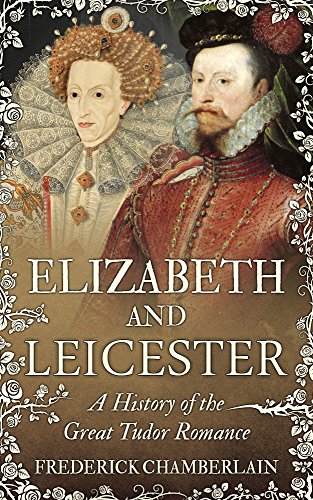
 Following on from the Bisley Boy legend and the myth that Elizabeth I was really genetically male, I just had to write about Arthur Dudley, a man who has been the subject of books and documentaries, a man who some say was the illegitimate son of Elizabeth I and Robert Dudley.
I decided to research the story after Jennifer commented on the Bisley Boy post saying that she had read of a man turning up at the Spanish Court and claiming he was Elizabeth and Dudley’s son. I love mysteries and conspiracy theories so I just had to know more and I actually found some great research material – a chapter in Sarah Gristwood’s “Elizabeth & Leicester” and an article on the Dudley Genealogy website. So, are you sitting comfortably? Then let me begin…
Arthur Dudley – Heir to the Throne or Impostor?
The Tudor era had seen many people claiming that they were heirs to the throne – Perkin Warbeck, the famous pretender who claimed to be Richard Duke of York, one of the Princes in the Tower; Lambert Simnel who pretended to be Edward Plantagenet, Earl of Warwick, son of George, Duke of Clarence (Edward IV’s brother) ; and the madwoman Anne Burnell who claimed to be the daughter of Mary I and Philip of Spain – so there was really nothing new about Arthur Dudley and his story, particularly when there were already rumours circulating during Elizabeth’s reign that her summer progresses were cover-ups for her giving birth to illegitimate children! However, the fact that he turned up at King Philip of Spain’s court might have been worrying to Elizabeth, unless he was in fact an English spy.
Arthur’s Story
In the summer of 1587, a Spanish ship intercepted a boat off the coast of San Sebastian which was heading for France. One of the passengers aboard this boat was a young man in his 20s who claimed to be a Catholic who had undertaken a pilgrimage to a shrine at Montserrat. The Spanish officials arrested the man, suspecting that he was an English spy, and incarcerated him at San Sebastian. The man asked to Sir Francis Englefield, a Catholic who had once been an adviser to Mary I and who was now in exile at the Spanish Court, and it was then that he told his story.
The young man, claiming to be called Arthur Dudley, told of how he had been raised by Robert Southern, a man who had once been a servant of Kat Ashley, Elizabeth I’s governess and friend, in a village around 60 miles outside of London. On Southern’s deathbed, he had told Arthur that he was not his real father but refused to tell him any more. Arthur had stormed off but Smyth, a schoolmaster who was sent after Arthur by Southern, told Arthur the truth, that he was the son of Robert Dudley and the Queen.
Arthur went on to tell Englefield that Southern had been handed a baby after being summoned to Hampton Court and that he had been told to name him Arthur and raise him as his own. Southern had been told at first that the baby belonged to one of the Queen’s ladies, but, when Arthur ran away to sea as a teenager and was stopped by a letter from Elizabeth I’s privy councillors and ordered back to London with John Ashely, Kat Ashley’s husband, it became clear that he was someone important.
Arthur told Englefield of how he had taken flight abroad, fearing for his life, when it became known that Arthur knew the secret of his birth. He also told of how, at one point, he had been taken before Robert Dudley, Earl of Leicester, by officers named Blount and Fludd (who did exist), and that Dudley had shown him affection “by tears, words, and other demonstrations” and had said “You are like a ship under full sail at sea, pretty to look upon but dangerous to deal with”. Dudley had then ordered Arthur to be taken out of the country under the supervision of Sir Francis Walsingham. Arthur then told Englefield of how Walsingham’s manner had scared him so he escaped once again and joined a group of English soldiers who were on their way to serve in Flanders.
Arthur’s rather long and complicated story told of his many travels and his fear that he would be tracked down and murdered by Elizabeth’s agents to hush him up. It was a brilliantly told story and the fact that it contained plausible events and real people, like Fludd and Blount, must have made it seem slightly plausible but Englefield was suspicious. He sent a statement to King Philip and included a letter from Arthur with it. Arthur’s letter to the King said:-
“If God grants that his Majesty should take me under his protection, I think it will be necessary to spread a rumour that I have escaped, as everybody knows that I am here, and my residence in future can be kept secret. I could then write simply and sincerely to the Earl of Leicester all that has happened to me, in order to keep in his good graces; and I could also publish a book to any effect that might be considered desirable, in which I should show myself to be everybody’s friend and nobody’s enemy…”
Gristwood writes of how Englefield made further reports back to the King after he had questioned Arthur again and Sandy Sellers, in the article “Arthur Dudley”, writes of how Englefield tested Arthur on his education, his knowledge of the Queen’s household (because he claimed to have spent his summers at one of the Queen’s houses in Enfield) and his knowledge of the people he had mentioned in his elaborate story. Apparently, Arthur passed these tests but Englefield was convinced that he was a spy and wrote to the King:-
“I am of the opinion that he should not be allowed to get away, but should be kept very secure to prevent his escape.”
According to the Venetian ambassador in Madrid, Arthur Dudley was then sent to the castle of Lameda, proof that he was thought to be an English spy. Sellers writes of how Englefield believed that Elizabeth was planning to acknowledge Arthur as her son and nominate him as heir to the throne to obstruct the claims of James VI of Scotland and King Philip. In Englefield’s opinion, Arthur Dudley was both an English spy and a English tool:-
“I think it very probable that the revelations that this lad is making everywhere may originate in the queen of England and her Council, and possibly with an object that Arthur himself does not yet understand. Perhaps, if they have determined to do away with the Scottish throne, they may encourage the lad to profess Catholicism, and claim to be the queen’s son, in order to discover the minds of other princes as to his pretensions, and the queen thereupon acknowledge him, or give him such other position as to neighbouring princes may appear favourable. Of perhaps in some other way they may be making use of him for their iniquitous ends.”
Englefield also wrote:-
“It also manifests that he has had much conference with the Earl of Leicester, upon whom he mainly depends for the fulfillment of his hopes. This and other things convince me that the queen of England is not ignorant of his pretensions; although, perhaps, she would be unwilling that they should be thus published to the world.”
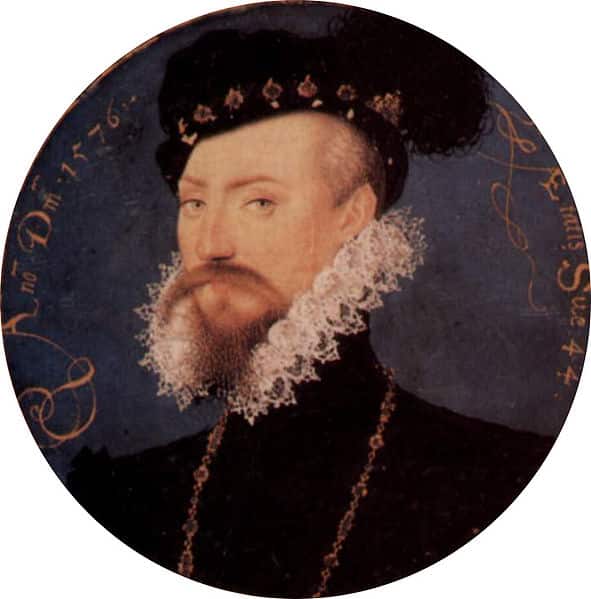
Gristwood believes that Englefield thought that Arthur was a “stooge” of Elizabeth I and her government, and the Venetians thought him to be a spy. Historian Martin Hume wondered if Arthur had actually been on a secret mission to report back to the English government on Spain’s preparations for war and was forced to concoct his story as a cover when he was arrested.
Whoever we believe Arthur to be, historical evidence shows him to have definitely existed and we even know from a letter sent to William Cecil in May 1588 that Arthur was costing the King of Spain 6 crowns a day to keep imprisoned. In 1590 a report to England mentioned a man purporting to be Leicester’s son being imprisoned in Alcantara, but Arthur is never mentioned again.
Could his Story Have Been True?
Sarah Gristwood writes of how Arthur’s story has been given credence in “The Secret Life of Elizabeth I”, a book by Paul Doherty who is an historian and novelist, and in novelist Robin Maxwell’s “The Queen’s Bastard”. But could Elizabeth really have had an illegitimate son by the Earl of Leicester or anyone else?
The letter written to William Cecil in 1588 about Arthur Dudley described him as being 27 which would give him a date of birth in 1561, a year where, according to Gristwood, records of Elizabeth’s movements are somewhat scanty. Gristwood goes on to write of how there are reports from the summer of 1561 of how Elizabeth looked like she had come from her childbed and how, according to the Spanish ambassador, she was “swelling extraordinarily” and was “dropsical”. When you put this together with:-
- The fact that Elizabeth would have conceived in the winter of 1560/61, when marriage to Robert Dudley would have been impossible because of the scandal surrounding his wife’s death.
- The fact that the name Arthur was in both the Dudley and Tudor trees
- The fact that in 1562, when she was gravely ill, Elizabeth wanted to appoint Dudley as Lord Protector.
then you may begin to wonder if this is more than a conspiracy theory or tall tale.
But how on earth could Elizabeth have hidden a pregnancy?
I for one cannot believe that she could have hidden her pregnancy or childbirth from her council. Her ladies would have certainly noticed her weight gain and swelling and such scandal would surely have got out somehow, however hushed up Elizabeth tried to keep it. As Sarah Gristwood says:
“Do we really believe that someone as closely watched, as incessantly accompanied, as Elizabeth could have carried a pregnancy to term and given birth with no one knowing? Do we really believe that her ladies and councillors, her chambermaids and doctors were in on the act? And that no one, ever, would have breathed a word about the most saleable secret of the century?”
A resounding no!
Even when we consider that there are often stories today of teenage girls giving birth in secret after hiding their pregnancy under baggy clothes or the fact that Anne Vavasour, one of Elizabeth’s ladies, was able to keep her condition secret, I just can’t see how someone who was always in the public eye and always the centre of scandal and rumour could have given birth to an illegitimate child without anyone knowing, or without the story getting out. Also, can we really believe that Spanish officials managed to capture Elizabeth I’s illegitimate son just by chance? As Gristwood concludes, ” In the end I feel like the White Queen in “Alice”, asked to believe too many impossible things before breakfast”!
So, who was Arthur Dudley?
We just don’t know.
Gristwood wonders if he was in fact an English agent. She points out that Walsingham made good use of “agents provocateurs”, sending them undercover to gather information on foreign enemies, and that this may explain why Arthur Dudley suddenly disappears from history, perhaps he escaped and resumed his own identity. Whoever he was, it is very unlikely that he was the son of Dudley and the Queen.
Gristwood concludes her examination of the story of Arther Dudley by saying that we actually don’t know that Elizabeth slept with anyone, never mind giving birth to an illegitimate child, and by saying:
“In the world of fact, not fiction, I still believe that the “Virgin Queen” as more than just mythology”
and I have to agree with her. For me, there is no reason to believe that Elizabeth was not the person she said she was. Why is it so difficult for us to believe that she was a virgin and why, if we do believe in her virginity, do we have to explain it by implying that there was something wrong with her? I think Elizabeth made a life choice and stuck to it – period, end of story. What do you think?
More Conspiracy Theories
While browsing on the internet, I found a press release about a book called “Oxford, Son of Queen Elizabeth I” by Paul Streitz which claims that the Edward de Vere, 17th Earl of Oxford, (AKA William Shakespeare) was the illegitimate son of Elizabeth I. The press release goes on to say:
“”Oxford, Son of Queen Elizabeth I” is the result of seven years of painstaking, meticulous historical research. Mr. Streitz reveals that historians have omitted or ignored historical documents that throw doubt on the myth of the Virgin Queen. He further uses new historical documents that show John de Vere, 16th Earl of Oxford, was forced into
marriage to provide a foster home for the newborn. The result of this research is a remarkable story of royal scandal, sex, murder, betrayal and incest with all the hallmarks of a gripping Elizabethan drama.The book reveals:
- How Elizabeth gave birth to the first of several illegitimate children and how that first child came to be known as ‘William Shakespeare.’
- How ‘Shake-speare’s Sonnets’ reveals the relationship between Oxford, the Queen and the Earl of Southampton.
- How Oxford’s story is found in the character of Hamlet and in Shakespeare’s Sonnets.
- How there is line of descendants from Queen Elizabeth and the rightful King of England should be a descendant of the Tudor line of monarchs and of William Shakespeare.”
Has anyone read this book? Sounds intriguing!
Sources
- “Elizabeth and Leicester:The Truth about the Virgin Queen and the Man She Loved” by Sarah Gristwood
- “Arthur Dudley” – an article by Sandy Sellers.
Related posts:
 Robert Dudley to Marry Mary Queen of Scots?
 4 September 1588 – The Death of Robert Dudley, Earl of Leicester
 The Old Myths Regurgitated – The Bisley Boy and More
 Robert Dudley
The Marriage of Robert Dudley and Amy Robsart
Robert Dudley
The Marriage of Robert Dudley and Amy Robsart
 4 September 1588 – Death of Robert Dudley, Earl of Leicester
 Elizabeth, Seymour and Shakespeare
 Did Robert Dudley Murder Amy Robsart?
24 June – The Birth of Robert Dudley, Earl of Leicester
Did Robert Dudley Murder Amy Robsart?
24 June – The Birth of Robert Dudley, Earl of Leicester
 Robert Dudley
Update on “Did Robert Dudley Murder Amy Robsart?”
Robert Dudley
Update on “Did Robert Dudley Murder Amy Robsart?”
 A Response to “Did Robert Dudley Murder Amy Robsart?”
I’ve just read the “Cross Dressing Women in History” article on your site, Robin, very interesting. Love the bit about how these women could urinate standing up, how ingenious! The direct link to the article is http://www.robinmaxwell.com/BONUS-CrossDressingWomenInHistory.htm.
Well it seems that in the past my home town of Worcester supplied various bits of juicy gossip such as the case of Hannah Snell who was convinced her husband was pressganged (18th century) and after she lost her baby joined up, and did the rounds before finding out that her husband deserted her so went back to being a woman and became a stage celebrity ion London , ran a tavern married twice more became insane and died at the age of 69 – A lot to pack into a life!
Hi Everyone,
In the few months since I discovered this site (which I have to say has been the best thing to happen to me when I get bored, which is very easy), I have seen a number of authors mentioned, but no-one has mentioned Jean Plaidy. Many people might poo-poo the idea of this lady, but I have to say in my childhood (I am 58) there was very little on the market to make any history interesting – I was lucky to learn to read from a very early age and as I mentioned before the delight in ereading a book about a red-haired queen who was to become super.-famous (and I have red hair) certainly helped my shy nature of the time. Jean Plaidy did not have to hand the info. we have now, and obviously she embroidered on what “facts” she had – but interesting to look up her life and see where she came from and where she went. I have to say that I was also fortunate to have excellent History teachers who helped make the past come alive. Not only myself, but a number of friends of my generation have said their interest in history started with the Jean Plaidy Books they read as children and obviously later researched what they needed to know. Whether I agree or disagree with any of the authors who have been mentioned, I applaud you all – I couldn’t write a book to save my life – I am good at short, sharp articles, creating atmospheres for selling purposes, but writing ab book???? I admire you all even if I sometimes don’t agree
Hi Jenny,
No, I haven’t mentioned Jean Plaidy here but I did choose her book “Murder Most Royal” as Book of the Month in September over at the Anne Boleyn Files – see http://www.theanneboleynfiles.com/resources/books/previous-books-of-the-month/book-of-the-month-september/. What I loved about Murder Most Royal was how she made Anne so alive and how she explained the souring of Henry’s love for Anne. I know it’s fiction but she did a wonderful job at portraying Anne and Henry and also their relationship.
Which other books of hers would you recommend? Feel free to write a review and I’ll publish it on the site.
Thanks, Jenny, it’s always good to hear from you x
I would love to get and read this book on the so-called illigitimate son and heir born to Elizabeth I and Robert Dudley.There is no doubt that Elizabeth and Dudley were friends and had been since childhood but to say she gave birth to a child born out of wedlock by Robert Dudley is I think a myth.When Elizabeth was a small child she had vowed to her friend Robert that she would never marry and as she grew up and when she became queen elizabeth had answered a famous question put to her by one of her ladies.The Queen was asked if she would marry and whether there would one day be a future king of England and her response to this was “I am married namely to the kingdom of England,I take here one maid but no master for everyone of you are children of mine”. So what does that tell you.? No doubt she liked the opposite sex and flirted with certain men at her court and had her “favourites” as they were called.Well we all know that actions speak louder than words but she had kept her promise on her word of never marrying so why wouldn’t she keep her promise on not having a child or children? Well anything is or could be probable but to me this sounds a bit farfetched to me. I know why the name Arthur was mentioned because Arthur had been a popular famous medeival name hence the ledgend Prince Arthur and the knights of the round table,guinevere and sir lancelot and above all Arthur had been Elizabeth’s uncle.During 1561 Elizabeth had became ill with dropsy which is swelling of the body which had her confined to her chamber.The spanish ambassodor had reported that her abdomen had swelled causing concern for speculation that she was or may have been pregnant with an illigitimate heir.Then in 1562 she had fallen ill for the second time with smallpox which caused a scare for those around her aswell as herself but she survived while she was ill she had told one of her closest advisors to pay Robert Dudley a sum of £20.000 for the year and also she requested that Dudley’s servant John Tamworth be paid £500.When she recovered and was back in high spirits later that year she had written some prayers but theese prayers stood out from her usual written ones.Theese prayer seemed to revolve a sin that she had commitied at sometime during her life.The prayer goes as follows “For my secret sins cleanse me,for the sins of others spare your handmaiden.”Many sins have been forgiven her because she hath loved to much.” This can only mean one thing that she was indeed pregnant and had abandone her child to spain and was being cared for and brought up in spain.Arthur Dudley lived at the court of King Phillip II of spain.The prayer is said to revolve around her abandonment of her child and after all what else could her written words of prayer mean? What else could she or did she have to feel guilty of? To me this does imply a guilty concience over something she did or that happened.The stories and myths that surround certain aspects of certain times in history especially those that involve the Tudor era have always fascinated me and still do.
Elizabeth when princess had suffered smallpox whilst staying at Hatfield house then it was to return four years into her reign as queen. I call her “The second time lucky,the lady Elizabeth” whearas the majority of people would have died the first time the desease had been contracted especially in days when disease and germs where rife and there was no treatment or cure as such and the treatments that ere availible did not work.
One thing that has intrigued me though is if she did concieve an illigitimate son and child why not try and get him legitimized through parliment like her father tried to do before her with Henry Fitzroy?
On foing a “Spring clean” at the beginning of Winter, I discovered a book that I must have pocked up about 10 years ago called “Unicorn’s Blood” by Patricia Finney. In her forward she states” This is a novel, not a history book. I have used history as akeleton and scafoolding, but I have freely jumped off into fantasy whenever I felt like it, turned speculation into fact and rank conjecture insot assumpton – although I have tried to keep within the boundaries of what might just be possible, gevn the evidence”
The book is set in the period when Elizabeth is being co-oerced into signing the warrant for the execution of Mary Queen of Scots – and Davison, seems to have some hold over the Queen by mentioning a “unicorn Book” which is supposed to be recommendations to teh state of Virginity. This particular copy was supposed to belong to the young and teenaged Princes Elizabeth, who according to the plot, did become progenant by Sir Thomas Seymour, performed her own abortion with a Knitting needle and co-oerced a witch (ex -nun) to patch her up! Prior to that howver, thinking that she as about to die, wrote her last will and testament on the last pages of the book, naming the father and willing the throne (if it ever came her way) to he cousin Mary Queen of Scots.! The “witch” sees the book when Elizbeth feints and steals it hoping that it will come in handy in the future to acquire a dowry for either her grandchild or greatgranchild (as it turns out to be) so as to avoid her becoming a whore. It’s a novel, very funny, very sad and very poignant in places – worth a re.read which is what I did this weekend
I agree, Tudorrose, it is a very far-fetched story. I think this kind of rumour always surrounded her because people could not accept that she was what she said she was, the Virgin Queen. There were rumours of a pregnancy from an affair with Thomas Seymour too so the Arthur Dudley story was not anything new really. It is interesting the point you make about the prayers she wrote but I wonder if you can read lots of different things into these prayers. Very interesting! I wonder what Elizabeth thought of all these rumours. I wonder if she just had a good laugh about them or whether they hurt her.
I’ve never heard of that book, I’ll have to see if it’s on Amazon as it sounds rather good. Thanks for the recommendation. Hope you enjoyed your cleaning!
HI Claire,
Have never enjoyed cleaning – Can’t organise myself either but very good at organising others! The one thing that really gob-smacked me when I first read the book was a number of things. I have read over the years a number of books about the Tudors but it was this novel (and much later the ones by S J Sansom) that hit me on how society completely charnged under Henry VIII and Thomas Cromwell. We alll know that some of the religious establishments were completely corrupt, but there were others that did help the poor . By closing these places down, not only did the original poor sufer, but nuns and monnks were thrown out on the street to survive. Some had the fortune to have families to go back to, or jobs to go to, but most were out on the road to seek their own fortunes. A number of monks became thieves and a number of nuns, prostitutes – To survive!!! This particular story speaks about a nun who was quite high up in her nunnery but was thrown out on the streets and had to survive – basically through, begging prostitution (whereby she had children who followed that profession) and a “Witch” i.e. a wise woman who could help people with various ailments. She also hots the bottle big time to try to forget wht has happened but seeing her granddaughter die of veneral dicease, in her sober moments, she is determined to get the cash to enable her small granddaughter to have enough money to ensure a dowry and marry a man who would protect her. Unfoprtunately the booze has set in and she often falls by the wayside. Davison is aware that this “hidden witch” has the documents”, tells the queen that he knows what is in them, so has Elizabeth on tenterhooks. After chasing the “wicth” and seing her drown, he fionallly catches up with teh young 4 or 6 year old grandaughtr “Penticost” whom he tries to bully. You have youbg kids so you will appreciate this one.He has alreqdy told her that her beloved grandmother has gone to Hell (which she doesn’t understand) so he tells her that if she lies to him she will follow her loved one- Pentincost is quite happey about that and she lies through her teeth and they both know they are lying.
My wonderful moments in that book is wjhe he askes her if she ever goes you church to which she replies no, the reason being that “Mr. Crhsit” is there . He was her gradamn’s husband once but he left her , banadoned her to starve which in Pentecost’s eyes was noty a very good thing. Try to find the book. It is a good novel and to be taken as a novel although there is some background taking into consoderation we don’t have TV, etc. – Woudl have liked to have been a Doctor Who and gone back to see the reality of things.
I know this is a kind of old post, but I had to comment on the “Oxford” book by Paul Streitz. I was also intrigued and bought this book off of amazon a few years ago. It was so bizarre and hard to believe. The book states, among other things:
1. Elizabeth was the mother of the Earl of Oxford.
2. The Earl of Oxford was Shakespeare.
3. Elizabeth then had an incestuous relationship with the Earl of Oxford.
4. That relationship produced the Earl of Southampton.
5. She also had four children by Robert Dudley, including the Earl of Essex.
6. Mary Seymour (daughter of Catherine Parr) actually survived and had a relationship with the Earl of Oxford.
I’m really not kidding here. It’s all in the book. I really wouldn’t waste your money on it. It doesn’t even work as fiction.
As for Arthur Dudley, that story is a bit more believable, but I still question whether Elizabeth could’ve concealed a pregnancy. Then again, there are other royal women in history who did so successfully. Catherine the Great, and Princess Thyra of Denmark are the first ones that come to mind. I also think one of George III’s daughters had a child secretly, but that wouldn’t be comparable considering how isolated those girls were for most of their lives.
In the Victorian era some women wore their corsets during pregnancy to shorten the amount of time their pregnancy would show. I don’t think that would be healthy for mother or child, but it has been done. http://www.corsetinformation.com/pregnancy.htm
But Arthur Dudley saying he was Elizabeth’s son certainly doesn’t make it true. Pretenders were common then, and they still exist even today. I recently read about a man who claimed to be Princess Margaret’s son by Peter Townsend because he wanted in on her will. Obviously DNA testing has not been done and if it was I’m sure it would prove him a liar or maybe just insane.
I suppose I really don’t know what to think about that story. It’s certainly possible but probably not true.
-Tatiana