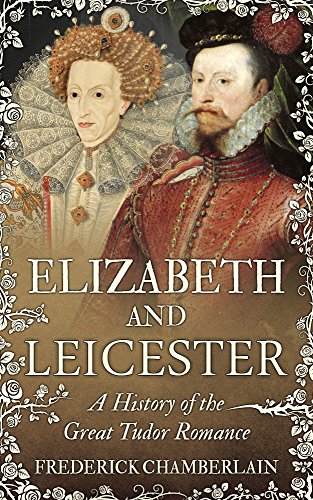
 Following on from the Bisley Boy legend and the myth that Elizabeth I was really genetically male, I just had to write about Arthur Dudley, a man who has been the subject of books and documentaries, a man who some say was the illegitimate son of Elizabeth I and Robert Dudley.
I decided to research the story after Jennifer commented on the Bisley Boy post saying that she had read of a man turning up at the Spanish Court and claiming he was Elizabeth and Dudley’s son. I love mysteries and conspiracy theories so I just had to know more and I actually found some great research material – a chapter in Sarah Gristwood’s “Elizabeth & Leicester” and an article on the Dudley Genealogy website. So, are you sitting comfortably? Then let me begin…
Arthur Dudley – Heir to the Throne or Impostor?
The Tudor era had seen many people claiming that they were heirs to the throne – Perkin Warbeck, the famous pretender who claimed to be Richard Duke of York, one of the Princes in the Tower; Lambert Simnel who pretended to be Edward Plantagenet, Earl of Warwick, son of George, Duke of Clarence (Edward IV’s brother) ; and the madwoman Anne Burnell who claimed to be the daughter of Mary I and Philip of Spain – so there was really nothing new about Arthur Dudley and his story, particularly when there were already rumours circulating during Elizabeth’s reign that her summer progresses were cover-ups for her giving birth to illegitimate children! However, the fact that he turned up at King Philip of Spain’s court might have been worrying to Elizabeth, unless he was in fact an English spy.
Arthur’s Story
In the summer of 1587, a Spanish ship intercepted a boat off the coast of San Sebastian which was heading for France. One of the passengers aboard this boat was a young man in his 20s who claimed to be a Catholic who had undertaken a pilgrimage to a shrine at Montserrat. The Spanish officials arrested the man, suspecting that he was an English spy, and incarcerated him at San Sebastian. The man asked to Sir Francis Englefield, a Catholic who had once been an adviser to Mary I and who was now in exile at the Spanish Court, and it was then that he told his story.
The young man, claiming to be called Arthur Dudley, told of how he had been raised by Robert Southern, a man who had once been a servant of Kat Ashley, Elizabeth I’s governess and friend, in a village around 60 miles outside of London. On Southern’s deathbed, he had told Arthur that he was not his real father but refused to tell him any more. Arthur had stormed off but Smyth, a schoolmaster who was sent after Arthur by Southern, told Arthur the truth, that he was the son of Robert Dudley and the Queen.
Arthur went on to tell Englefield that Southern had been handed a baby after being summoned to Hampton Court and that he had been told to name him Arthur and raise him as his own. Southern had been told at first that the baby belonged to one of the Queen’s ladies, but, when Arthur ran away to sea as a teenager and was stopped by a letter from Elizabeth I’s privy councillors and ordered back to London with John Ashely, Kat Ashley’s husband, it became clear that he was someone important.
Arthur told Englefield of how he had taken flight abroad, fearing for his life, when it became known that Arthur knew the secret of his birth. He also told of how, at one point, he had been taken before Robert Dudley, Earl of Leicester, by officers named Blount and Fludd (who did exist), and that Dudley had shown him affection “by tears, words, and other demonstrations” and had said “You are like a ship under full sail at sea, pretty to look upon but dangerous to deal with”. Dudley had then ordered Arthur to be taken out of the country under the supervision of Sir Francis Walsingham. Arthur then told Englefield of how Walsingham’s manner had scared him so he escaped once again and joined a group of English soldiers who were on their way to serve in Flanders.
Arthur’s rather long and complicated story told of his many travels and his fear that he would be tracked down and murdered by Elizabeth’s agents to hush him up. It was a brilliantly told story and the fact that it contained plausible events and real people, like Fludd and Blount, must have made it seem slightly plausible but Englefield was suspicious. He sent a statement to King Philip and included a letter from Arthur with it. Arthur’s letter to the King said:-
“If God grants that his Majesty should take me under his protection, I think it will be necessary to spread a rumour that I have escaped, as everybody knows that I am here, and my residence in future can be kept secret. I could then write simply and sincerely to the Earl of Leicester all that has happened to me, in order to keep in his good graces; and I could also publish a book to any effect that might be considered desirable, in which I should show myself to be everybody’s friend and nobody’s enemy…”
Gristwood writes of how Englefield made further reports back to the King after he had questioned Arthur again and Sandy Sellers, in the article “Arthur Dudley”, writes of how Englefield tested Arthur on his education, his knowledge of the Queen’s household (because he claimed to have spent his summers at one of the Queen’s houses in Enfield) and his knowledge of the people he had mentioned in his elaborate story. Apparently, Arthur passed these tests but Englefield was convinced that he was a spy and wrote to the King:-
“I am of the opinion that he should not be allowed to get away, but should be kept very secure to prevent his escape.”
According to the Venetian ambassador in Madrid, Arthur Dudley was then sent to the castle of Lameda, proof that he was thought to be an English spy. Sellers writes of how Englefield believed that Elizabeth was planning to acknowledge Arthur as her son and nominate him as heir to the throne to obstruct the claims of James VI of Scotland and King Philip. In Englefield’s opinion, Arthur Dudley was both an English spy and a English tool:-
“I think it very probable that the revelations that this lad is making everywhere may originate in the queen of England and her Council, and possibly with an object that Arthur himself does not yet understand. Perhaps, if they have determined to do away with the Scottish throne, they may encourage the lad to profess Catholicism, and claim to be the queen’s son, in order to discover the minds of other princes as to his pretensions, and the queen thereupon acknowledge him, or give him such other position as to neighbouring princes may appear favourable. Of perhaps in some other way they may be making use of him for their iniquitous ends.”
Englefield also wrote:-
“It also manifests that he has had much conference with the Earl of Leicester, upon whom he mainly depends for the fulfillment of his hopes. This and other things convince me that the queen of England is not ignorant of his pretensions; although, perhaps, she would be unwilling that they should be thus published to the world.”
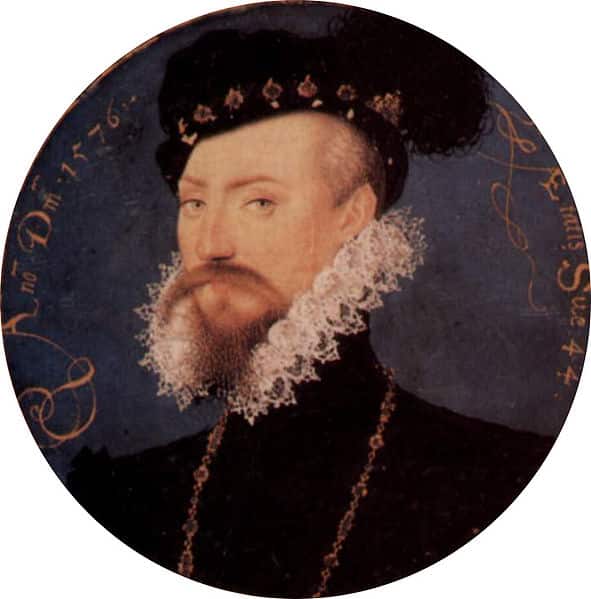
Gristwood believes that Englefield thought that Arthur was a “stooge” of Elizabeth I and her government, and the Venetians thought him to be a spy. Historian Martin Hume wondered if Arthur had actually been on a secret mission to report back to the English government on Spain’s preparations for war and was forced to concoct his story as a cover when he was arrested.
Whoever we believe Arthur to be, historical evidence shows him to have definitely existed and we even know from a letter sent to William Cecil in May 1588 that Arthur was costing the King of Spain 6 crowns a day to keep imprisoned. In 1590 a report to England mentioned a man purporting to be Leicester’s son being imprisoned in Alcantara, but Arthur is never mentioned again.
Could his Story Have Been True?
Sarah Gristwood writes of how Arthur’s story has been given credence in “The Secret Life of Elizabeth I”, a book by Paul Doherty who is an historian and novelist, and in novelist Robin Maxwell’s “The Queen’s Bastard”. But could Elizabeth really have had an illegitimate son by the Earl of Leicester or anyone else?
The letter written to William Cecil in 1588 about Arthur Dudley described him as being 27 which would give him a date of birth in 1561, a year where, according to Gristwood, records of Elizabeth’s movements are somewhat scanty. Gristwood goes on to write of how there are reports from the summer of 1561 of how Elizabeth looked like she had come from her childbed and how, according to the Spanish ambassador, she was “swelling extraordinarily” and was “dropsical”. When you put this together with:-
- The fact that Elizabeth would have conceived in the winter of 1560/61, when marriage to Robert Dudley would have been impossible because of the scandal surrounding his wife’s death.
- The fact that the name Arthur was in both the Dudley and Tudor trees
- The fact that in 1562, when she was gravely ill, Elizabeth wanted to appoint Dudley as Lord Protector.
then you may begin to wonder if this is more than a conspiracy theory or tall tale.
But how on earth could Elizabeth have hidden a pregnancy?
I for one cannot believe that she could have hidden her pregnancy or childbirth from her council. Her ladies would have certainly noticed her weight gain and swelling and such scandal would surely have got out somehow, however hushed up Elizabeth tried to keep it. As Sarah Gristwood says:
“Do we really believe that someone as closely watched, as incessantly accompanied, as Elizabeth could have carried a pregnancy to term and given birth with no one knowing? Do we really believe that her ladies and councillors, her chambermaids and doctors were in on the act? And that no one, ever, would have breathed a word about the most saleable secret of the century?”
A resounding no!
Even when we consider that there are often stories today of teenage girls giving birth in secret after hiding their pregnancy under baggy clothes or the fact that Anne Vavasour, one of Elizabeth’s ladies, was able to keep her condition secret, I just can’t see how someone who was always in the public eye and always the centre of scandal and rumour could have given birth to an illegitimate child without anyone knowing, or without the story getting out. Also, can we really believe that Spanish officials managed to capture Elizabeth I’s illegitimate son just by chance? As Gristwood concludes, ” In the end I feel like the White Queen in “Alice”, asked to believe too many impossible things before breakfast”!
So, who was Arthur Dudley?
We just don’t know.
Gristwood wonders if he was in fact an English agent. She points out that Walsingham made good use of “agents provocateurs”, sending them undercover to gather information on foreign enemies, and that this may explain why Arthur Dudley suddenly disappears from history, perhaps he escaped and resumed his own identity. Whoever he was, it is very unlikely that he was the son of Dudley and the Queen.
Gristwood concludes her examination of the story of Arther Dudley by saying that we actually don’t know that Elizabeth slept with anyone, never mind giving birth to an illegitimate child, and by saying:
“In the world of fact, not fiction, I still believe that the “Virgin Queen” as more than just mythology”
and I have to agree with her. For me, there is no reason to believe that Elizabeth was not the person she said she was. Why is it so difficult for us to believe that she was a virgin and why, if we do believe in her virginity, do we have to explain it by implying that there was something wrong with her? I think Elizabeth made a life choice and stuck to it – period, end of story. What do you think?
More Conspiracy Theories
While browsing on the internet, I found a press release about a book called “Oxford, Son of Queen Elizabeth I” by Paul Streitz which claims that the Edward de Vere, 17th Earl of Oxford, (AKA William Shakespeare) was the illegitimate son of Elizabeth I. The press release goes on to say:
“”Oxford, Son of Queen Elizabeth I” is the result of seven years of painstaking, meticulous historical research. Mr. Streitz reveals that historians have omitted or ignored historical documents that throw doubt on the myth of the Virgin Queen. He further uses new historical documents that show John de Vere, 16th Earl of Oxford, was forced into
marriage to provide a foster home for the newborn. The result of this research is a remarkable story of royal scandal, sex, murder, betrayal and incest with all the hallmarks of a gripping Elizabethan drama.The book reveals:
- How Elizabeth gave birth to the first of several illegitimate children and how that first child came to be known as ‘William Shakespeare.’
- How ‘Shake-speare’s Sonnets’ reveals the relationship between Oxford, the Queen and the Earl of Southampton.
- How Oxford’s story is found in the character of Hamlet and in Shakespeare’s Sonnets.
- How there is line of descendants from Queen Elizabeth and the rightful King of England should be a descendant of the Tudor line of monarchs and of William Shakespeare.”
Has anyone read this book? Sounds intriguing!
Sources
- “Elizabeth and Leicester:The Truth about the Virgin Queen and the Man She Loved” by Sarah Gristwood
- “Arthur Dudley” – an article by Sandy Sellers.
Related posts:
 Robert Dudley to Marry Mary Queen of Scots?
 4 September 1588 – The Death of Robert Dudley, Earl of Leicester
 The Old Myths Regurgitated – The Bisley Boy and More
 Robert Dudley
The Marriage of Robert Dudley and Amy Robsart
Robert Dudley
The Marriage of Robert Dudley and Amy Robsart
 4 September 1588 – Death of Robert Dudley, Earl of Leicester
 Elizabeth, Seymour and Shakespeare
 Did Robert Dudley Murder Amy Robsart?
24 June – The Birth of Robert Dudley, Earl of Leicester
Did Robert Dudley Murder Amy Robsart?
24 June – The Birth of Robert Dudley, Earl of Leicester
 Robert Dudley
Update on “Did Robert Dudley Murder Amy Robsart?”
Robert Dudley
Update on “Did Robert Dudley Murder Amy Robsart?”
 A Response to “Did Robert Dudley Murder Amy Robsart?”
Thanks for the rundown on the book, Tatiana, and perhaps I won’t bother with it! It does sounds like it’s just spreading rumour and scandal about Elizabeth for nothing. I don’t believe any of these rumours and myths, they just don’t make sense and Elizabeth was very image conscious and knew how reputations could be easily tarnished. I don’t think she would have risked pregnancy.
I have read the messages on this site with great interest – especially those dealing with “Arthur Dudley”. The idea that Elizabeth I gave birth to a son by Robert Dudley is not totally impossible, but highly unlikely. All of Henry VIII’s children were highly educated and intelligent in varying degrees and all ‘enjoyed’ childhoods which were, to say the least, unusual. As an adolescent, Mary Tudor suffered demotion from the status of princess to that of incestuous bastard almost overnight. She was deprived of her household, her friends and the love and company of her mother. Her father refused to see her and, through his ministers, bullied and threatened her. It is virtually certain that he contemplated having her executed (he admitted as much in public when his third wife, Jane Seymour, succeeded in having her received at Court again). The effects on Mary’s physical and mental health were permanent.
Elizabeth, two years old when her mother Anne Boleyn was executed, was similarly demoted and bastardised by Act of Parliament. Even at that tender age she understood and commented on her loss of status. In the coming years she saw the death after childbirth of Jane Seymour, the annulment of Anne of Cleves’ marrage to Henry VIII and the execution of Katherine Howard, his fifth wife. If, at the age of eight, Elizabeth truly did declare that she would never marry, it can hardly come as a surprise. Then there was her experience in the household of Thomas Seymour and his wife Katherine Parr, Henry VIII’s last queen and thus her stepmother. Elizabeth was then fourteen years old. Seymour’s behaviour towards her was coarse, very much over-familiar and – for the first time – exposed her to widespread rumour and suspicion. The active participation of Katherine Parr – on at least one celebrated occasion – in this behaviour is very strange indeed. At all events, Seymour was subsequently executed for this and other outrageous indiscretions.
Throughout the reigns of Edward VI, Jane Grey and finally Mary I, Elizabeth relied on the loyalty and advice of a small group of devoted supporters. Nevertheless, she endured house arrest and a period of imprisonment in the Tower of London (where her mother had been executed and was buried). She was lucky indeed to survive until she herself came to the Throne at the age of twenty-five.
Robert Dudley, the son and grandson of men who had been beheaded for treason, had known her from childhood and had shared her imprisonment in the Tower. He showed great loyalty to her, apparently provided her with much-needed funds when her revenues were restricted by Mary I and was almost immediately given the high appointment as her Master of The Horse. There can be little doubt that Eizabeth was, in her own way, in love with him. She may have actually toyed with the idea of eventually marrying him – although this became impossible after the very mysterious death of Dudley’s wife in September 1560.
Precisely what took place of a physical nature between Elizabeth and Robert Dudley between her accession and the death of Robert’s wife has been a matter of speculation for the last four centuries. Certainly she threw caution to the winds, granted him sleeping quarters adjoining her own appartments and behaved towards him in such a manner that it created enormous scandal in England and Europe. After the death of Dudley’s wife, it is known that she suffered from “dropsy”, an accumulation of fluid in the abdomen which caused her stomach to swell – an illness which had contributed to the death of her sister Mary I. Diagnoses of ancient illnesses are notoriously difficult and Elizabeth’s 1561 swollen stomach could indeed have been of dropsical origin. On the other hand it could have been a phantom pregnancy (also suffered by her sister) or, indeed, a real one. Whether or not Arthur Dudley was truly the result of this illness can never now be known – unless his remains are ever found and subjected to DNA analysis. Such an examination would also entail the exhumation of Elizabeth I herself and permission for this to take place is extremely unlikely to be granted.
My own feelng is that Arthur Dudley was either a spy employed by Walsingham to discover as much as he could about Spanish Armada preparations or was a very plausible adventurer who concocted his story to evade the Inquisition or simply to provide a comfortable exile for himself.
Luckily for those of us who love good mysteries, there are many others to occupy the long winter evenings which lie ahead : exactly who fathered the son of Princess Sophia, daughter of George III ? What really happened to “The Princes In The Tower” ? Did Queen Victoria have illegitimate brothers and sisters ? For that matter, did Queen Victoria herself marry her servant John Brown after the death of Prince Albert ?
Good sleuthing !!!!
The contention that Edward DeVere, Earl of Oxford was Elizabeth’s son by Thomas Seymour is laughable becasue it is impossible. Yes, Seymour had his eyes on her for political reasons of self promotion, and may well have been sexually attracted to her, but In the end it was these motives which led to his arrest and execution. In August 1548, Seymour recommenced his attempts to lure Elizabeth to him. She was interrogated following Symours arrest on 16th January 1549 and was found innocent of accusations of improper behaviour. Evidently, she wasn’t pregnant at the time because her inqisitors tested her on the matter.
Seymour was charged with treason on 22nd February and executed on 20th March 1549.
Edward DeVere was born on 12th April 1550.
Are we expected to believe in a thirteen month pregnancy? Don’t fall for it…there are people who make a good living from selling books and will ignore the obvious in support of cock eyed theories. If final proof is needed, consider that in 1549 Elizabeth was 17. She had powerful enemies and was living in fear. In 1553 Dudley was imprisoned at the Tower and Elizabeth was there too. He was released around October 1554. Now I ask you, how likely is that if he too was thought to have knocked up the Princess Elizabeth.
If there is an illigitimate child, Elizabeth could only have survived and protected the secret AFTER she became queen in 1558, with her ‘smallpox’ (which she vehemnetly denied) illness in 1562 being the most likely date for a convenient cover up….enter Arthur Dudley?
There really is some sloppy reseacrh here….Quoted from above “Even when we consider that there are often stories today of teenage girls giving birth in secret after hiding their pregnancy under baggy clothes or the fact that Anne Vavasour, one of Elizabeth’s ladies, was able to keep her condition secret”….This is only partly true becasue she may have concealed her condition but what happened to her was common knowledge. Here is an extract from a letter from the Thynne Family Papers held at Longleat House:
“A great mischeaunce at court yeasterdaye beinge tewsdaye that one of the mayds of Honor called Mris Wauisire was delyvered of a goodly boy begotten by my L. of Oxford”: 23 March, 1580″.
Elizabeth sent Oxford to the Tower for several months and he was banished from court until June 1583. If we are to beleive that Oxford was Elizabeth’s illigitimate son, she had a funny way of looking after the interests of her son and grandson!
Hi Mike,
I didn’t say that Vavasour kept the birth secret, I said that she was able to keep her condition secret, so much so that she actually gave birth in the maidens’ chamber and only the cries of the baby gave her away and that is when the Queen found out.
Like you, I don’t believe that Oxford was Elizabeth’s illegitimate son, it just does not make sense in any way whatsoever. I don’t believe that Elizabeth had any illegitimate children and I believe she was a virgin.
I completely agree, Mike. I haven’t read Streitz’s book but I assume that he comes up with a different date of birth for de Vere because, as you say, an April 1550 birthdate does not tally with Seymour being his father and certainly does not tie in with Elizabeth’s banishment from Catherine Parr’s home, which happened in 1548.
Arthur Dudley and the Mysterious Sir Arundel Talbot: Evidence of a Unique Individual?
I hadn’t been aware of Arthur Dudley until quite recently and it intrigues me that after the Englefield Papers he seems to vanish from history. What happened to him?
The full record of the Spanish Calendar of State Papers details that Arthur had been in France, Germany, Holland and Spain. He had been with Dudley; he had access to the elector in Cologne and also claimed to have written to the Pope. He knew and named several influential court figures in England and abroad. He even detailed the name of the Doctor who had been asked to help his dying ‘father’ Robert Southern. Dr. Hector Nunez. I checked the National Archive and can confirm that Dr Nunez was indeed a real person attending the Court. It’s the small details like this that add to the conviction that Arthur Dudley was able to draw on the resources of the Court. Not something a ‘nobody’ could possibly have done.
Reading the full Englefield Papers makes it clear that Arthur Dudley was a very intelligent, resourceful and well connected man. He obviously confused Englefield and King Philip because it’s apparent they want to believe they have living proof of ER’s sinful misdeeds, but suspect a plot. The records show that the King (in his own hand) endorsed that Arthur be kept safe and should not be allowed to escape whilst they figured out what to do with him. And then….Nothing. He simply is never mentioned again.
Isn’t this extraordinary? The Armada was defeated a year later and Spain’s power and national pride is severely damaged. Even if they didn’t believe Arthur, it would make perfect sense for them to have used or even abused him in revenge for their defeat. But nothing happened. Why?
The lack of any evidence of his existence in Spain after the summer of 1587 may be taken as an indication that he was no longer a prisoner. Arthur was obviously known about and identifiable in the courts of Europe. At every court there were representatives from other courts, even enemies retained diplomatic discourse. The English network was the best in Europe so I make the reasonable claim that his whereabouts would have been known, giving him a sort of insurance that no harm would be done to him without the story becoming a cause celebre. In fact Arthur writes that his whereabouts are indeed known. Spain murdering Elizabeth’s catholic sympathiser love child would make no sense at all.
I think the most likely explanation is that Arthur was released. If the Spanish had detained him and made some use of him, there would have been a record. One cannot say for sure, but logic suggests the silence indicates a secret. Given what we know of Arthur he must have represented an asset of some significance to Spain. It would be more useful to have him potentially undermining the English crown by him being at large. Perhaps they thought that he had value as a double agent (being a catholic) who might well succeed in becoming a powerful figure in England in the right circumstances?
Allowing my conjecture, I need to offer an opinion as to what happened next.
I believe Arthur was indeed the son to Elizabeth and Dudley. I think that following his trail into the arms of his real father it is inconceivable that Elizabeth would have been unaware of this. Given Arthur was known to senior Court figures in England and had let the cat out of the bag I am equally sure that Walsingham would have known or discovered who he was. Arthur states that he went to see Walsingham twice and that his father, the Earl of Leicester went with him. But this is where the dissembling begins. Arthur says he was frightened by Willingham’s close questioning of him. But can this be taken as the truth. Walsingham was not an Earl and neither was he the Queens lifelong friend. How could it be that Arthur felt under some threat when his father had him under his wing? In this aspect of Arthur’s testimony to Englefield I think I detect a lie.
I think Arthur was the illegitimate and unacknowledged son of ER. I also think he was an adventurer and an agent who easily and cynically changed his game plan according to circumstance and opportunity.
Arthur evidently had access to Elizabeth’s Court and to the Privy Council through his father. Following the line of conjecture that he was an opportunist and adventurer, after his release by the Spanish what would he have done?
Spain had been defeated and the political map of Europe was changed. Arthur had been in Spain the year before the English victory, and possibly during 1588. What could be more natural than for him to return to England saying he had twisted the Spaniards tail and wrought confusion in their political strategy? Maybe that was the name of the game all along?
If you will permit further conjecture, I believe he did return to England and became an important (If unrecognised) man who served his self interest by undertaking a variety of aliases.
There is a miniature portrait of Sir Arundel Talbot in the V&A. It was painted by Oliver in Venice in 1596 and is (unusually) inscribed that the subject is a Gilded Knight. The odd thing is that no such person existed! If you’d like to see it scroll down to the bottom of the page on this site:
http://www.shafe.co.uk/art/Tudor_10_-_Isaac_Oliver.asp
Who was he? There is absolutely no reference to him in any of the National Archive papers. He is unknown in the peerage listings and genealogies of the Talbot families, is never mentioned in any contemporary histories or letters. But, I do know he existed and was in Venice because I have seen a document that is about ciphers used by the English in Venice “endorsed by Mr Talbot in his own hand”.
Who is this known but unknown individual? What rank of man could afford to have his portrait painted by a well known and respected artist? With the exception of Sir William Standen, who was the James Bond of Elizabethan spies, no other agent was ever elevated. It’s obvious that Sir Arundel Talbot is an alias and it is (I think) equally obvious that whoever he was, he had the confidence and authority to create himself a Knight.
On the same web site you can also see the miniature by Hilliard 1588 of an unknown man clasping a hand from the clouds. I have often puzzled over this picture. Leslie Hotson (Shakespearian Scholar) claims it is Mr. W.H. of the Sonnets. Others, including Robert Nield believe it is Elizabeth’s son clasping his mother’s hand. The Latin inscription translated reads Athenian therefore Love and is thought to indicate a connection to and with the ‘gods’.
Who is this man painted at Court in 1588? There are only a few people who could possibly have afforded it, and perhaps only one who would associate themselves directly and physically connected to a ‘goddess’ and get away with it.
The likeness and age difference depicted in these two portraits makes me think they are one and the same person. Somebody of rank whose identity is deliberately obscured, yet somebody who has the means and motive to tell us he existed but cannot be identified except through the double bluff that says ‘look at me…I cannot tell you who I am, but by this artifice you will know me”.
It’s pure speculation of course. But I think we’re looking at Arthur Dudley.
I published a book in 2007 titled: “Breaking the Shakespeare Codes” which provides a significant amount of new evidence, mainly in the form of special anagrams by the real author and his contemporaries, which very strongly indicates that “William Hastings”, the illegitimate son of Elizabeth I and Robert Dudley, was the secret author of the Shakespeare canon. Since 2007 I have found a great deal more evidence – including about 2000 anagrams – that this conclusion is indeed correct. Clearly, Elizabeth could not hide her late pregnancy from close friends etc at court – even the general public strongly suspected in 1562 that she had given birth (when she supposedly had smallpox). The government was so keen to smother the story that they executed people at Norwich in 1572 who made the claims public. Many others had their toungues cut out and ears cut off for repeating the rumours. The idea that Elizabeth’s secret son was the author of Shakespeare is certainly not ridiculous – one only has to think about the power politics and profound insight into the minds of rulers to see that Shakespeare’s author was in a very special social position. By contrast, the man from Stratford did not even know his age when questioned in a law suit in 1612.
Wow! Amazing stuff here–I have THe Queen’s Bastard as well as Anne Boleyn’s Diary–also The Virgin-great reads–I find the ARthur Dudley stuff quite intriguing and am willing to admit it as a possibility–mainly because the timing would be right as that is the time E and R were young and much in love. I think the pregnancy could have been concealed. I have had teenagers in class who went home for Christmas break and had babies I didn’t even know they were expecting! But Shakespeare as Elizabeth’s son? I’m not buying it. Oh but it’s all such good stuff to think about–
And as for Jean Plaidy–she is one of my favorites, all time! Thank you Claire–this is wonderful!
do you not think that elizabeth would wanted to have been with her child since she did not have a mother and father in her life. That she would have emrassed her children and loved them since she had not been loved by her own mother and father or was she just like her father and only enjoyed the pleasure of being in power of eveyone and everything? I mean she was the strongest king or queen england ever had or has had.